Viewing Note: This blog is best viewed on a 1080p or higher resolution display. Mobile and small-viewport browsers are not recommended.
To stay connected with Alice Hall/"Falk Whitaker" and receive future updates, follow @Neolodge on Telegram t.me/neolodge or visit our homepage, FREUDIANDEATHDRIVE.COM
All inquiries may be directed to the author at freudiandeathdrive@outlook.com.

Thursday, May 28, 2026

From the TikTok Slop Abyss: Xiao Xiao, the "Chinese Kick/Junk Food" Girl

One of the most revealing TikToks of Xiao Xiao, the “Chinese Kick Girl”, is one in which she hauls a large speaker through the street, dressed in traditional Chinese children’s clothing. An AI narration explains in that familiar hollow, robotic female voice that she is off to work. We cut to her performing TikTok dances in a crowded street while passersby poke and prod her, smartphones raised, each hoping to capture their own viral moment.

[VIDEO]

“Girl” is hardly an appropriate word for Xiao Xiao as she is 39 years old. She is a street performer from rural Sichuan, China, born with Seckel syndrome and primordial dwarfism. She stands just over a meter tall and weighs less than fourteen kilograms. Xaio Xaio’s father left when she was young, with her disability being given as the reason, so her mother raised her alone. The two receive modest government allowances from the local Disabled Persons Federation and Women’s Federation, which have supported them since 2011.

[VIDEO]

Her body always appears worn, pained, covered in scrapes and bruises. Whether self-inflicted from the kicking and flailing that won her Western internet fame is unclear. In several videos she appears with a large wound across her face, which heals slowly over time into what looks like an unset broken nose. What caused it is never addressed, of course nobody in the comments section thinks to ask.


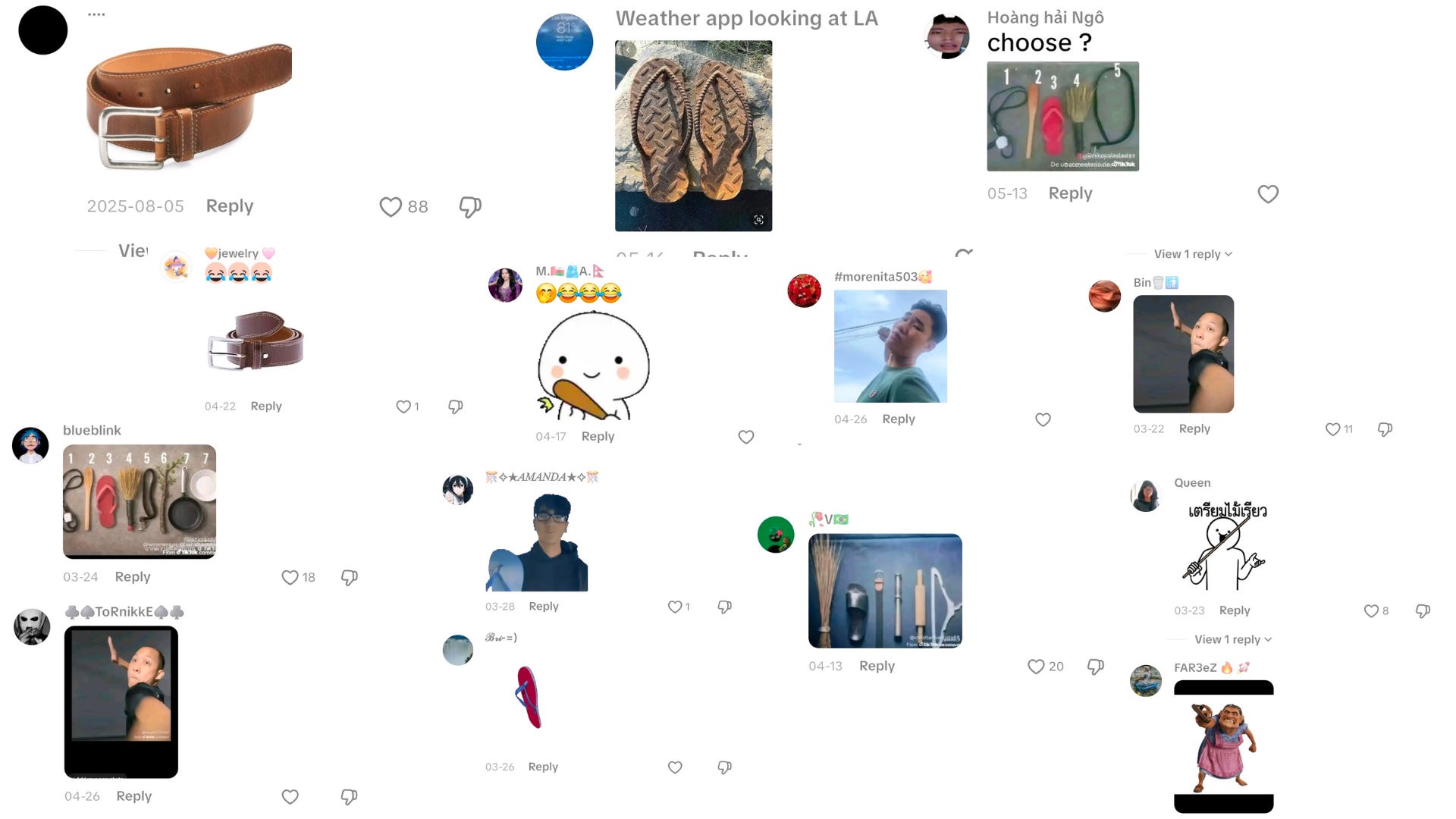
Scroll through the comments of any Xiao Xiao video and you will find image after image of shoes, switches, and paddles, objects associated with corporal punishment in the rural, impoverished households of the Global South, posted with gleeful suggestions of beatings. It is a particular kind of cruelty, one that reveals more about the commenters than they intend. There is something about Xiao Xiao, be it her size, her volatility, her unruliness, that triggers in a certain type of viewer a sadistic, primal desire to inflict pain. The same impulse drives the monkey torture communities that have flourished in the obscure corners of YouTube and TikTok: small, vulnerable, visibly distressed creatures made into objects of entertainment for a perversely sadistic audience.


It doesn’t seem that Xaio Xaio’s mother initially set out to become her exploiter. When her mother began selling homemade honey, she began filming her daughter to help sell it on a social media platform called Kuaishou. Their profile was a way to document their lives, build an audience, and sell honey that supplemented their government allowance. It worked well, and the account grew to 140,000 followers. People were drawn to Xiao Xiao, intrigued by her size, her expressiveness, and her volatility.

It was not the first time Xiao Xiao had been put in front of a camera – as a child she had appeared on television, paraded as a curiosity, her small body treated as spectacle. Her mother claims she was never compensated for these appearances.

[VIDEO]

There are reports, difficult to verify, of a Chinese documentary or television segment featuring a child matching her description, a small girl from rural Sichuan with primordial dwarfism. Whether this is Xiao Xiao is not certain. Her name translates roughly to “little little,” a generic term of endearment applied to small children, which makes tracing her history through Chinese-language sources considerably difficult. She is not the only girl with primordial dwarfism to have received media attention in China under that name.

In August 2022, village officials reviewed the Kuaishou profile, found several videos to be inappropriate, and requested its removal. The Chinese government had begun cracking down on accounts deemed to showcase antisocial or inappropriate behavior around this period, so the account was permanently banned. When Xiao Xiao’s Kuaishou account was banned, rumors of her death began circulating online. She later resurfaced through Mei Niang Xinxin’s Douyin lives in mid-2023, and by September of that year a clip of the two was circulating across every platform globally.

Mei Niang Xinxin is a man in his forties from Sichuan who began featuring Xiao Xiao in his Douyin livestreams. A cross-dresser and singer with an established following, he is known for his loud, performative energy. Douyin live performance operates on a gift economy: viewers send virtual gifts during streams which convert into real money for the performers. The more compelling the content, the more gifts flow. Xiao Xiao’s presence, her dancing and the unpredictability of her outbursts, helped the streams generate significant engagement. Wolong appears in the background of several of these videos as well. She is another woman who exists in Xiao Xiao’s orbit without ever quite entering the frame fully.

[VIDEO]

[VIDEO]

[VIDEO]

The power differential is obvious, but Xaio Xaio is a middle-aged woman who has been navigating these arrangements her entire life. She seemingly has spent nearly four decades being poked, prodded, filmed, monetized, and managed by people who benefit from her presence more than she does. Xaio Xaio naturally has a short temper, something local officials noted in their 2022 investigation.

The TikTok account @chinesejunkfood2023 reposted the clip with Mei Niang Xinxin in September 2023. It received 16 million views. Within days of the clip going viral, Western TikTok had named her “Kick Girl” first, then “Chinese Kick Girl,” then “Chinese Junk Food Girl” after the account that had introduced her to them. On FlopTok, a corner of TikTok organized around ironic celebrity worship and heavily edited fan content, she was absorbed into an existing collection of meme figures. Fancams were created, edits circulated, and a whole aesthetic apparatus was built around her image by people who had watched a twenty-five second video.

[VIDEO]

In Latin America, Xaio Xaio’s distinctive hairstyle, her high pigtails bound with multiple rubber bands, loose pieces hanging down, spawned a trend called “Penteado Xiao Xiao,” were young women recreate the look on TikTok for their own engagement. During Halloween, Japanese TikTok users dressed as her, performing street dances in qipao, which generated its own cycle of “cultural appropriation” outrage from Chinese media.

In 2024, Xiao Xiao’s mother was allegedly jailed for exploitation. The details beyond this are sparse on English language Tiktok and the Chinese sources are difficult to verify through translation alone (a caveat that applies to much of what is known about Xiao Xiao’s life) where the distance between what happened and what was reported and what was then translated and then paraphrased on TikTok by an AI voice narration is considerable and worth keeping in mind.

[VIDEO]

What is known is that someone stepped in to fill the vacancy her mother left. Reports variously identify this person as a coworker, a neighbor, a cousin, a collegue she had a crush on. The inconsistency is either a translation problem or a reporting problem or both.


[VIDEO]

[VIDEO]

[VIDEO]


She is still livestreaming on TikTok. Recent videos confirm she is alive, which is worth stating plainly given that rumors of her death have circulated more than once. Whoever her current handlers are appear to be leaning into deliberate ambiguity about her age, listing it anywhere from 9 to 26 on her English-language profile. Xiao Xiao is being dressed in increasingly juvenile outfits: toddler-style princess dresses in soft pastel colors. The AI narrations added to her TikToks push the same angle, framing her circumstances as maximally pitiable to drive engagement. All of it is calculated to reframe her on-camera meltdowns as the endearing fits of a child rather than the justified rage of a grown woman who has spent four decades being managed by people who profit from her presence more than she does.


Sources

Tuesday, May 19, 2026

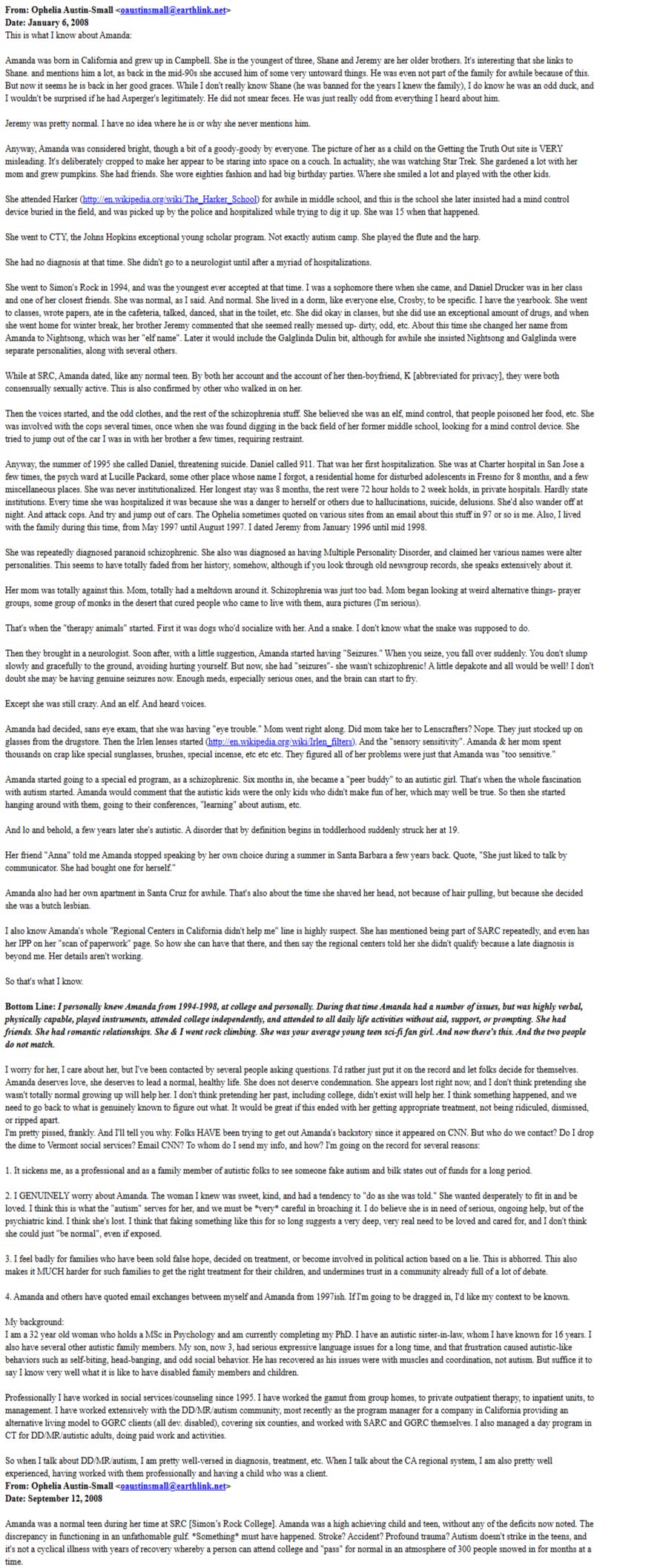
In Her Own Language — The Untold Story of Amanda Baggs

Amanda Melissa Baggs (also known by her later legal name Amelia Evelyn Voicy Baggs, and online as ballastexistenz, cussinanddiscussin, and withasmoothroundstone) was a disability rights advocate based in Burlington, Vermont. Born in Mountain View, California on August 15, 1980, to Ronald and Anna Baggs, she relocated from California to Vermont in 2005, reportedly to be closer to a friend. She would remain in Burlington until her death in 2020.

Amanda identified as genderless and nonbinary, preferring the neopronouns sie/hir and ze/zer. She also identified as a lesbian and described herself as ‘cognitively disabled, physically disabled, chronically ill, developmentally disabled, and psychiatrically disabled’. As an adult, she claimed to have lost all functional speech and communicated exclusively through a text-to-speech device.

Within disability and autism advocacy circles, Amanda was widely known and broadly celebrated. She created a website titled ‘Getting the Truth Out’ in response to a campaign by the Autism Society of America, arguing that the ASA’s messaging reduced autistic people to objects of pity rather than recognizing their autonomy and inner lives. She spoke at disability conferences, collaborated with researchers at MIT who were studying autism, and maintained two long-running blogs (Ballastexistenz and Cussin’ and Discussin’) which together built her a devoted online following over nearly two decades.

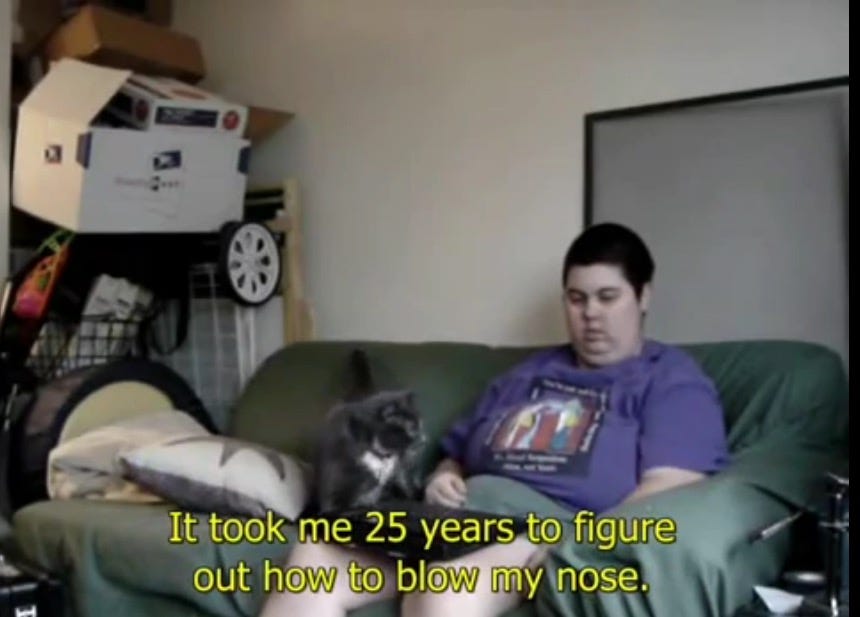
Amanda’s reach extended beyond advocacy circles in January 2007, when she posted a video to YouTube entitled ‘In My Language.’ The video, which depicted Amanda engaging with her environment in ways she presented as characteristic of severe autism before transitioning to a typed narration delivered via text-to-speech device, became the subject of multiple CNN segments and earned her a guest blogging spot on Anderson Cooper’s blog, where she answered audience questions via email. The video’s cultural footprint reached even into the art world with “video artist” Mark Leckey citing Baggs’ stated empathic relationship to inanimate objects as something he found himself envious of and incorporated the singing from ‘In My Language’ into his own video work ‘Prop4aShw.’


The widespread media attention proved to be a double-edged sword. Among the viewers who encountered Amanda’s story through CNN were former classmates and acquaintances, several of whom came forward with accounts that directly contradicted the narrative she had spent years constructing.

Peers who knew Amanda Baggs at Simon’s Rock College (a selective institution for academically gifted teenagers) describe her as high-functioning, verbally fluent, and socially engaged. According to these accounts, Baggs underwent a dramatic change after heavily abusing psychedelics in 1995, leading to a psychotic break and an eventual diagnosis of schizophrenia. After extensive doctor shopping, she received a diagnosis of low-functioning autism around the age of 20, and began building her public identity around it, all while producing writing that was, by any measure, articulate, sophisticated, and inconsistent with the severe disabilities she claimed.

In spite of multiple testimonies from her former classmates, the medical inconsistencies that ran through her claimed diagnoses, and questions that had quietly circulated in online spaces for years, Amanda remained a respected and broadly celebrated figure in disability advocacy circles. None of it was enough to prompt serious mainstream scrutiny. She died quietly from respiratory failure on April 11, 2020, at the age of 39, largely unquestioned to the end. Both the Washington Post and the New York Times published obituaries celebrating her life and legacy, with neither publication seeing fit to examine the questions that had long surrounded her story.

Amanda Baggs’ story is not a simple one of deliberate deception. It is a case study in how trauma, mental illness, and a desperate need for identity can converge. She was either the most remarkable case of adult-onset autism ever documented, or she wasn’t autistic at all. The truth, as the evidence strongly suggests, is more complicated than either answer.
Before the Diagnosis


Amanda was considered academically gifted from an early age, and at just 14 (younger than even the typical Simon’s Rock student, who usually enters at 15 or 16) she was accepted to Bard College at Simon’s Rock in Massachusetts, a highly selective institution specifically founded for intellectually advanced students who have outpaced their conventional school curricula.

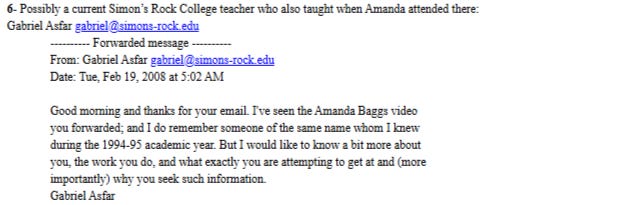
Those who knew Amanda there describe a young woman who bore no resemblance to the profoundly disabled person she would later present herself as. Former classmates recall her as verbally fluent and socially engaged - eating in the cafeteria with friends, playing the flute, attending classes and participating in discussions at a normal level. She had a boyfriend with whom, by her own account to peers at the time, she was sexually active. Her former classmates consistently maintain that there was nothing that suggested any form of autism, low-functioning or otherwise.

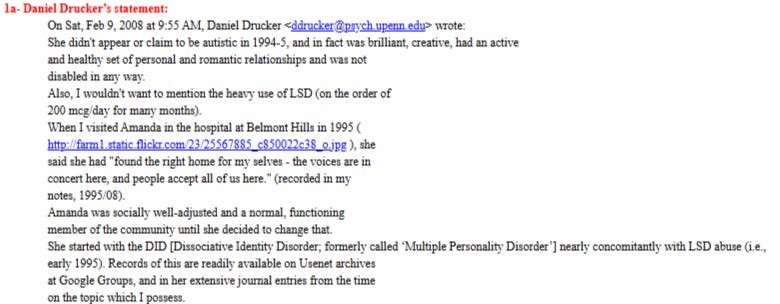
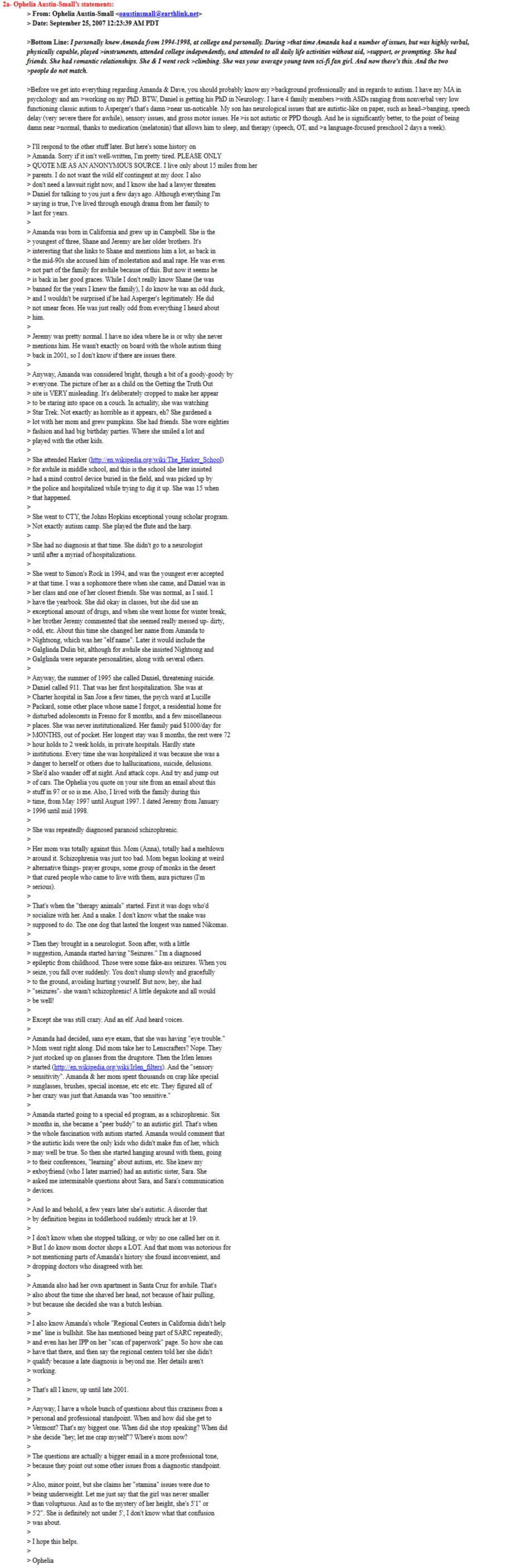
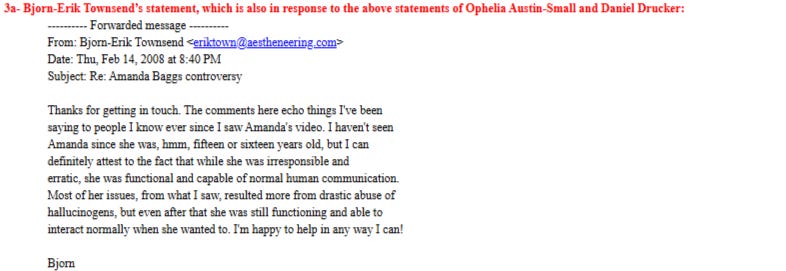
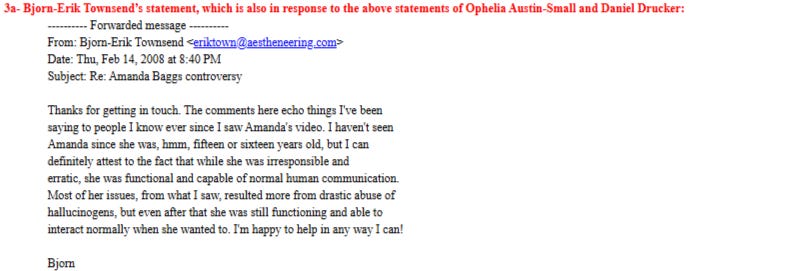
The witness testimony against Baggs’ autism claims is both extensive and credible. Neuroscientist Daniel Drucker, who was one of her closest friends at Simon’s Rock, stated plainly that she ‘didn’t appear or claim to be autistic in 1994-5’ and was ‘brilliant, creative, had an active and healthy set of personal and romantic relationships and was not disabled in any way,’ noting her heavy LSD use of approximately 200 micrograms per day for many months. Ophelia Austin-Small, a psychology PhD candidate with over a decade of professional experience in disability services who lived with Baggs’ family in 1997, provided the most detailed account. She describes a normal, verbally fluent teenager who attended classes, ate in the cafeteria, went rock climbing, played the flute and harp, attended the prestigious Johns Hopkins CTY program, and was the youngest student ever accepted to Simon’s Rock. Austin-Small also provided the single most damning detail about the autism claim’s origins: that Baggs had befriended an autistic girl through a special education peer program, became fascinated by autism, attended conferences, and researched communication devices before eventually claiming the diagnosis herself. Bjorn-Erik Townsend, another former classmate, confirmed she was ‘functional and capable of normal human communication,’ and a former teacher who came forward publicly wrote simply: ‘I knew her when she was fourteen and she was definitely not autistic then. You don’t get autism.’

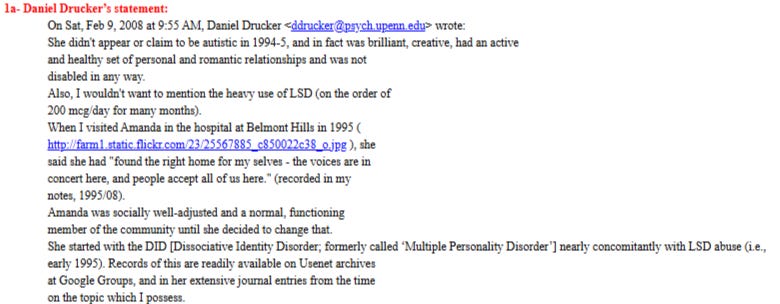
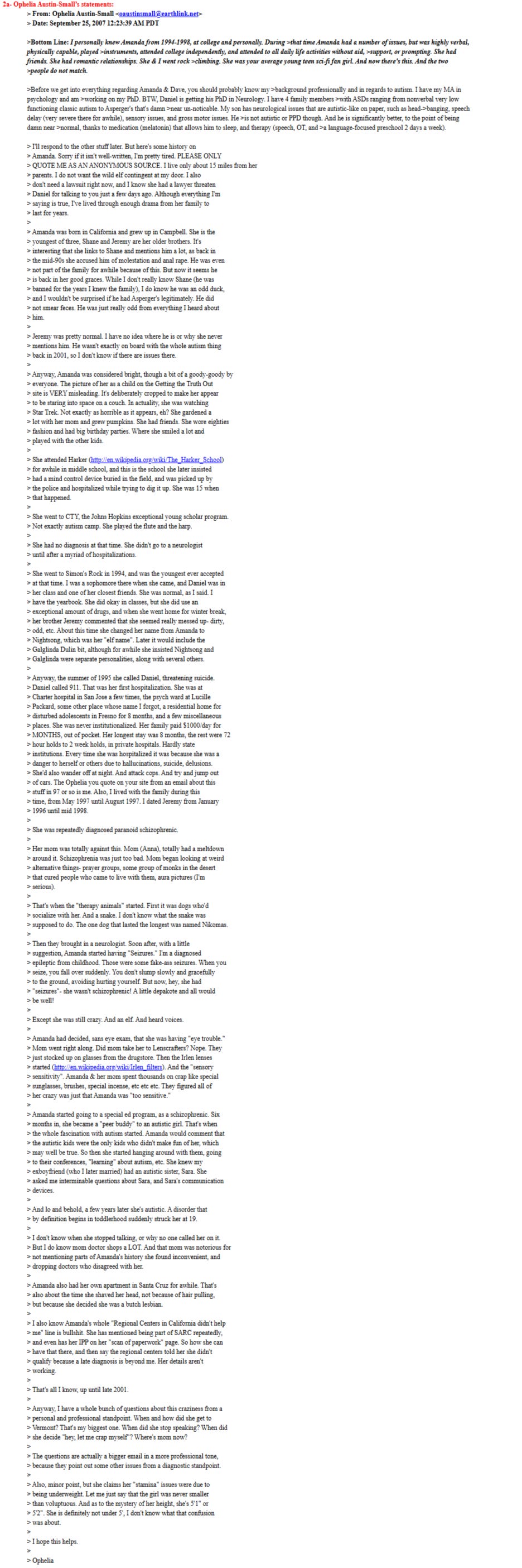
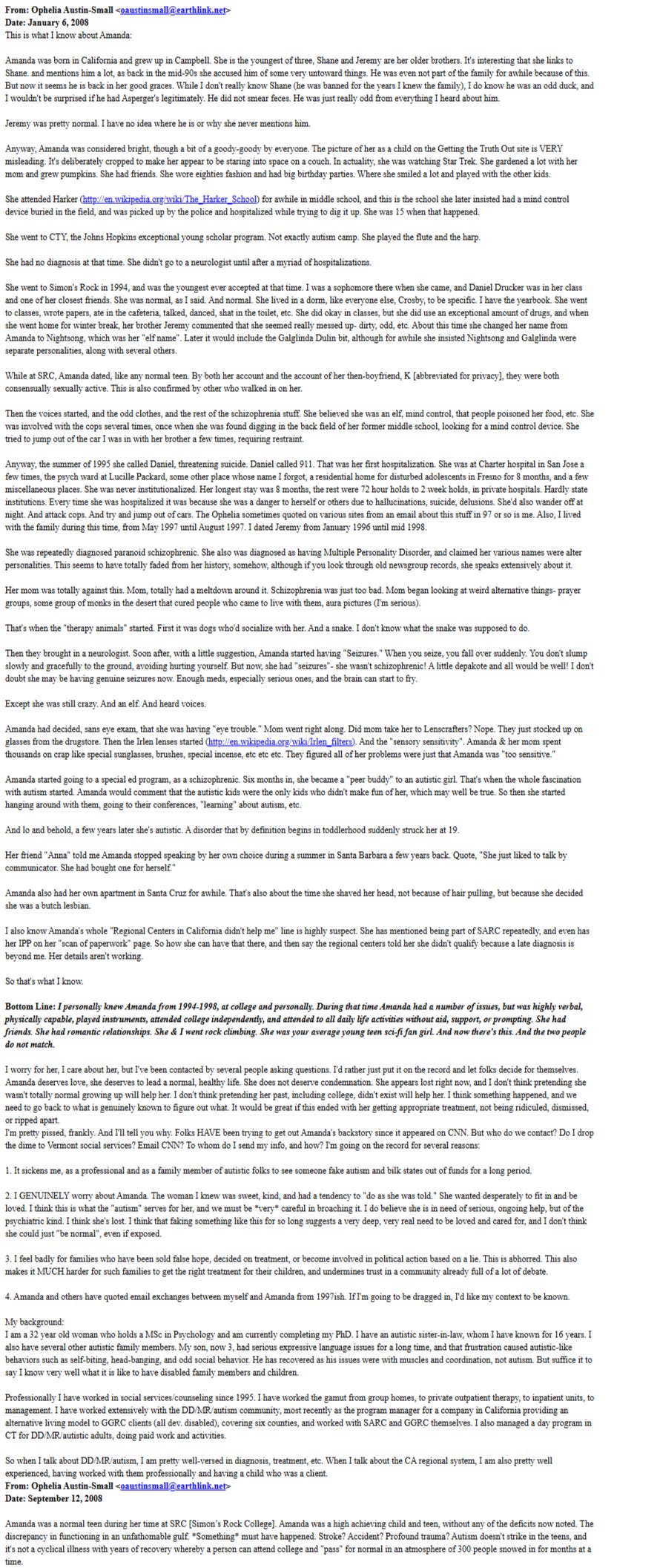


In 1995, during her time at Simon’s Rock, Amanda began using psychedelics heavily. Former classmates describe a period of approximately three months during which she was using LSD and psilocybin on a near-daily basis. The consequences were severe and rapid. Amanda began claiming to be an elf and reported hearing voices, made suicide attempts, and exhibited increasingly erratic and aggressive behavior. She eventually withdrew from Simon’s Rock and entered a psychiatric institution.

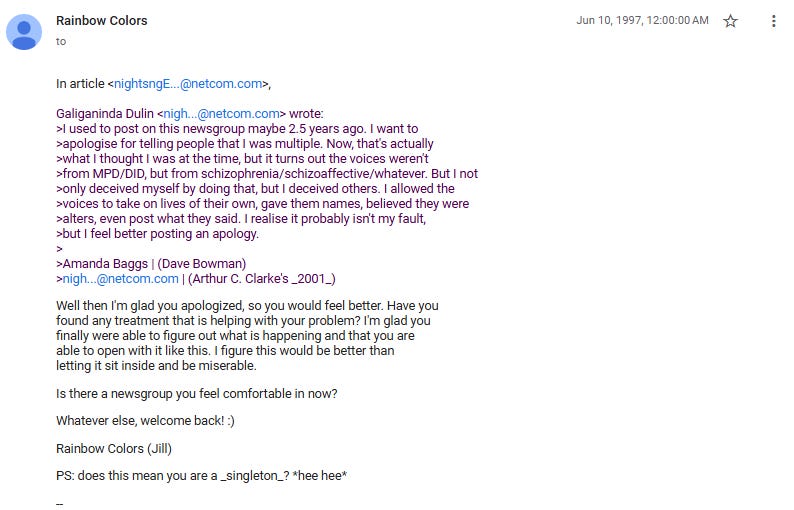
A December 1995 email written by Baggs under the username ‘Galig-Nightsong Dulin’ and sent to former Simon’s Rock classmates, presenting an elaborate account of her claimed Dissociative Identity Disorder — complete with named alternate personalities including an ancient elf named Galiganinda, a nine-year-old child named Katy, and an entity called Dark Mind (the same DID diagnosis she would publicly retract two years later in 1997).



A diagnosis of schizophrenia emerged from this period — and by most accounts, it was the most accurate diagnosis Baggs would ever receive. Her mother, Anna, reportedly refused to accept it outright, and what followed was an extended period of doctor shopping that would set the template for the decades to come.

A journal kept by Baggs during her 1996 stay at the Shepherd Treatment Centre (later circulated among former friends and authenticated by neuroscientist Daniel Drucker, who knew her at the time) documents in granular detail a young woman in the grip of genuine psychosis. Written under her then-username ‘Nightsong,’ the entries span May through September 1996 and describe auditory hallucinations, paranoid delusions about government conspiracies, a belief that staff members were poisoning her food, and a persistent, agonized conviction that she was an elf being forced to accept a human identity against her will. They also document a painful, medicated struggle to accept her schizophrenia diagnosis. A struggle her own doctors noted was being actively complicated by her mother’s refusal to accept it alongside her. ‘I wish Anna would accept my diagnosis as I have,’ Baggs wrote in May 1996. ‘I don’t like it, but I don’t deny it anymore. But I can’t change her opinion any more than she can change mine.’



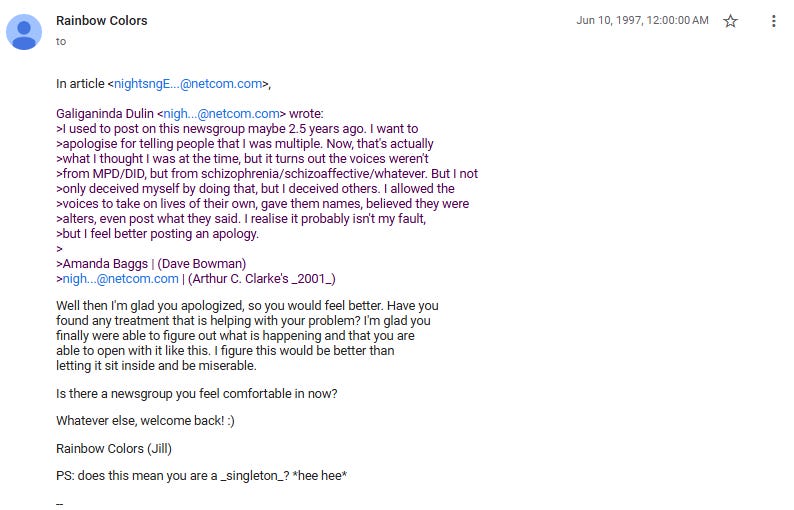
Later that year, she began publicly identifying as having dissociative identity disorder (then more commonly known as Multiple Personality Disorder) claiming this to family, friends, acquaintances, and online communities. She maintained this identity for roughly two years before publicly retracting it in 1997, acknowledging she had been deceiving both herself and others.

Born-Again Autistic

Amanda began claiming her autistic identity around the year 2000, at around 20 years of age. She claimed to be severely low-functioning, and non-verbal. The immediate issue is that autism is a developmental disorder, meaning that it is present from birth, with signs typically emerging between 18 and 24 months of age. No credible medical framework supports the idea that a person can develop severe, non-verbal, low-functioning autism at the age of 20, after having spent their teenage years attending a selective college, maintaining friendships and engaging in romantic relationships. The CDC notes that signs of autism spectrum disorder are typically identifiable by age 2 and reliably diagnosable shortly thereafter, meaning that a child with the severity of autism Amanda claimed to have would have been identified long before adolescence, let alone adulthood. The notion that it went entirely undetected through her gifted education, her college enrollment, and her years of apparently normal social functioning is not a medical grey area but a complete impossibility. Nevertheless, Baggs built a platform on this claim, and for a time, it worked extraordinarily well.

In January 2007, Baggs began uploading videos to YouTube documenting what she presented as her experience of severe, non-verbal autism. One of these, titled ‘In My Language’, went viral. The video depicted Amanda engaging in repetitive behaviors and interacting with her environment in ways she presented as characteristic of severe autism, before transitioning to a typed narration delivered via text-to-speech device, arguing that her way of experiencing the world represented a valid form of cognition.

The video became the subject of multiple CNN segments, earned her a guest blogging spot on Anderson Cooper’s blog, and caught the attention of CNN’s chief medical correspondent Dr. Sanjay Gupta, who dedicated a 2007 piece to Baggs and her story. Her case was also taken up by the New York Times’ Well blog in 2008, where health journalist Tara Parker-Pope examined the video and its implications for public understanding of autism. For a brief period, Baggs was held up by the neurodiversity movement as proof of their central argument that autism is a different way of being, not a disorder to be treated or cured, and that the apparently silent and unreachable might have more to say than the world had given them credit for.

What Baggs could not have anticipated was that the widespread media coverage would reach beyond the disability advocacy circles that had long accepted her story, and into the lives of people who remembered her differently.

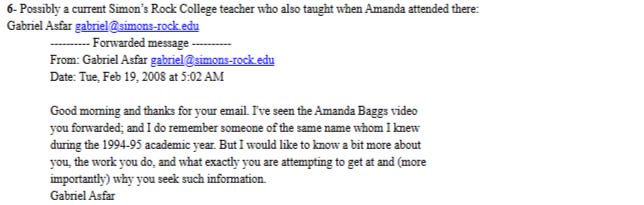
By mid-2007, former classmates and acquaintances from Simon’s Rock College had begun coming forward, first to CNN and then across various online platforms, expressing their confusion and alarm at how Baggs was presenting herself. Their accounts were consistent and credible as several held advanced academic positions, including a neuroscientist at the University of Pennsylvania and a PhD candidate in psychology with over a decade of experience as a mental health professional. None recognized the person being celebrated on CNN as the Amanda Baggs they had known. Naturally, CNN, the New York Times and Wired did not meaningfully engage with these accounts. Go figure.
Cat-Facilitated Communication

Central to Amanda Baggs’ public platform was a single, powerful claim: that a person who appeared to the world as severely cognitively impaired was, in fact, communicating coherent, sophisticated, and philosophically rich thoughts through typing. It was a compelling narrative and for the families of genuinely nonverbal, severely disabled people, it was an emotionally loaded one. It offered the possibility that their loved ones, too, might have rich inner lives that the world had simply failed to access. That hope, real and understandable as it was, is precisely what made the claim so worth examining carefully.

The method Baggs used to communicate sits within a broader and deeply controversial tradition. Facilitated Communication (known as FC) is a technique developed in the early 1970s and popularized in the United States throughout the 1990s, in which a person with severe communication impairments is assisted by a facilitator who supports their hand, arm, or shoulder while they type or point to letters on a keyboard or letter board. Proponents claimed it unlocked hidden intelligence in people with severe developmental disabilities, allowing them to communicate for the first time. The reality, as decades of controlled research have demonstrated, is considerably more troubling.

The American Psychological Association formally rejected FC as a valid therapeutic technique in 1994, finding that in controlled conditions the communication produced invariably reflected what the facilitator knew rather than the subject. The American Academy of Pediatrics, the American Association on Intellectual and Developmental Disabilities, and numerous other major medical bodies have since reached the same conclusion.

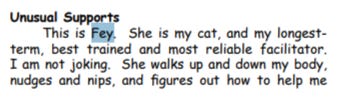
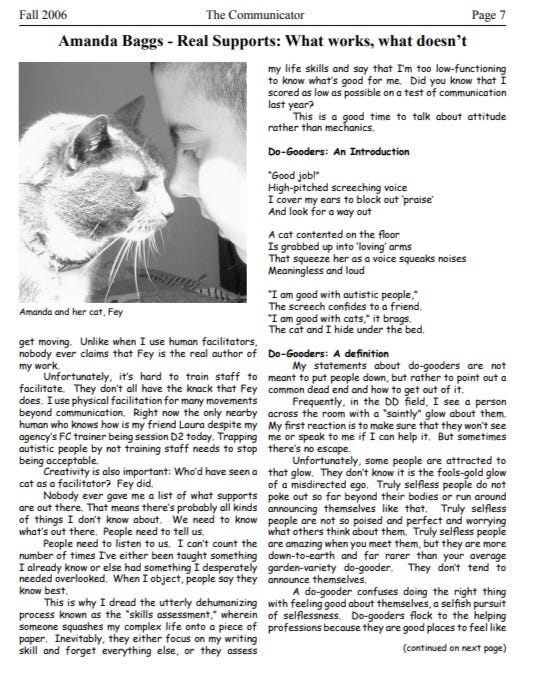
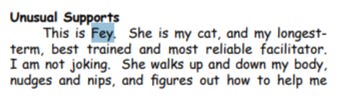
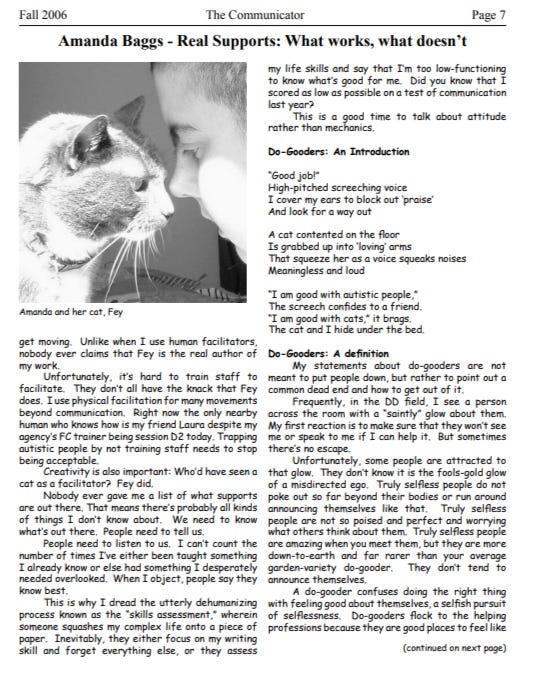
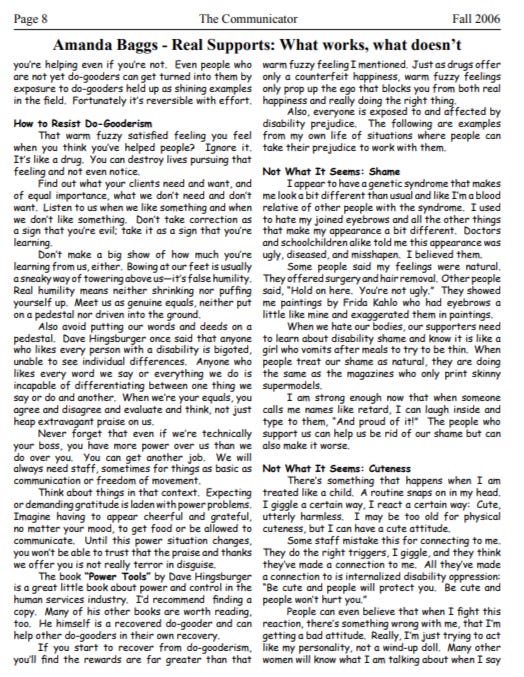
Baggs was an open supporter of FC, a position that should itself have prompted harder questions from the journalists who covered her. According to her Wikipedia page, Baggs claimed to use FC independently — but offered at least one detail that should have immediately strained credulity among even her most sympathetic readers: that her cat, Fey, was her most effective facilitator. A claim she elaborated on in a 2006 newsletter published by the Autism National Committee, in which she described Fey as moving her limbs around to assist her communication. A cat. Listed, without irony or editorial challenge, on a Wikipedia page that multiple journalists consulted while covering her as a legitimate disability advocate.

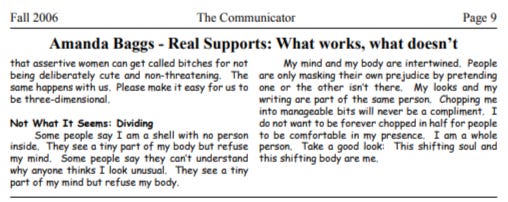


Amanda maintained that she could not boil water without extreme difficulty, that she regularly forgot how to stand up, and that she required caregivers to visit twice daily to assist her with basic personal hygiene. She claimed to be frequently unable to recognize emergency situations. Yet Amanda was apparently able to film, edit, and upload YouTube videos, manage multiple blogs, file her own medical directives, and engage in sustained, sophisticated online advocacy.
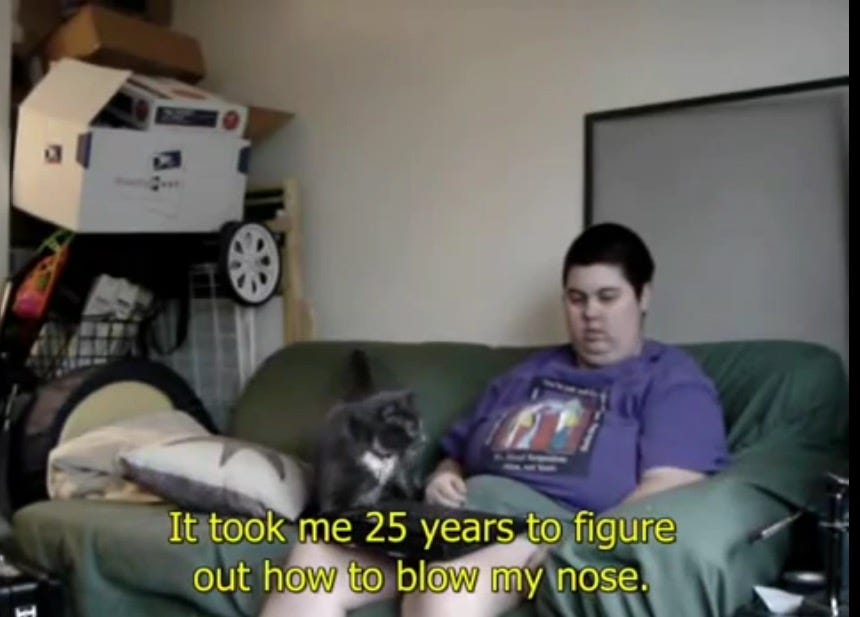


She also claimed, at various points, an IQ of between 135 and 160, placing her in the exceptionally gifted range, before later revising this figure down to 85, a drop of at minimum 50 points. A cognitive decline of that magnitude would represent an extraordinary and largely undocumented medical phenomenon, one that would typically be the subject of significant clinical interest and documentation. Whatever the true nature of her conditions, Amanda produced a body of written work that was, by any honest measure, entirely inconsistent with the profound cognitive impairment she claimed. Her blogs read like the output of a highly intelligent person, one with a sophisticated command of language, medical terminology, and rhetorical argument that sat in direct contradiction with virtually every claim she made about her own abilities. The platform Amanda Baggs built rested entirely on the acceptance of a claim that her own output consistently contradicted.

The Munchausen Question

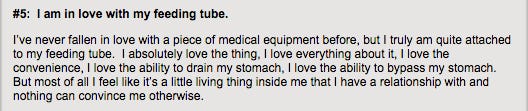
There is a term for what Amanda Baggs may have been doing, and it is not malingering in the conventional sense. Munchausen syndrome is a psychiatric condition in which a person fabricates, exaggerates, or induces physical or psychological symptoms in order to assume the identity of a patient. It is not primarily about financial gain, which distinguishes it from straightforward fraud. It is about the attention, care, sympathy, and sense of identity that comes with being sick. People with Munchausen syndrome often become highly knowledgeable about medicine and tend to accumulate diagnoses while resisting getting better. They tend to become extraordinarily invested in their medical equipment and procedures as symbols of their illness and identity.
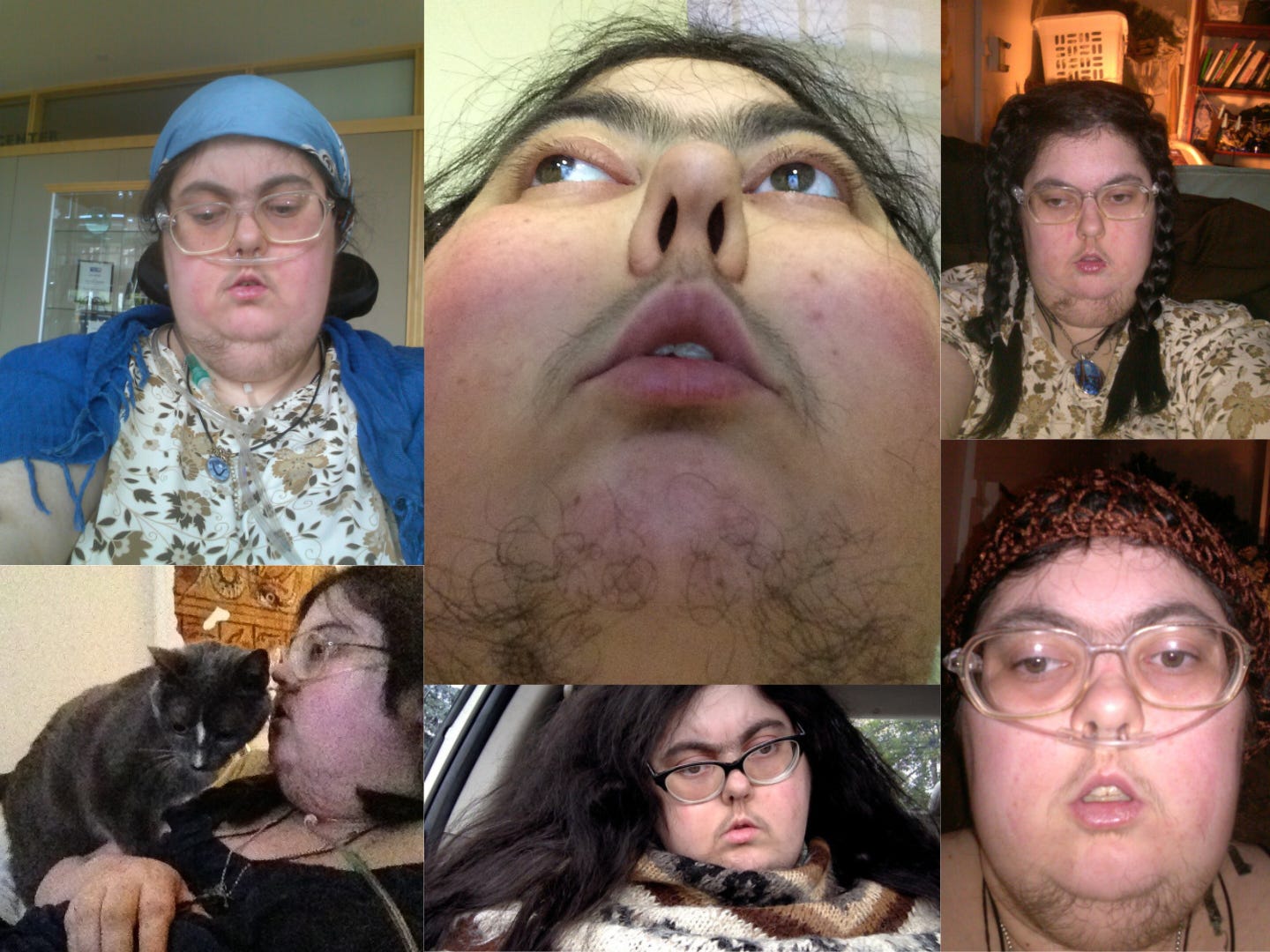


By the time of her death in 2020, Amanda had accumulated a list of diagnoses that strains credulity even when considered individually, let alone collectively. She claimed, at various points, to have been living with schizophrenia, Dissociative Identity Disorder, Schizoaffective Disorder, Bipolar Disorder, PTSD, depression, and cognitive disability. On the developmental side, she claimed low-functioning non-verbal autism and intellectual disability, despite having previously claimed an IQ of between 135 and 160 (a figure she later revised down to 85, representing a drop of at least 50 points that she never adequately explained). She also claimed obsessive-compulsive disorder, Tourette syndrome, synesthesia, and Irlen syndrome (a controversial condition affecting visual processing that is itself not recognized by mainstream ophthalmology).

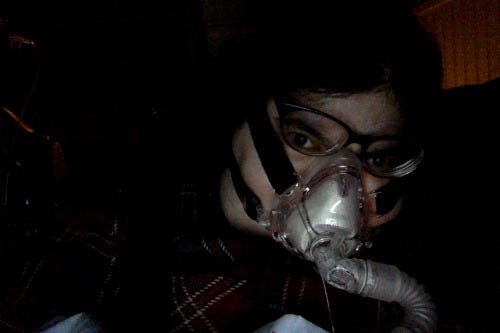
Physically, her claimed conditions included gastroparesis, chronic aspiration of food into her lungs, a brain abnormality dating to age 13, something she described as ‘similar to myasthenia gravis,’ trigeminal neuralgia (widely considered one of the most painful conditions known to medicine), a hypermobility disorder causing deformity of her hands, adrenal insufficiency, PCOS, sleep apnea, bronchiectasis, asthma, a craniofacial abnormality, bladder dysfunction requiring a surgically implanted electrical node, recurring meningitis, and, in the final months of her life, functional blindness.



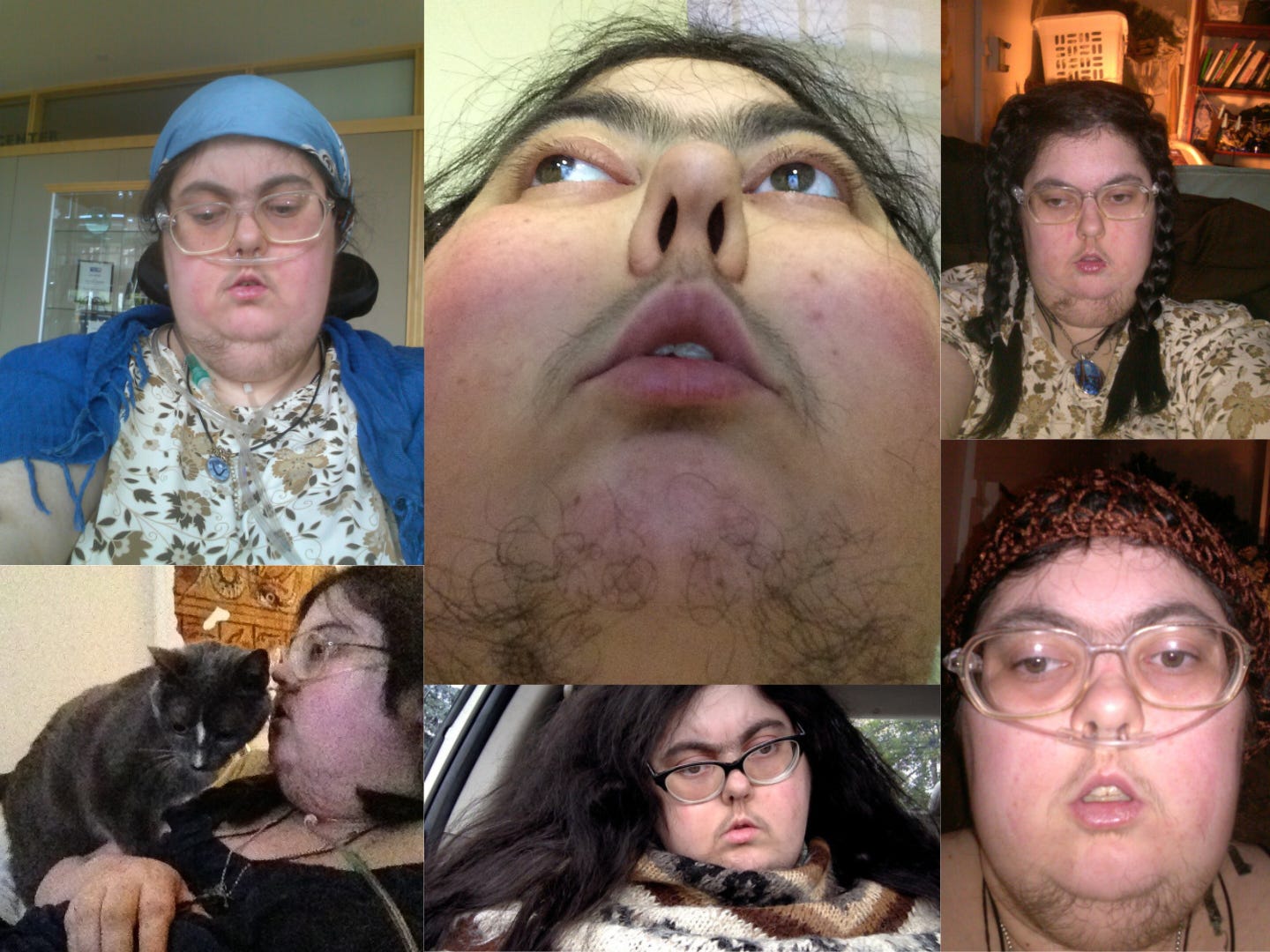
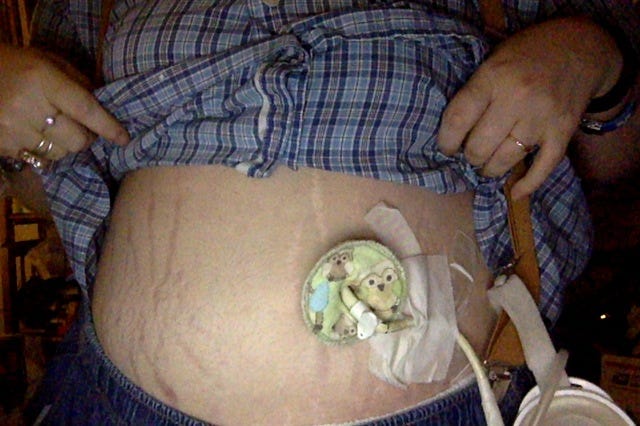
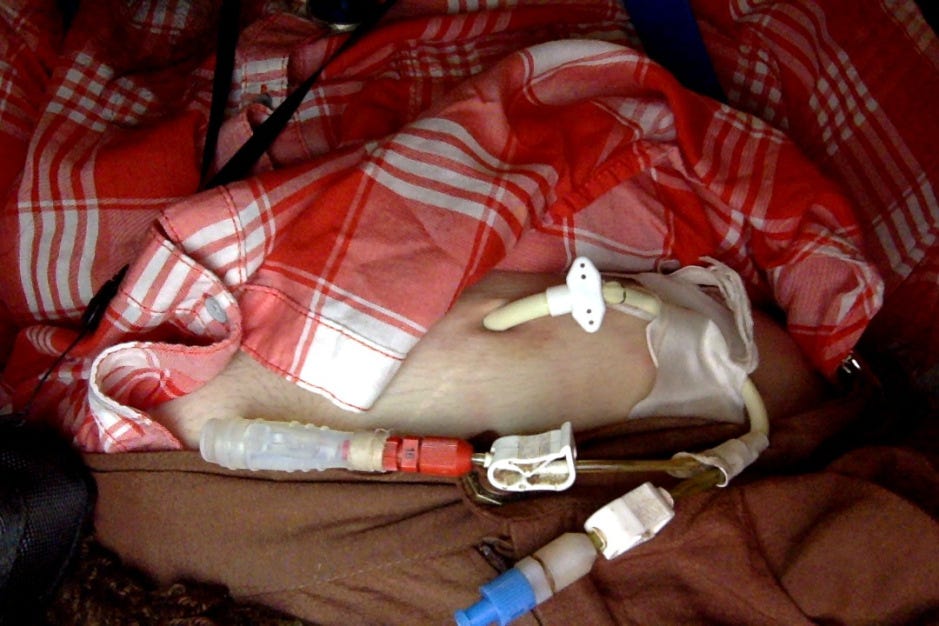
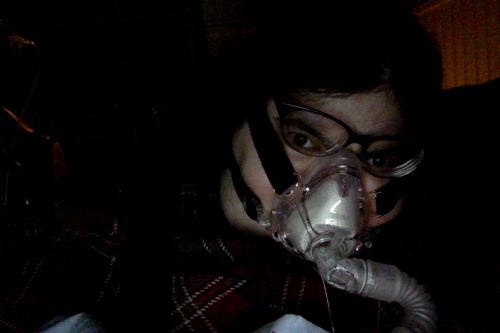
The feeding tube is perhaps the single most revealing element of Baggs’ medical history. A gastrojejunal feeding tube (the type she used) is a significant surgical intervention, typically reserved for patients who are genuinely unable to maintain adequate nutrition through oral feeding, most commonly those who are severely underweight or medically fragile. Baggs was neither. She was, by all visual evidence, significantly obese — a fact that created an immediate and glaring contradiction with her primary justification for the tube, which was gastroparesis.
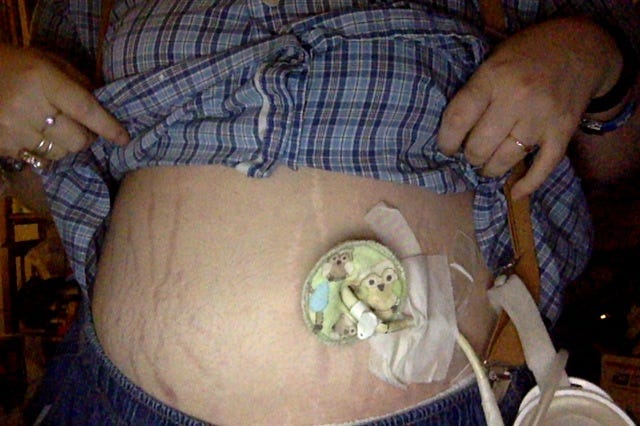
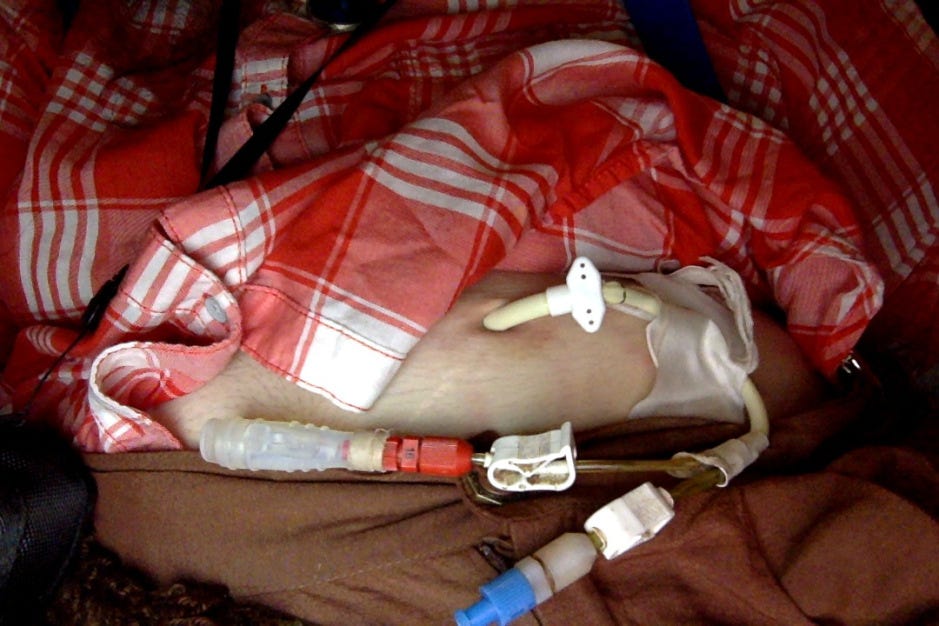


Baggs herself acknowledged, in various blog posts, that she had to fight her doctors to obtain the tube. In the world of Munchausen syndrome, this is a familiar pattern: the patient who is not genuinely ill enough to warrant an intervention they have become fixated on obtaining, pushing until a doctor, worn down by persistence or liability concerns, finally acquiesces.
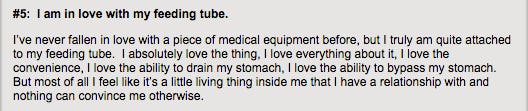


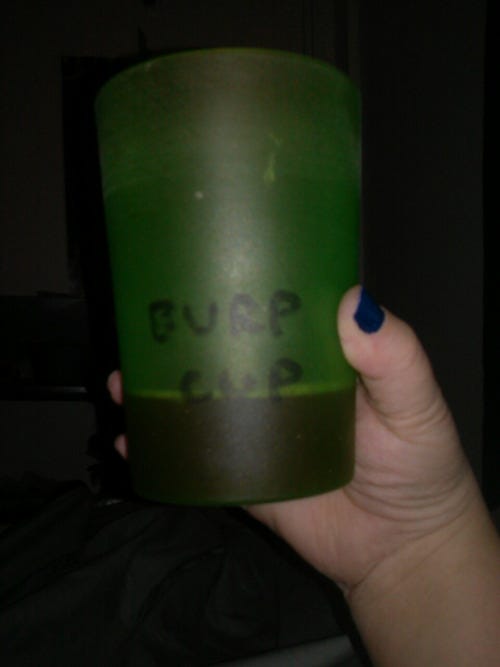
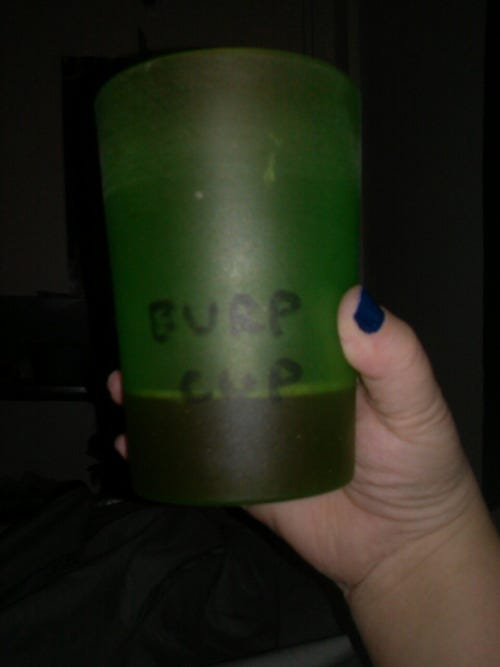
She documented it obsessively. She photographed it. She wrote about it at length. She described, without apparent embarrassment, a practice of eating candy and then removing it from her stomach through the tube into a vessel she referred to as her “burp cup”.


She wrote in detail about bodily functions, medical procedures, and the mechanics of her various conditions in ways that can described as having a fetishistic quality. Her blog read less like someone managing illness and more like someone deriving something from it.


Her blog, Ballastexistenz (the name itself a German term meaning “ballast existence,” a reference to the Nazi concept of lives not worth living, which she apparently adopted as an ironic identity) was a sustained, years-long performance of medical suffering. Every caregiver who questioned her was an abuser. Every doctor who declined to provide a requested intervention was evidence of systemic ableism. Every challenge to her self-reported symptoms was proof of society’s failure to believe disabled people. The framework was constructed, whether consciously or not, to make scrutiny impossible.

Whether or not Baggs met the clinical criteria for Munchausen syndrome, the pattern of her behavior over two decades is difficult to explain any other way. The diagnoses escalated steadily over time, each one more dramatic than the last. Getting better was never, in any documented instance, something she appeared to want. And through all of it, being disabled remained the fixed center of her public identity, the thing around which everything else in her life was organized, documented, and performed. It would be easy, and lazy, to dismiss Amanda Baggs as simply a liar. The fuller picture is considerably more complicated, and considerably sadder.

Baggs was, by her own account, a child who had already experienced serious trauma before she ever set foot on the Simon’s Rock campus. She disclosed, in a blog post written just weeks before her death, that she had been sexually abused between the ages of 11 and 15 by a family member, and earlier accounts from people who knew her suggest the abuse extended to at least one other male relative.



In this context, at the age of 14, she was sent away from home to attend one of the most academically demanding institutions in the country. Simon’s Rock College attracts students who were, in their previous schools, almost universally the smartest person in the room. For many of them, arrival at Simon’s Rock is the first time in their lives that their intelligence does not automatically set them apart. For a child already carrying the weight of unprocessed trauma, already fragile in ways that her academic performance had perhaps obscured, this collision with peers who were equally or more gifted may have been genuinely destabilizing.

The drugs were almost certainly a factor but the question of why a gifted 14-year-old with apparent prospects begins using psychedelics compulsively is at least as important as the pharmacological consequences of doing so. Self-medication, escape, and the search for an altered sense of self are not uncommon responses to unprocessed trauma. The breakdown that followed may have been, on some level, inevitable.

When Amanda Baggs broke, she received something she may never have adequately received before: care. Attention. The suspension of expectations. Nobody was asking her to compete, to perform, to be exceptional. Her mother, whatever her failings, rallied around her. Doctors paid attention to her. Online communities welcomed her. The identity of a disabled person, it turned out, came with its own form of status. One that did not require her to out-think or out-achieve anyone or defend her place at the top of any hierarchy. It simply required her to suffer, visibly and persistently.

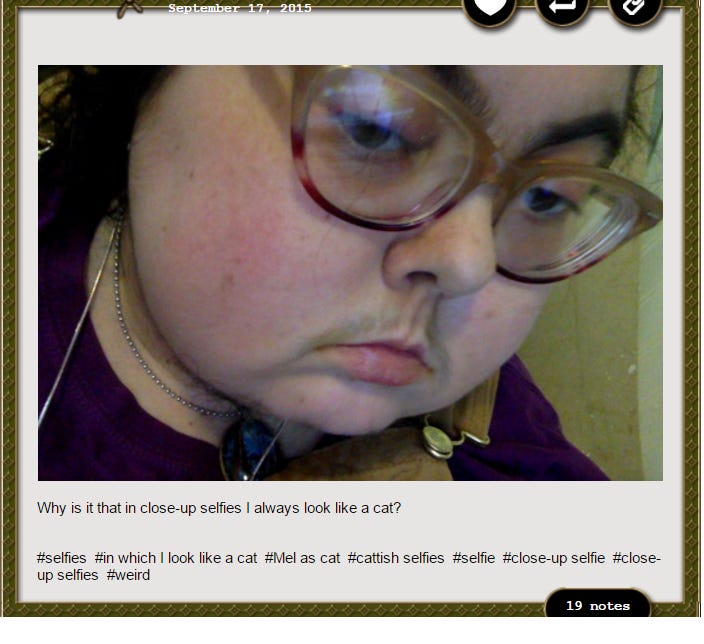
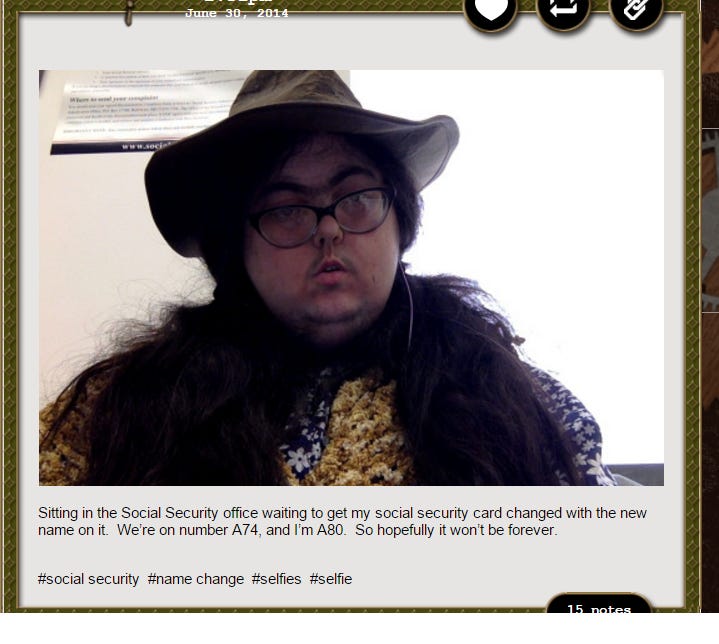
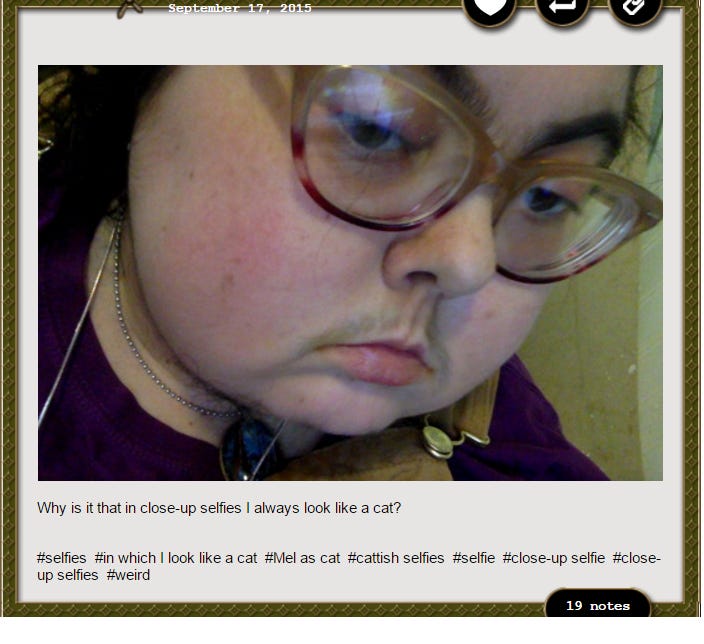
An autism diagnosis, particularly the specific presentation Amanda adopted, of a profoundly disabled person with a hidden inner life, offered something uniquely powerful. It was sympathy without being pitied and permanent without being terminal. It positioned her not as someone who had fallen apart, but as someone who had always been different, always been misunderstood, always been more than the world had given her credit for. It transformed a history of dysfunction into a narrative of neurodivergent identity. And so she built her life around it, not just her public persona, but apparently everything. Her hobbies were reframed as stimming or therapy. Her pets became service animals. Her appearance, the ungroomed facial hair she explicitly refused to remove, the medical equipment worn visibly rather than concealed, became markers of authenticity, evidence of how sick she really was.
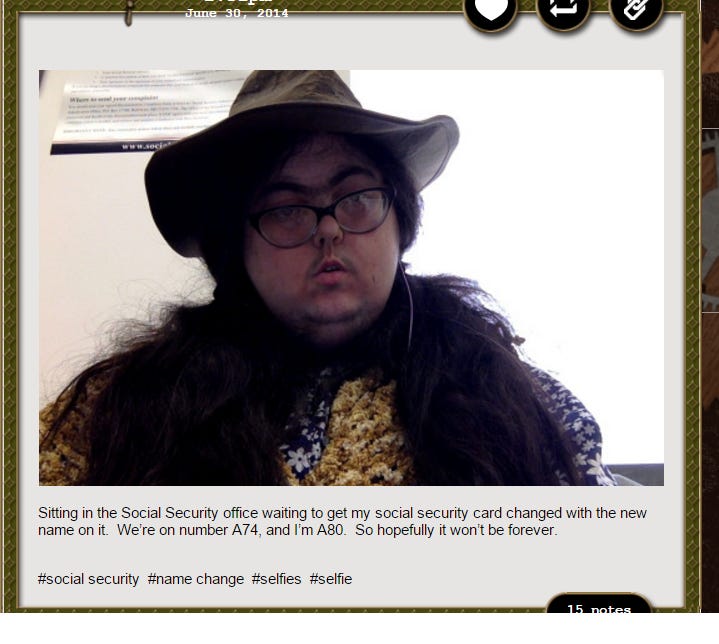


Whether she knew, on some level, what she was doing is a question that cannot be answered with certainty. It is entirely possible that by the end, Amanda Baggs had been sick for so long, and had invested so completely in that identity, that the original choice (if it ever was a fully conscious one) had long since become invisible to her.
The Final Blog Entry

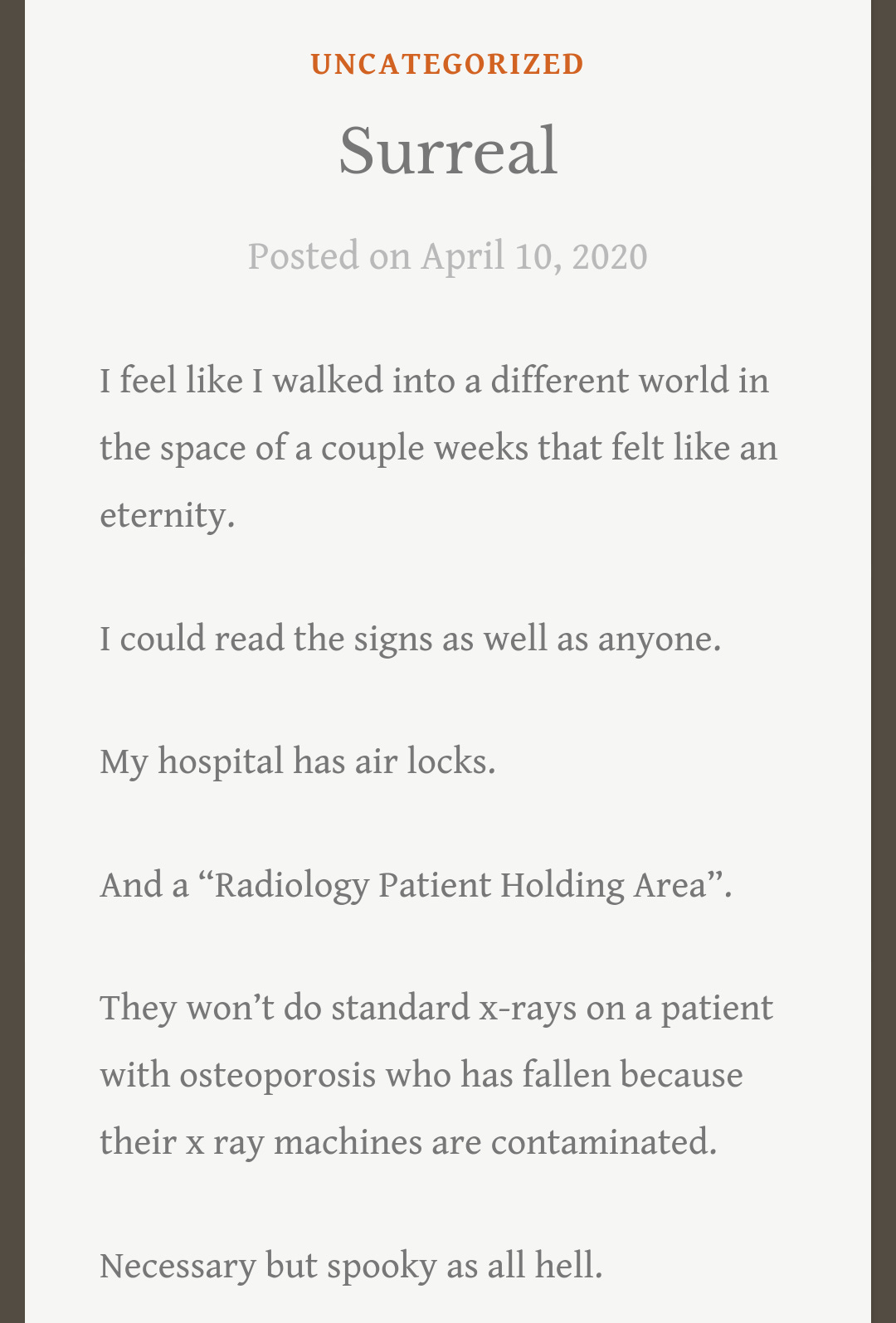
On April 10, 2020, Amanda Melissa Baggs posted to her WordPress blog for the last time. It was a short, disoriented entry, written from what she described as a state of delirium. She had been in and out of the hospital. She was struggling. She died the following day, April 11, 2020, in Burlington, Vermont. She was 39 years old. Her mother reported that the cause of death was believed to be respiratory failure.
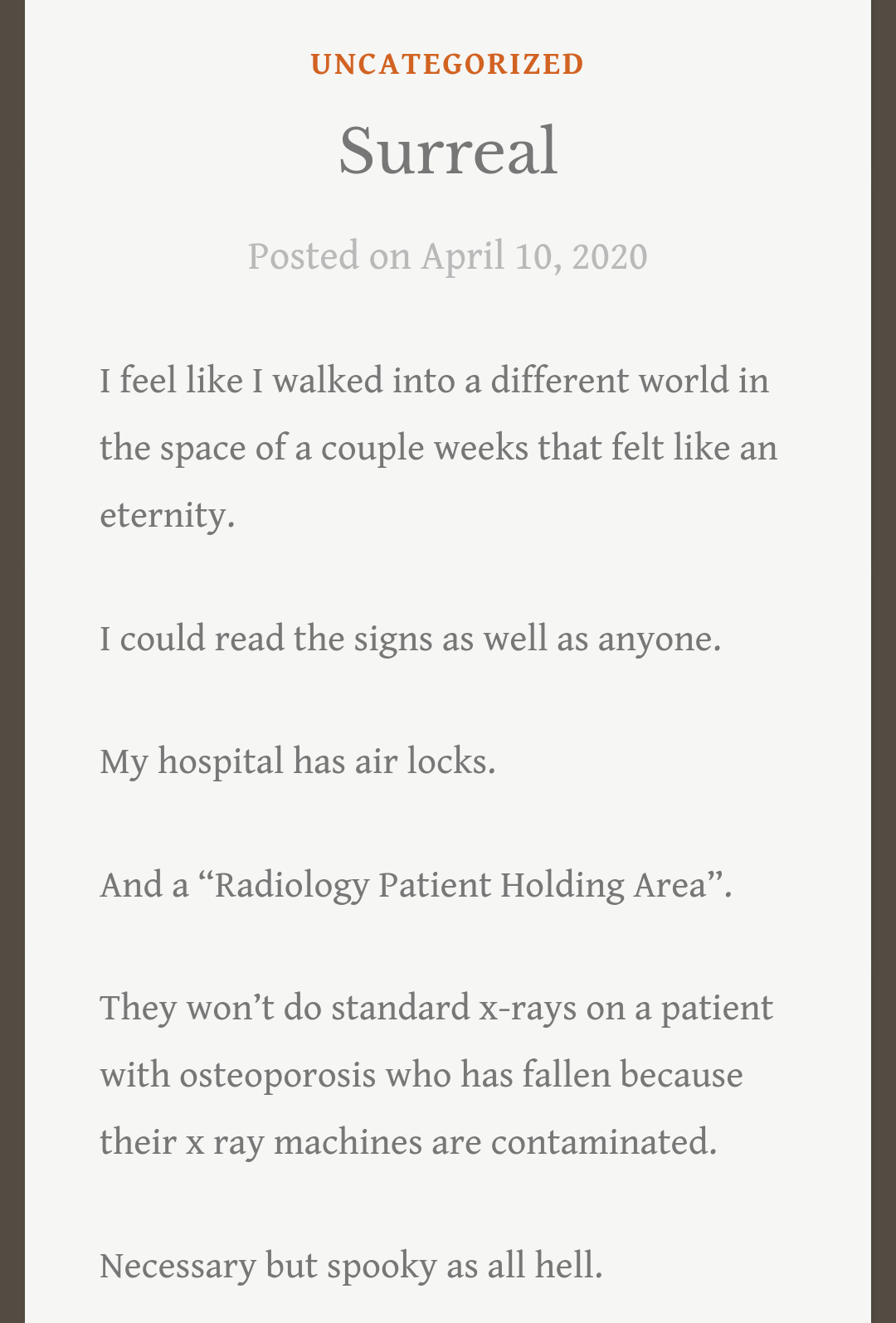


Respiratory conditions (sleep apnea, bronchiectasis, aspiration) had featured prominently in her long catalogue of claimed illnesses. Whether any of them were genuine, exaggerated, or entirely fabricated will never now be fully known. What can be said is that a 39-year-old dying of respiratory failure is not implausible for someone with her lifestyle and documented health history, whatever the true origins of that history were. Years of obesity, inactivity, and medical interventions of uncertain necessity take their toll regardless of the motivations behind them. In this sense, the ending of Mel Baggs’ story is not so much ironic as it is tragic - a person who spent decades performing sickness may ultimately have made herself sick in the process.

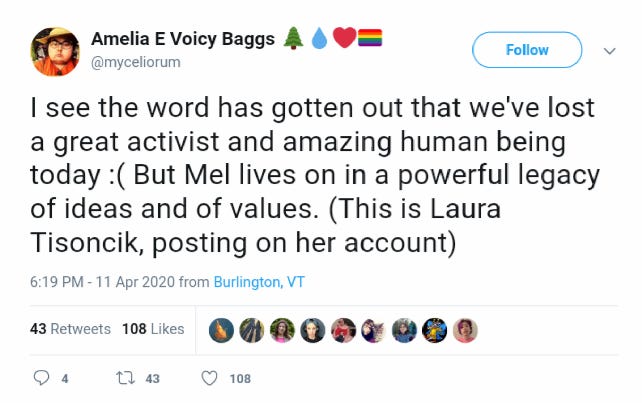
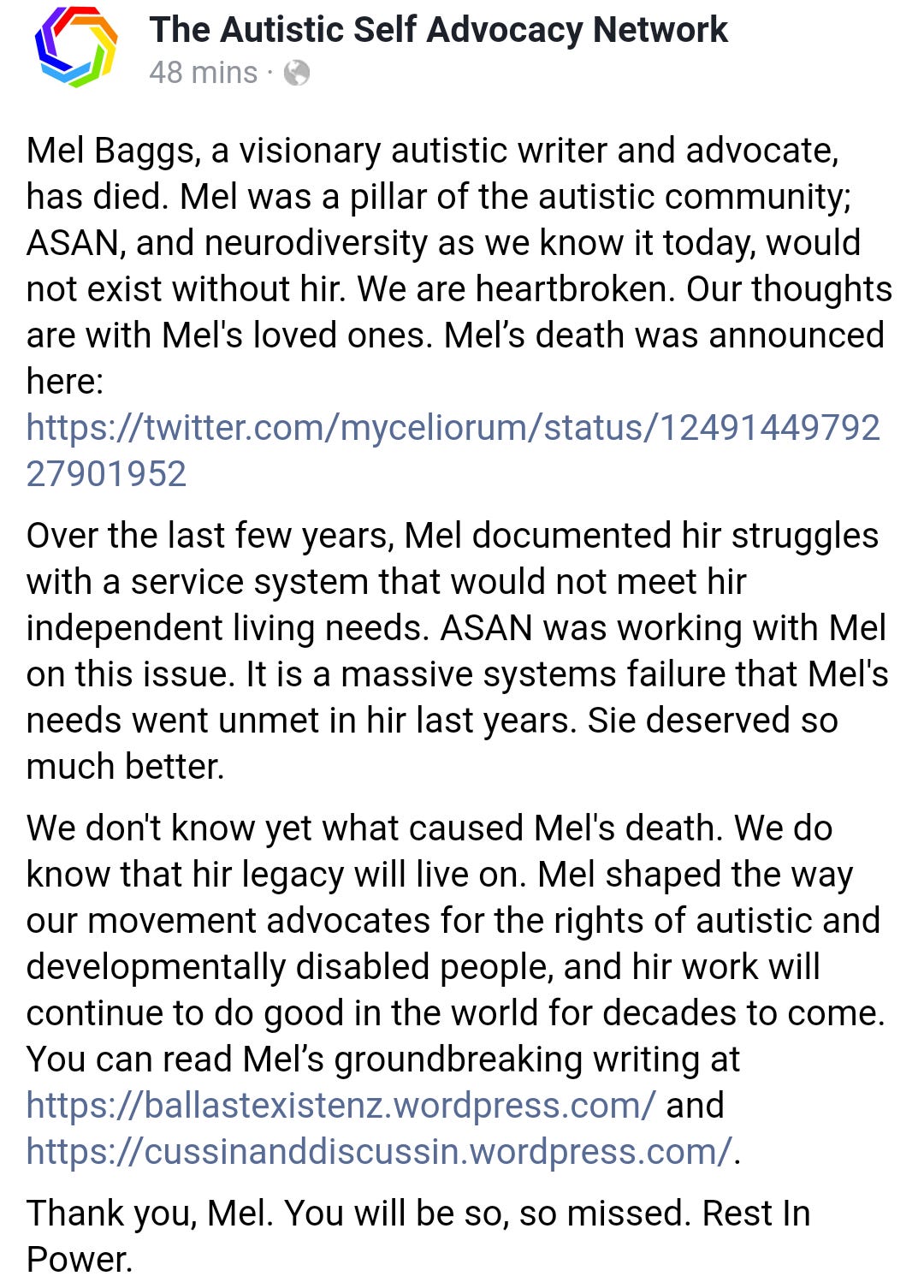
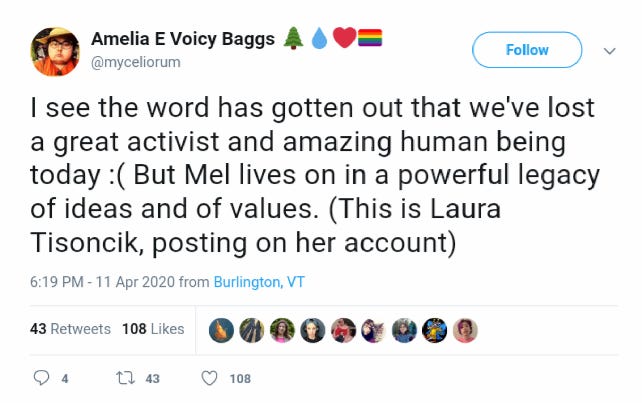
Laura Tisoncik, posting on Baggs’ social media accounts the day of her death, wrote that the world had lost a great activist and an amazing human being, and that Mel lived on in a powerful legacy of ideas and values. Within the disability advocacy community, this was the dominant response. Tributes poured in. The New York Times ran an obituary. The Washington Post followed. The Art of Autism published a tribute. She was remembered as a pioneer, a trailblazer, a person who had changed the way the world thought about nonverbal autism.
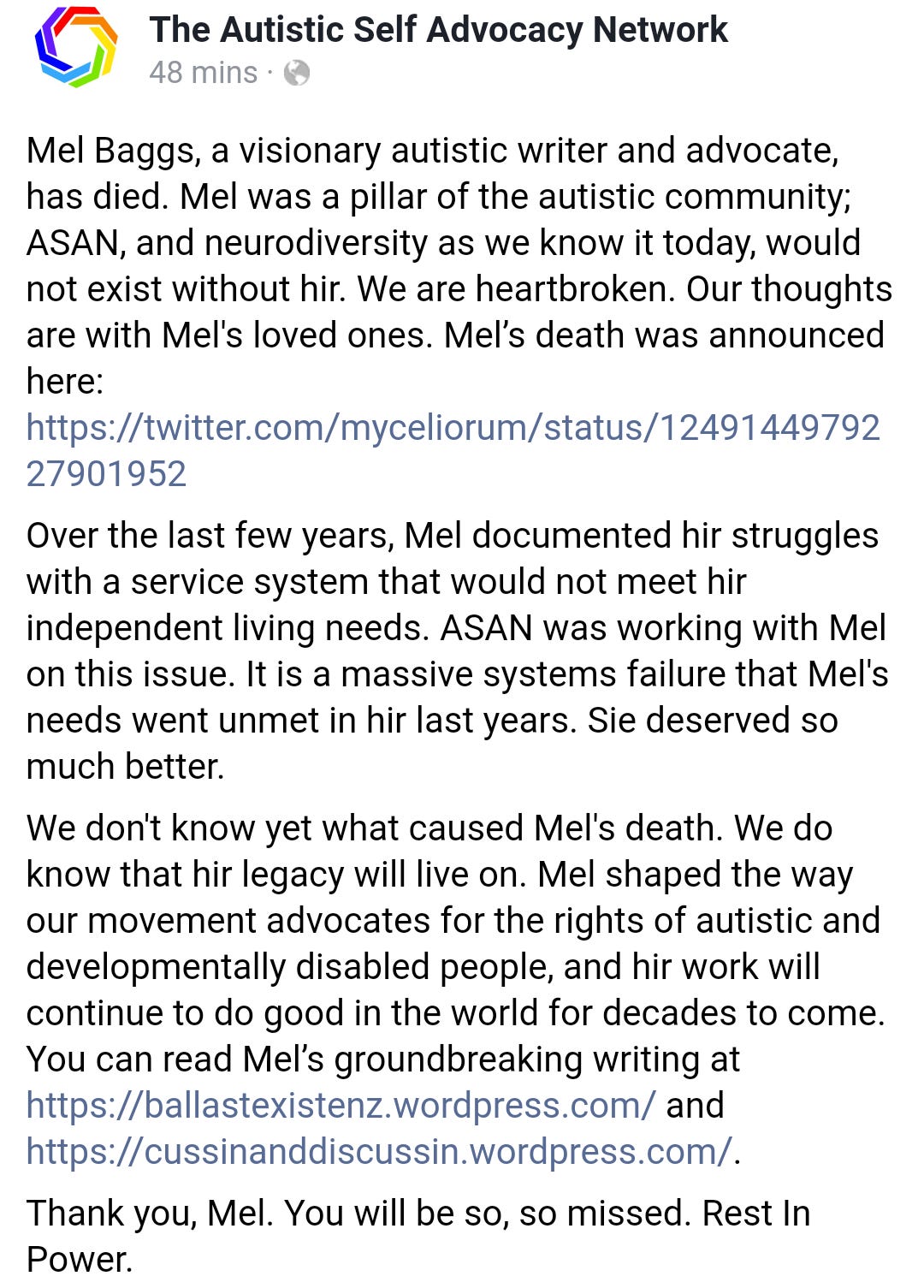


Her Wikipedia page, to this day, presents without qualification the version of Amanda Baggs that she constructed for public consumption: the nonverbal autistic savant, the disability rights pioneer, the woman who taught the world that a different kind of mind was still a mind worth having. The testimonies of those who knew Baggs before her autism identity was constructed were, for the most part, quietly ignored. The journalists who covered her moved on without accountability. The communities that had elevated her had too much invested in the narrative she embodied to examine it carefully. And so, the story was never fully told, not while she was alive, and not after her death.

Reference

Baggs’ Own Writing

Media Coverage

Witness Testimony and Controversy

Interviews

Donna Williams Interview with Amanda Baggs, July 2007

Medical and Scientific Sources
Monday, May 18, 2026

The Boy With the Keyblade — The Trauma Narrative of Soren Daniel Hayes

Between roughly 2012 and 2016, Tumblr was the internet’s most concentrated ecosystem of performative suffering. The more extreme your pain, the more engagement your posts received. Flower crowns and cigarette burns, soft grunge and eating disorders — Tumblr users built a whole visual language around the aestheticization of damage, with a reward structure that treated disclosed trauma like social currency. Ashley Anne Isaacs, who built an online following around her very public struggle with anorexia, was just one of these infamous figures — if you haven’t read that piece, I’d suggest starting there.

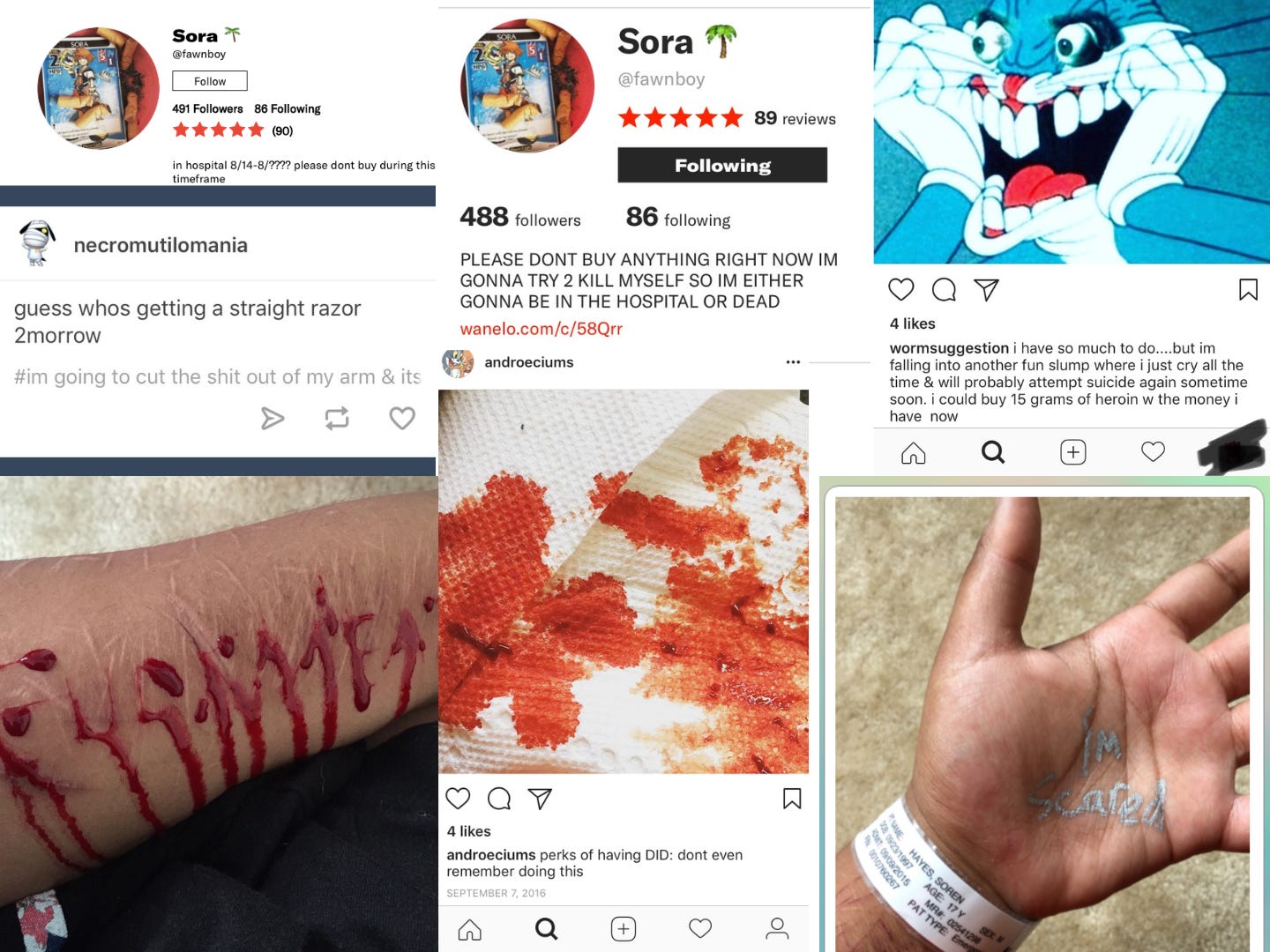
In 2015, a user posting under the name Soren Hayes (Tumblr: fawnsyndrome, shyfawn, sicklefawn, hurtc0re, faggotuglyhfukcingdickballs, umbillicalnoose, necrochotic, necromutilomania, oathful; MCR Forum: Dark Link The Assassin; Instagram: androeciums, sacrificalis, oathful, soratoys) published the first version of a document they referred to as their “Trauma Narrative” on their blog. It claimed to be a first-person account of nearly three years spent as a child sex trafficking victim in a Seattle warehouse operation. It was written with genuine literary skill. It was also, in every material sense, a fabrication.

A full compilation of Soren’s Trauma Narrative is available to download here: https://files.catbox.moe/2x4fo2.zip — the zip file contains two formats of the complete document (Standard and eBook-formatted PDF), including all three versions of the narrative and a master edition combining them into a single running text.

The person at the center of the narrative (a girl Soren called Sam) knew the truth better than anyone. In 2016, when contacted by an anonymous user from Lolcow.farm, asking about the posts and trauma narrative, she replied:

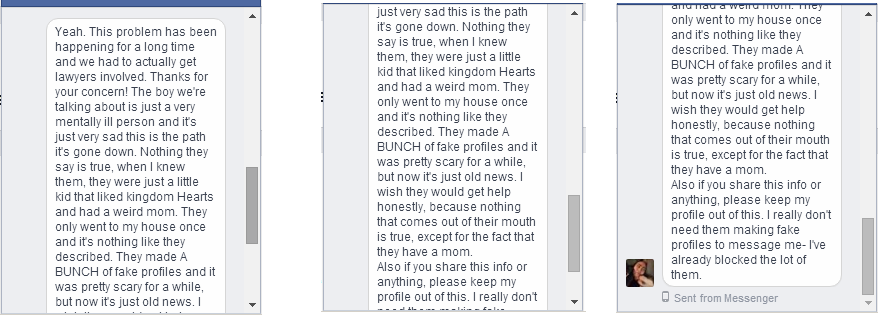
“The boy we’re talking about is just a very mentally ill person and it’s just very sad this is the path it’s gone down. Nothing they say is true. When I knew them, they were just a little kid that liked Kingdom Hearts and had a weird mom. They only went to my house once and it’s nothing like they described. They made A BUNCH of fake profiles, and it was pretty scary for a while, but now it’s just old news. I wish they would get help honestly, because nothing that comes out of their mouth is true, except for the fact that they have a mom.”

— Samantha Stowell, March 2016

The Tumblr Trauma Ecosystem

Tumblr was not a social network in the way Facebook or Instagram were social networks. Tumblr was both a blogging platform than a subculture aggregator - a place where aesthetics and identities centralized around shared interests rather than personal networks. Sitting somewhere between the confessional rawness of early 2000s Myspace and the curated self-presentation of modern Instagram, it occupied a strange middle ground: personal enough to feel intimate, and yet public enough to build an audience. Teenagers and young adults found each other across geography through shared darkness, and what they built together was a visual language as specific and recognizable as any subculture with pale skin and flower crowns, thrift store dresses and self-harm scars, soft focus photography and song lyrics about drugs.

To understand why it worked, you have to understand why some of us found this type of content beautiful - it was beautiful the way anything built around real feelings tends to be, even when those feelings are painful. I’ll admit I’m not a disinterested observer. Tumblr gave me, like it gave a lot of teenagers back in the day, a digital space to build an identity through image and language. It was a place to find a self in the collision of aesthetics and feeling before I knew how to articulate either.

Entire followings were built around a particular kind of image: beautiful, clearly unwell, vulnerable. Pale skin photographed in natural light, flower crowns, worn thrift store clothing, bands like The Smiths, My Chemical Romance, and Crystal Castles, whose entire project was the elevation of suffering into something worth listening to. There were specific figures: bloggers like Ginger Bronson/Kayla Day, a poet and musician whose confessional writing about trauma, addiction, and survival attracted a devoted following and Michelle Alessandra/Shmegeh, whose photographs made extreme thinness look ethereal and otherworldly.


They were not performing, per se. Or they were performing the way anyone performs when they make art out of their own life. The line was genuinely hard to find. Either way, the platform’s reward structure didn’t discriminate. Disclosing trauma online generated followers, community, and protection. Being a victim of something sufficiently extreme made you seen and beloved in a way that ordinary suburban adolescent loneliness never could. The more extreme the suffering, the more devoted the audience.

This is the structural condition that made what happened next not just possible, but in a certain light, logical.

In 2015, a user posting under the name Soren Hayes (fawnsyndrome, shyfawn, sicklefawn, hurtc0re, faggotuglyhfukcingdickballs, umbillicalnoose, necrochotic, necromutilomania, oathful) published a document they referred to as their “Trauma Narrative” on Tumblr. It claimed to be a first-person account of nearly three years spent as a child sex trafficking victim in a Seattle warehouse operation.

Soren’s Trauma Narrative

The document Soren posted in April 2015 opened with a preamble that established its own vulnerability before launching into an account that claimed to begin when Soren was nine years old, newly moved to Seattle, and befriended a girl named Sam. What followed was extraordinary in its scope and its brutality: kidnapping, sado-masochistic child sexual abuse contained within a warehouse trafficking operation and multiple murders of children witnessed firsthand. It was written in all lowercases, which gave the piece a tone that felt rawer and more vulnerable, like something typed in a state of barely controlled distress.

Upon immediate analysis, it becomes apparent that the work is a fabrication. The narrator’s voice is too controlled in the wrong places and sardonic and darkly witty at moments where genuine trauma would produce something less theatrical. At one point, while being driven to a cabin in the woods to be killed, Soren’s internal monologue is: “this is so fucking cliche. I thought of Danny’s horror movies again.” This is a literary voice performing world-weary detachment. It reads like a fictional character who has been written to seem hard, not like a child in danger.

Some scenes are almost comically absurd in their gratuitousness. At one point, Sam’s father bursts into the room while the two children are playing Kingdom Hearts on a PC emulator and beats the shit out of Sam without warning or explanation. Soren takes care to note that the Destiny Islands theme was playing softly in the background as the beating occurred. For those unfamiliar with the Destiny Islands theme, I have included it below (in the spirit of full journalistic transparency).

Plenty of other scenes read more like adolescent fantasy than anything resembling the actual experience of a trafficking victim. A client who boils rats alive one by one before getting to the actual abuse, atmosphere-building that belongs in a corny horror movie, not a trafficking narrative. The spider scene, in which spiders are inserted into the children’s orifices and then eaten, followed immediately by the remark that Soren couldn’t eat spaghetti for years afterward. Sam, locked in a room mid-psychotic episode covered in blood, being calmed down by Soren humming the Winnie the Pooh theme song. And perhaps most memorably, Sam spending the night locked in a closet with a dismembered corpse, having a full animated conversation with the severed head, then greeting the men who open the door the next morning by asking if she could have some orange juice.

The horror in Soren’s trauma narrative escalates with a fictional logic, each section trying to outdo the last, piling on detail with the compulsive energy of a high school fan fiction author. The details are specific in all the wrong places- gratuitously precise about torture devices and punishments, while being vague about anything that could be independently verified. The “best gang rape victim” line, delivered as sardonic self-assessment from Soren’s protagonist/self-insert, is perhaps the most telling moment in the entire document. No survivor frames their own victimization this way in genuine recall. It is the kind of dark gallows humor that gets written about trauma survivors in fiction. Then there is the spider detail: spiders inserted into the children’s bodies, forced consumption. Gratuitous to the point of absurdity, and very specifically the kind of shock content that circulated in dark corners of the internet, Soren demonstrably frequented.

Threaded through the entire narrative, functioning as its emotional skeleton, is Kingdom Hearts. The protagonist identifies as Sora, the game’s main character. The love interest is Sam, written as somewhere between Kairi’s tenderness and Riku’s darkness. When Soren comforts the injured Sam on a bathroom floor, he tells her they are on a boat to Destiny Islands, that they will get married under the paopu tree, and rocks her back and forth to “make it feel real”. It reads exactly like a teenage fan fiction writer’s idea of a tragic romantic scene, not a memory.

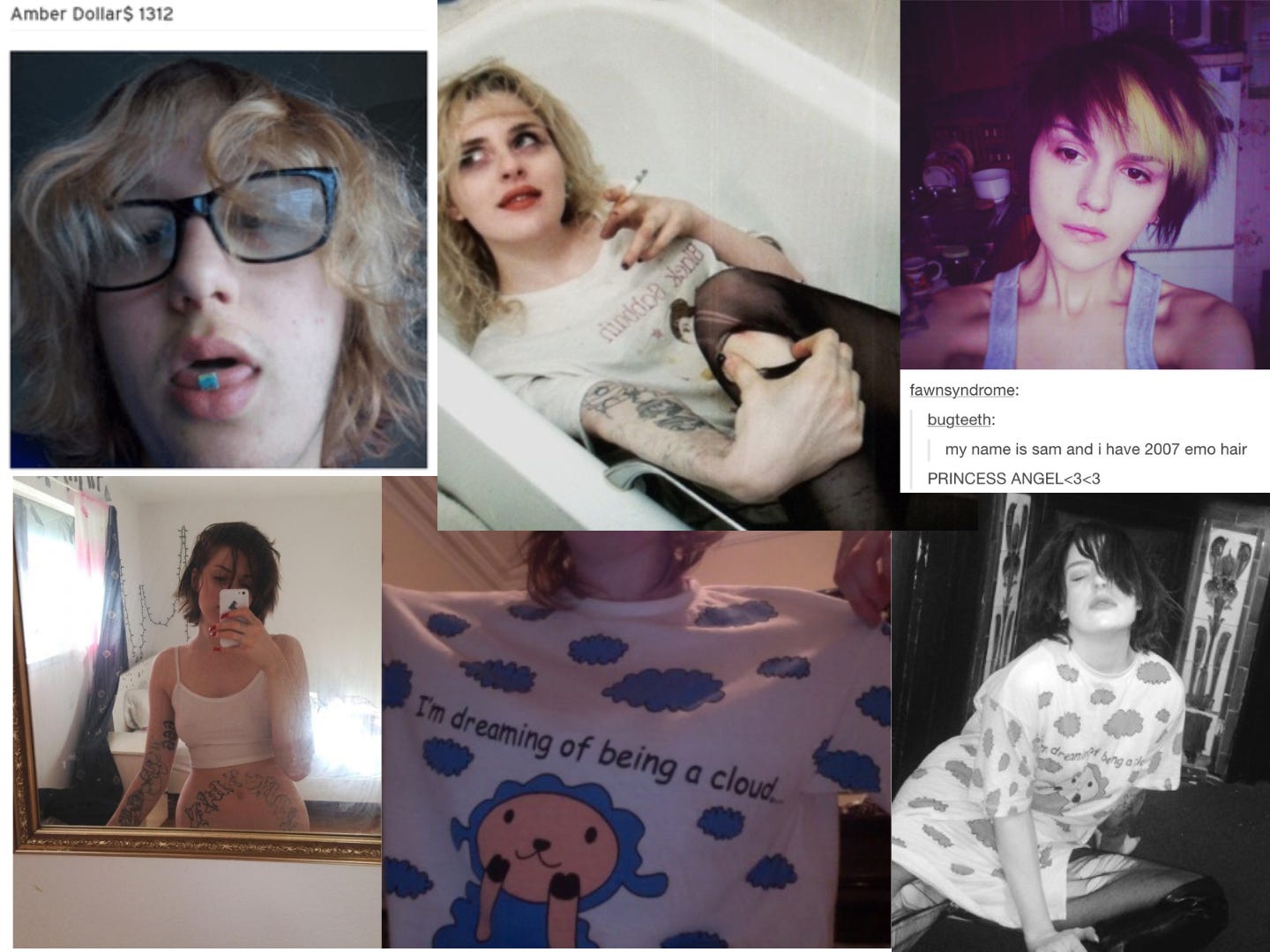
Sam herself is the clearest tell of all. Though Sam is based on a real person Soren encountered, she is not a person in this narrative but a literary archetype — and a fairly predictable one for that specific era of Tumblr culture. The vulnerable wolf girl; brutalized, and so she became brutal herself. Three-dollar thrift store dresses and leather jackets. A white t-shirt that said “i’m dreaming of being a cloud.” She had her head in the stars. She was only afraid of herself. She felt at home in gas stations and hospitals. She looked out for other girls and would turn a wild party into a quiet group of drunk girls sitting on the kitchen floor, braiding each other’s hair, telling secrets. Readers of a certain corner of Tumblr will recognize this character immediately, because she already existed there, under the name Ginger Bronson.

Ginger Bronson was the stage name of Kayla Day, a poet, musician, and blogger who was one of the more recognizable figures in Tumblr’s dark underground circa 2012-2016. Her writing was raw, confessional, and genuinely beautiful in its own right — a stream of consciousness dispatches about trauma, addiction, poverty, and survival. Her visual identity was specific and instantly recognizable: tattoos, many of which had been given to her against her will by an abuser, photographs of herself that made devastation look beautiful. She did runway modeling, including work connected to Yves Saint Laurent. She was, in the language of that world, extremely real.

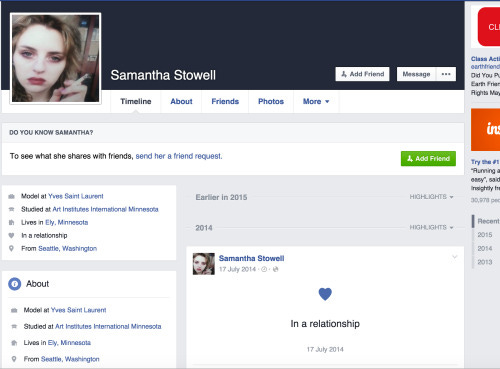
Sam’s fake Facebook page, created and maintained by Soren, used Bronson’s photograph as its profile picture and claimed Sam had modeled for Yves Saint Laurent — exactly what Bronson had actually done. This is not aesthetic inspiration. This is identity theft in service of a narrative, the appropriation of a real person’s real trauma to lend credibility to a fiction.


The deeper connection is harder to prove but impossible to ignore. Sam’s entire personality maps almost perfectly onto how Bronson presented during her most active period — the dreamy dissociation, the protective maternal instinct, the eating disorder, the drug addiction, the tattoos given by an abuser, the quality of being simultaneously feral and tender. Soren didn’t just borrow Bronson’s image. He borrowed her entire identity and gave it to a character.

What Soren constructed was a character study, complete with a protagonist, a love interest, a supporting cast, and a carefully maintained aesthetic, borrowing its emotional architecture from Kingdom Hearts, its central character from Ginger Bronson, and its authority from the Tumblr ecosystem that had taught its author exactly what a “trauma narrative” was supposed to look and feel like.

A full compilation of Soren’s Trauma Narrative is available to download here: https://files.catbox.moe/2x4fo2.zip — the zip file contains two formats of the complete document (Standard and eBook-formatted PDF), including all three versions of the narrative and a master edition combining them into a single running text.
Revisions to the Trauma Narrative

Soren didn’t write one version of this story. He wrote three.

The first, posted in April 2015, established the baseline: the Seattle warehouse, the Kingdom Hearts mythology, Sam as a Ginger Bronson surrogate, and the cinematic pacing. The first version included a keyboard smash buried in the post tags: “Gos. Fucking ycj fucj fuck fuck did d cjdjsnf.” A simulation of a writer so overwhelmed by their own material they lose motor control, a technique, borrowed from the same Tumblr aesthetic vocabulary that produced everything else in the document.

Six months later, in October 2015, a second version appeared. The pain room, previously described as stocked with BDSM gear, was reframed as a Tor-based livestreaming operation, grafting real dark web trafficking discourse that had been circulating in the media onto the narrative. Most significantly, a new character appeared: Mousy, who exists in the narrative solely to be dismembered in extreme detail before having a conversation with Sam post-mortem. And Kayla’s death changed entirely. In V1 she is shot accidentally by a nervous client. In V2 she dies during a livestreamed torture sequence.

Three years have passed. In October 2018, a third version appeared under the Instagram handle “Oathful”. Gone was the Seattle Montessori school, the sleepover, Sam’s father appearing over the bed. In its place: India. An orphanage. Abuse beginning in preschool when men entered the classroom and selected children. The operation was reframed as a multinational network connected to law enforcement, the military, and registered doctors.

Across all three versions, one element remains completely stable - Sam. The vulnerable wolf girl, the dreamy dissociation, the protective maternal instinct. Everything else in the narrative is negotiable (the origin story, the deaths, the institutional scope), but Sam is not. She is the emotional core the author cannot let go of, even as everything around her gets rewritten from scratch.
The Cast

The trauma narrative had a cast of characters, and most of them were real people. Not real in the sense that the events described were real (they weren’t) but real in the sense that behind each fictional name was an actual person whose identity, image, and in some cases whose genuine trauma, had been borrowed without consent to furnish Soren’s story. This is where the narrative stops being merely a curiosity of internet culture and becomes something with documented victims.

Sam was Samantha Stowell, a girl Soren had briefly known in high school. She really had a twin sister and her father’s initials matched the initials of the abuser in the narrative. When an anonymous user contacted Samantha in 2016 to let her know Soren was still writing about her, her response was measured, reassuring that Lawyers had already been involved and It was, she said, old news. “Nothing they say is true. When I knew them, they were just a little kid that liked Kingdom Hearts and had a weird mom. They only went to my house once and it’s nothing like they described.” Her statement is worth reading in full, because it is the clearest possible summary of what actually happened.


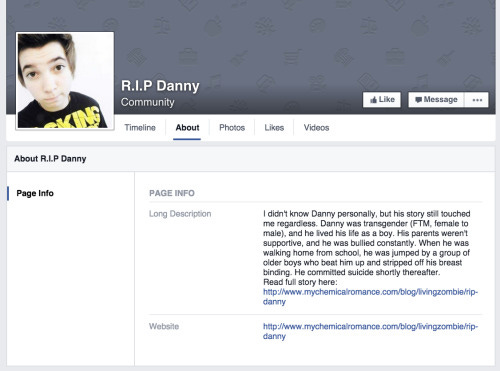
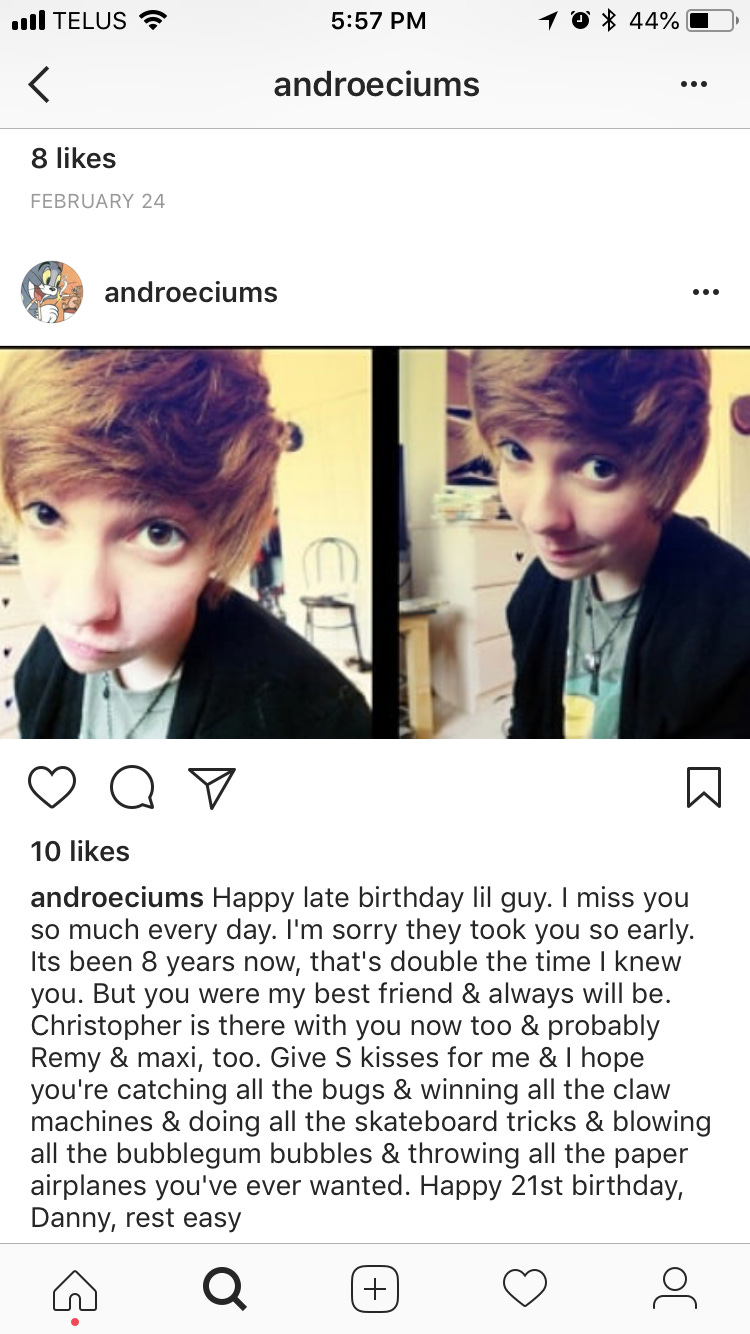
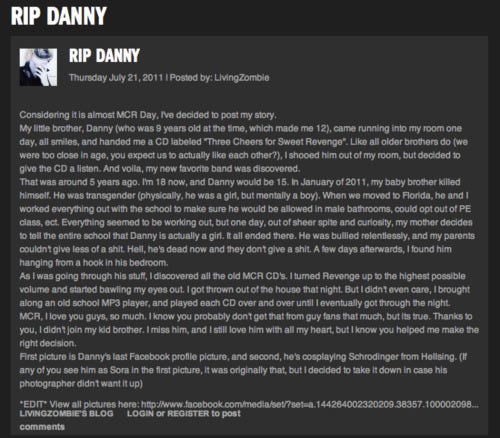
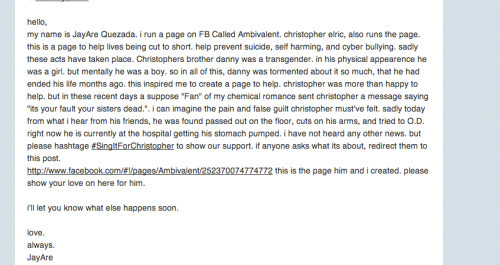
Danny was Ashton Drew, a Tumblr user whose photos Soren had been collecting since at least middle school. Soren constructed an entire fictional person around Drew’s image: a transgender boy named Danny who huffed paint thinner, loved My Chemical Romance, made flower crowns and eventually hanged himself after being outed and gang raped on his way home from school. When Soren posted Danny’s suicide in the voice of Danny’s brother Christopher, the post went viral. A Twitter campaign, #SingItForChristopher, emerged in response. Thousands of people mourned a person who had never existed, using the face of a person who was very much alive.


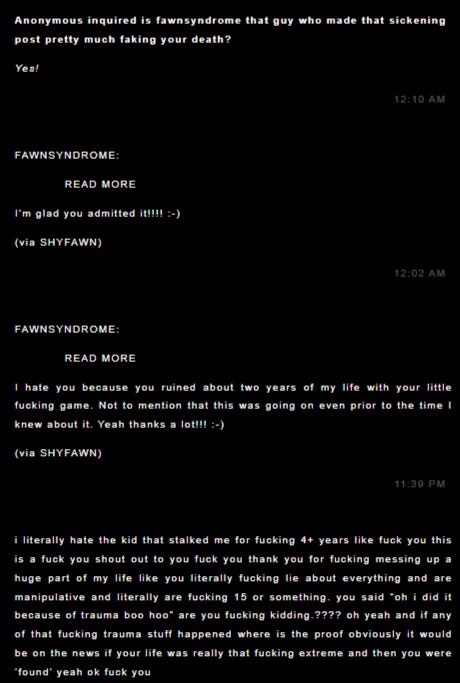
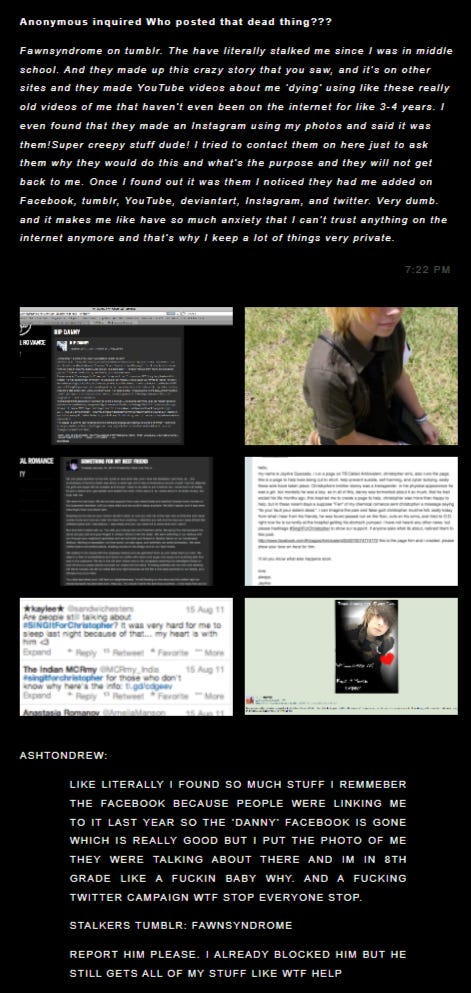
When Drew eventually found out, his response captured something essential about what Soren’s behavior actually cost real people. He had been stalked for years, and his image had been used to construct a dead person. He claims to have lost years to the anxiety of not knowing what else was out there, of not being able to trust what was on the internet about him. “I hate you,” he wrote, “because you ruined about two years of my life with your little fucking game.”

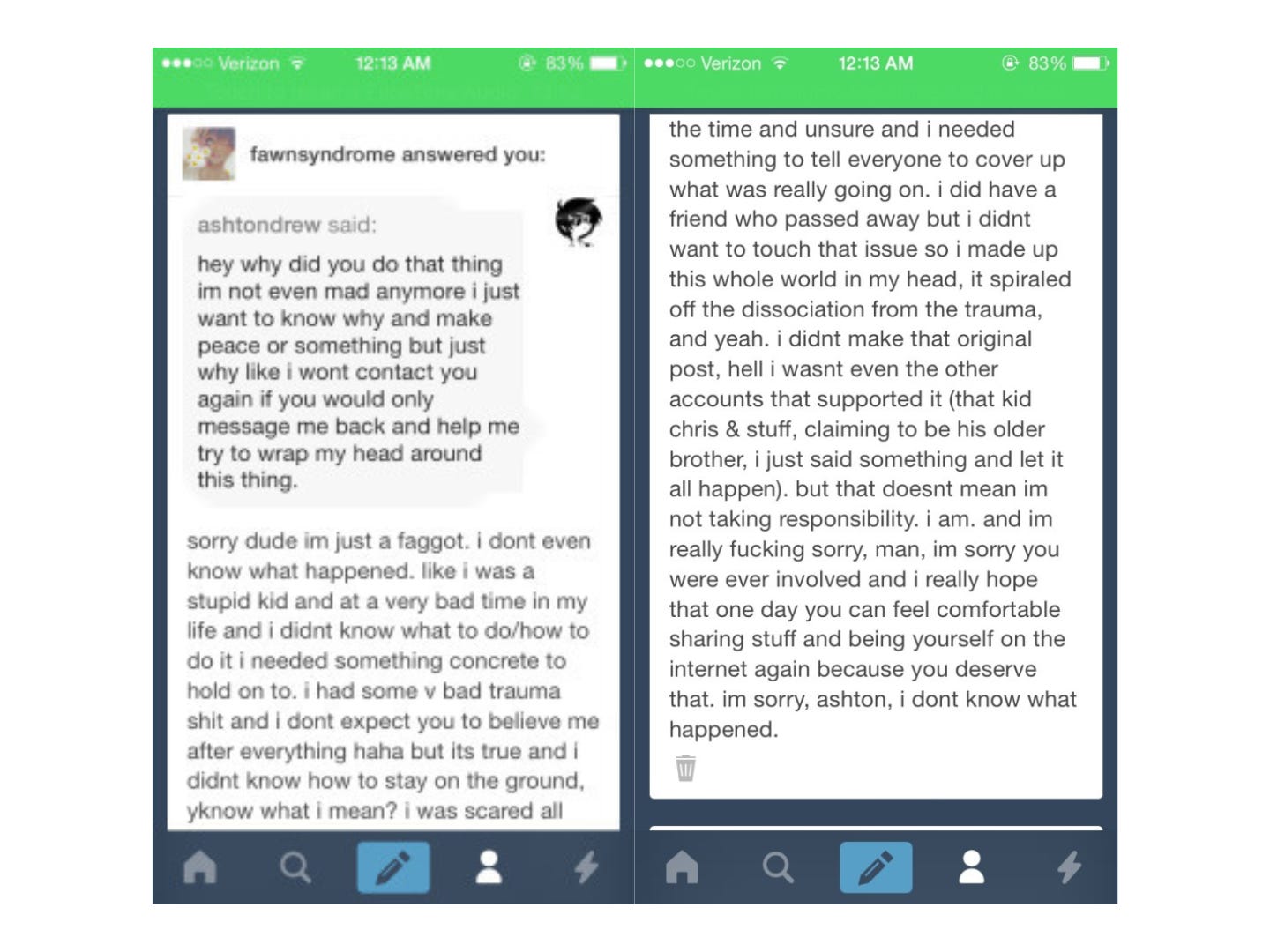
Soren admits to stalking Ashton Drew when called out directly on their FawnSyndrome blog.


Despite being called out directly by Ashton Drew for stealing his photos, Soren continued using them in reference to Danny as late as 2018 — years after Drew had gone public about the stalking.

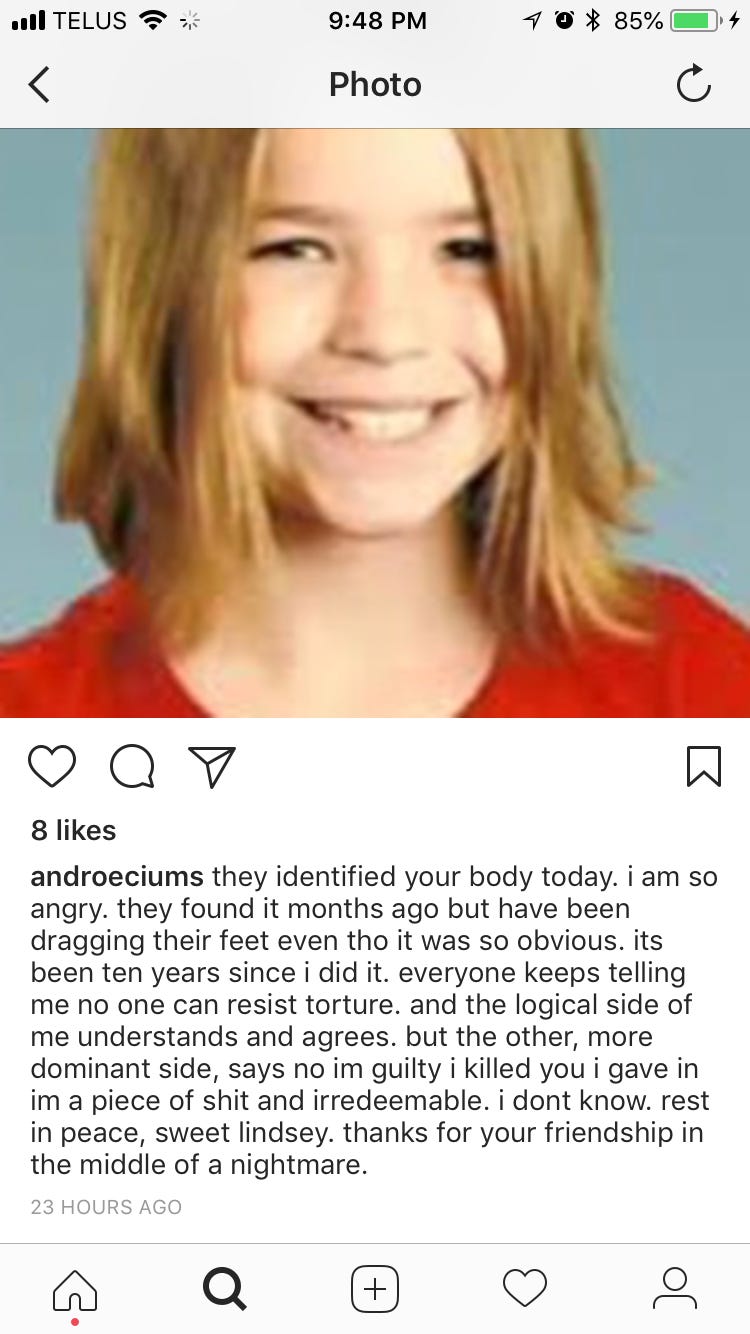
Then there was Lindsey Baum. In October 2015, Soren posted a screenshot from a missing persons database (a photograph of a real ten year old girl who had gone missing in 2009) and implied she had been part of the trafficking ring. A real missing child, whose family had spent years not knowing what happened to her, drafted into someone else’s fiction as supporting evidence. Lindsey Baum’s remains were eventually found in 2018. She had been murdered.


Who was Soren Daniel Hayes Really?

Soren did not emerge from nowhere. Tumblr’s trauma economy had its own aesthetics, its own hierarchies, and its own reward structures. It created a specific kind of hunger in its audience for suffering that was extreme enough to be interesting, beautiful enough to be bearable, and authentic enough to justify the attention it received. Soren fed that hunger with remarkable precision - Every element of the narrative was calibrated to what the platform craved: the vulnerability, the literary voice, the romanticized relationship at the center, the Kingdom Hearts mythology, and the Ginger Bronson soft grunge aesthetics.

There is a version of Soren’s story that is cynical: a calculated performance by someone who understood the platform’s reward structure and exploited it deliberately. There is another version that is more complicated: a genuinely unwell person whose delusions were fed rather than challenged by every system they encountered, from the Tumblr ecosystem that rewarded escalation to the parents and therapists who appear to have reinforced rather than questioned the narrative. The truth is probably somewhere neither version fully captures.

So, who really was Soren Daniel Hayes?

Across four lolcow threads spanning 2015 to 2021, a more mundane picture of Soren’s actual life assembled itself in the background of the narrative - visible in room photos packed with children’s toys, Depop listings for secondhand Hot Topic clothing, Instagram stories featuring drug paraphernalia, and the occasional slip of verifiable detail.


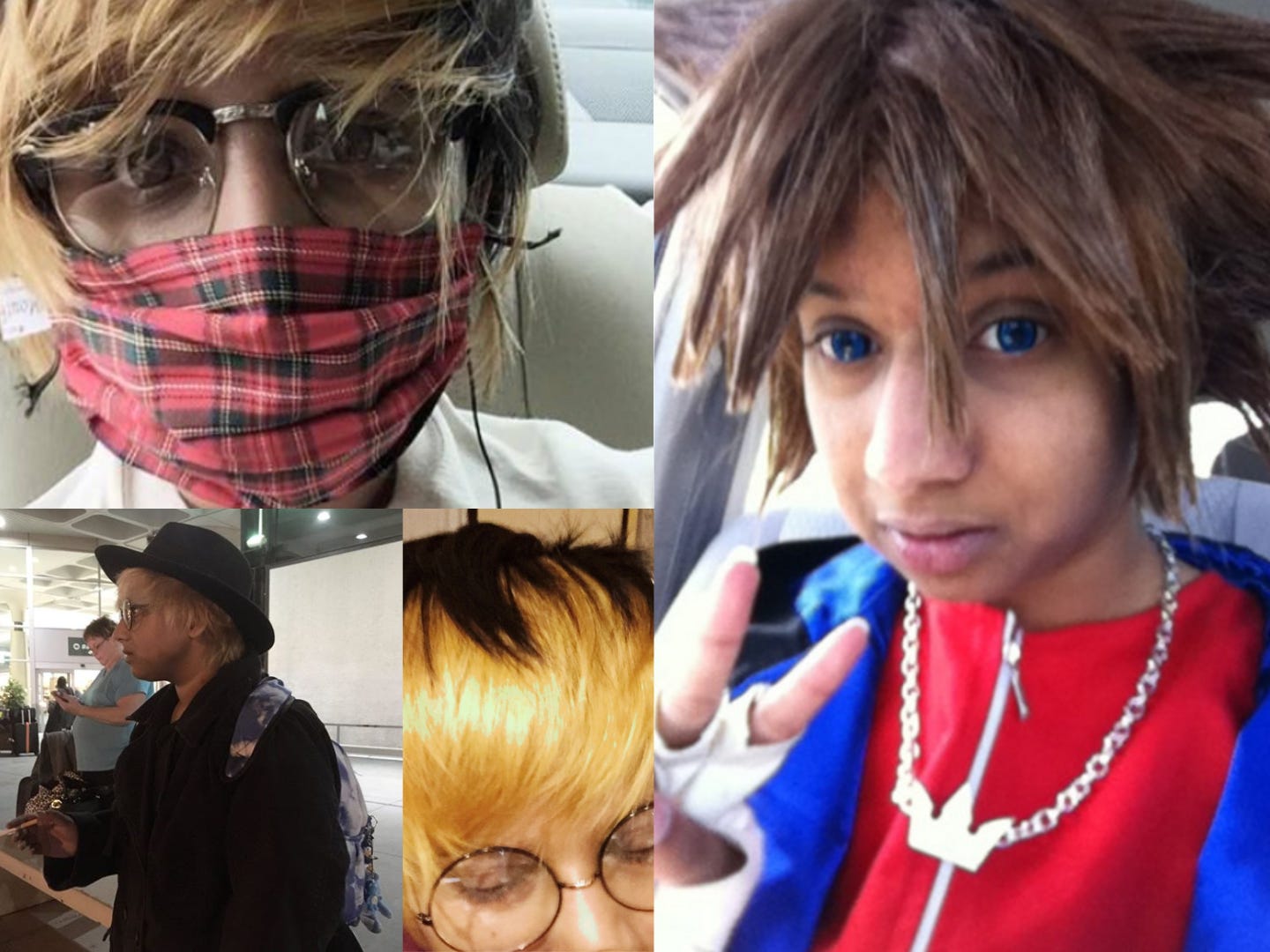
Soren Danial Hayes was a tans-identified female, born with the birth name, Priya (last name uncertain- Sweeny and then later changed to Hayes). S/he was adopted from India alongside a sister named Anjali, by older white parents living in the Seattle suburbs. Soren’s family was upper-middle class and his father worked as a scientist. Soren’s mother was a physician’s assistant, which reportedly enabled Soren’s early access to testosterone. Soren began transitioning around age thirteen with top surgery occurring in early adolescence. The family eventually settled in San Diego.


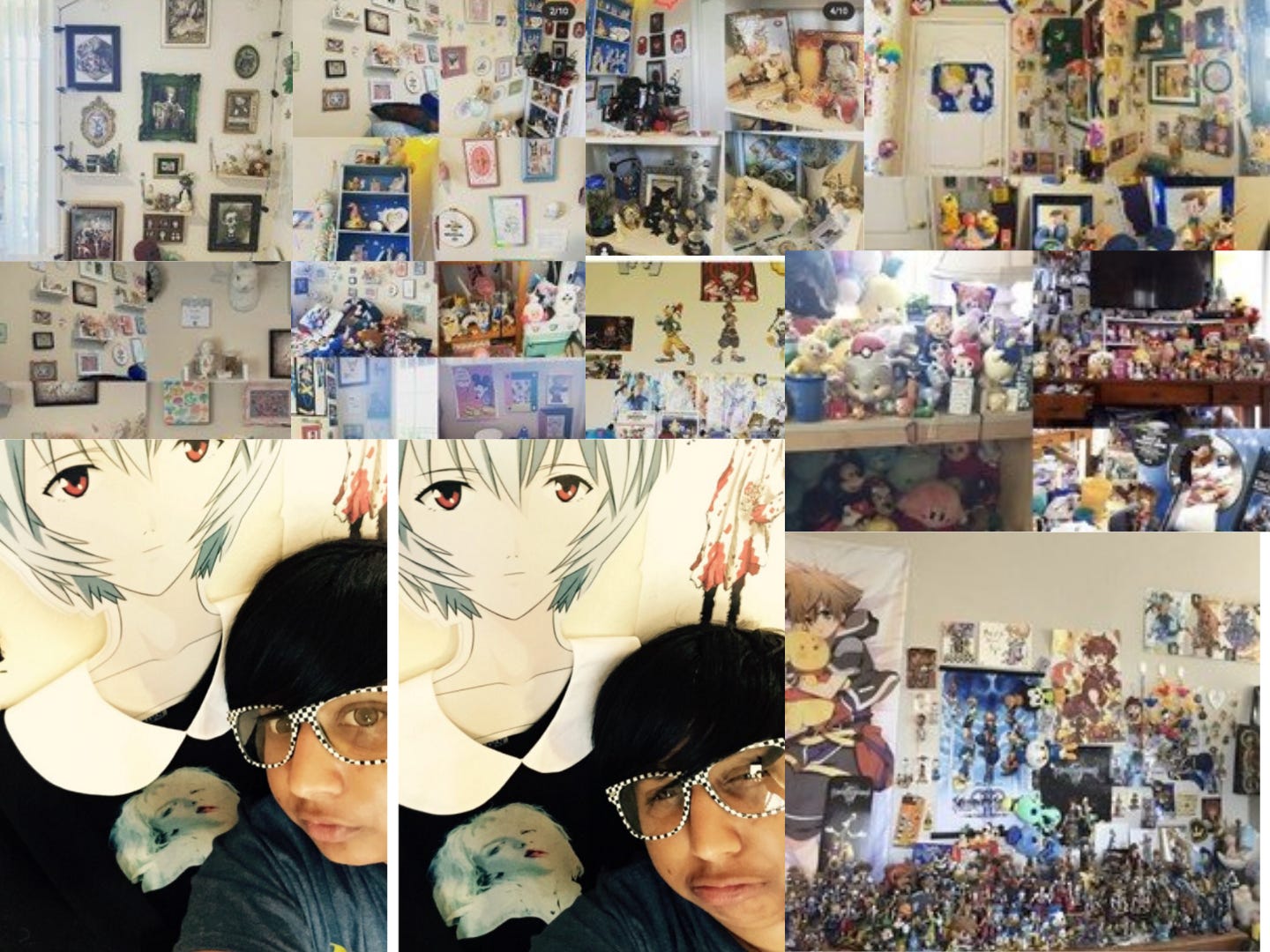
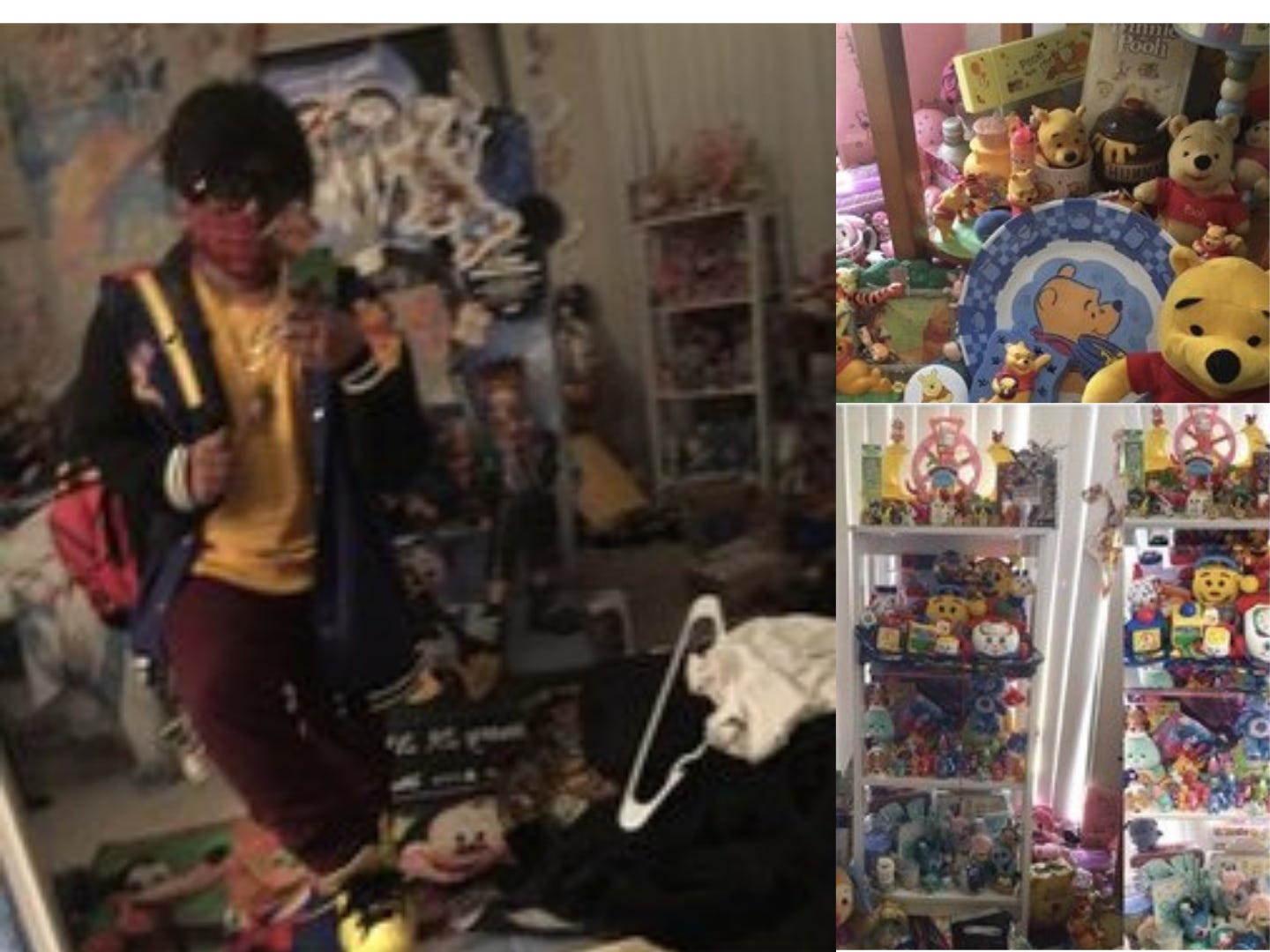
The bedroom tells its own story. Photos that surfaced over the years show a room that looks less like a living space and more like a shrine. Floor to ceiling Kingdom Hearts merchandise, plush toys, figurines, Disney collectibles, Mark Ryden prints, Pullip dolls, cosplay materials. Observers on Lolcow.farm noted the sheer volume of it, the way it consumed every available surface. One described it as looking like “a serial killer’s den.” Another noted it looked like “an edgy Pee Wee Herman.” It was the room of someone who had retreated very far inside a private world.


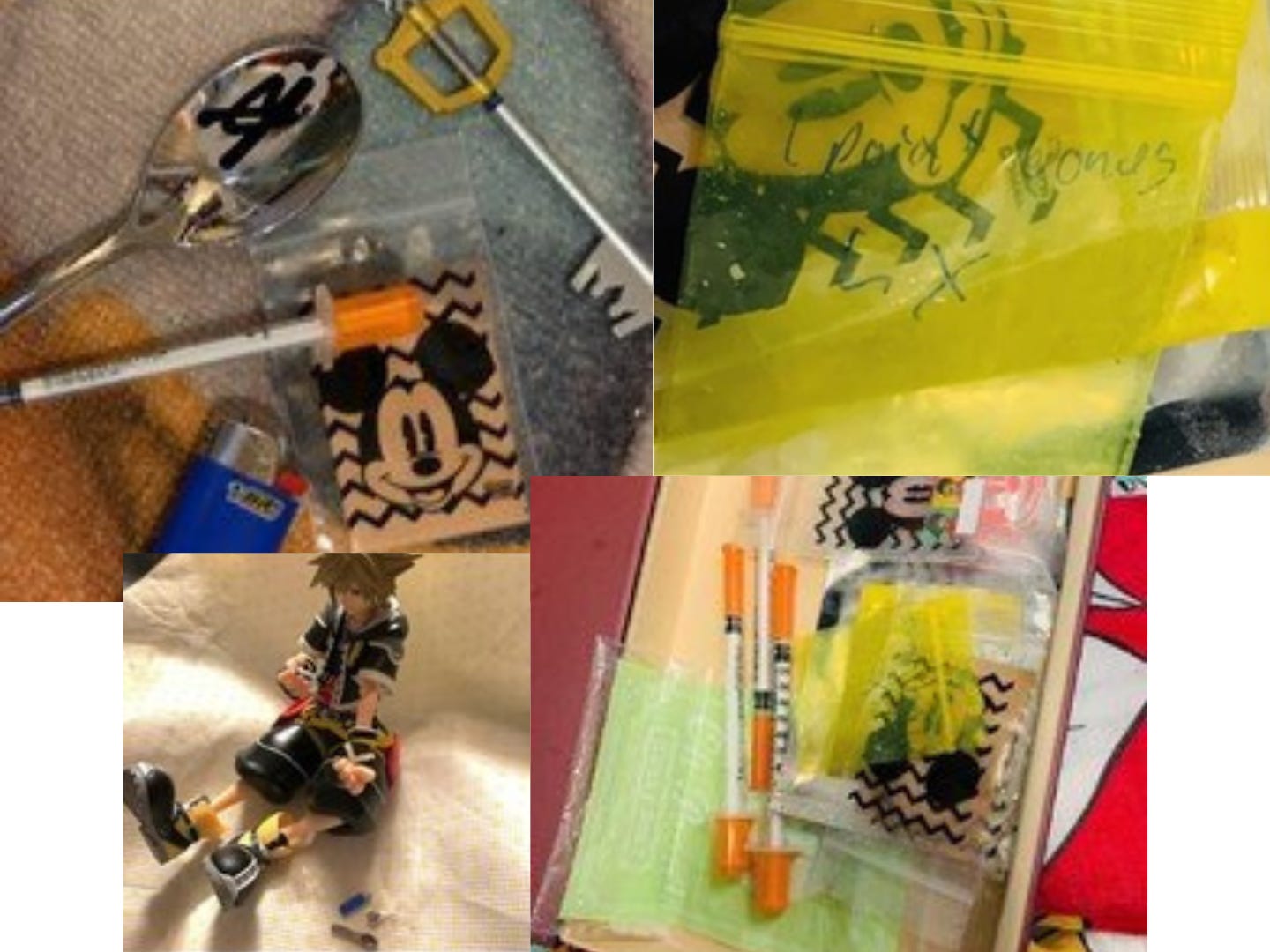
The drug use Soren claimed both in the narrative and on social media — heroin, meth, ketamine — was largely unverifiable and in several cases demonstrably staged. Photos of paraphernalia showed unused needles, clean spoons, and suspiciously fine powder in Mickey Mouse branded baggies that appeared to have been purchased online as props. The aesthetic of drug use was the point, not the drugs themselves. The ketamine treatments, by contrast, appear to have been real and medically supervised. Expensive but consistent with the family’s financial resources and the mother’s medical background but notably less glamorous than the street drug narrative Soren preferred to project.


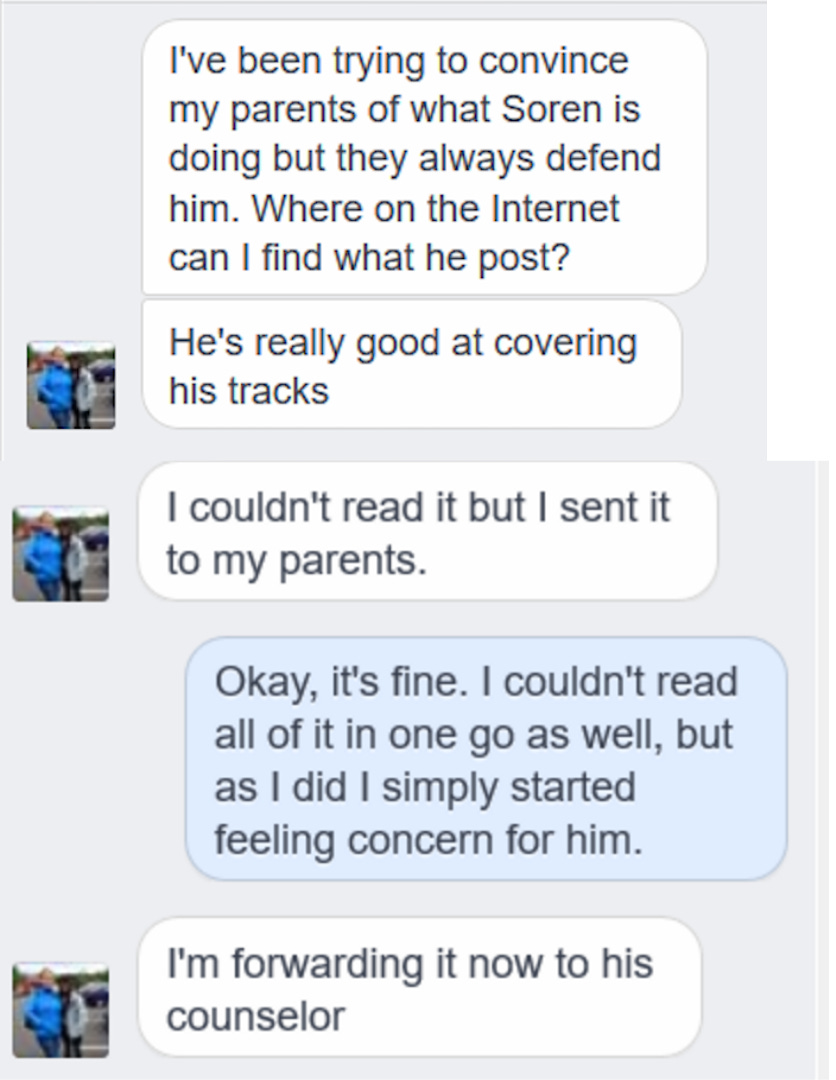
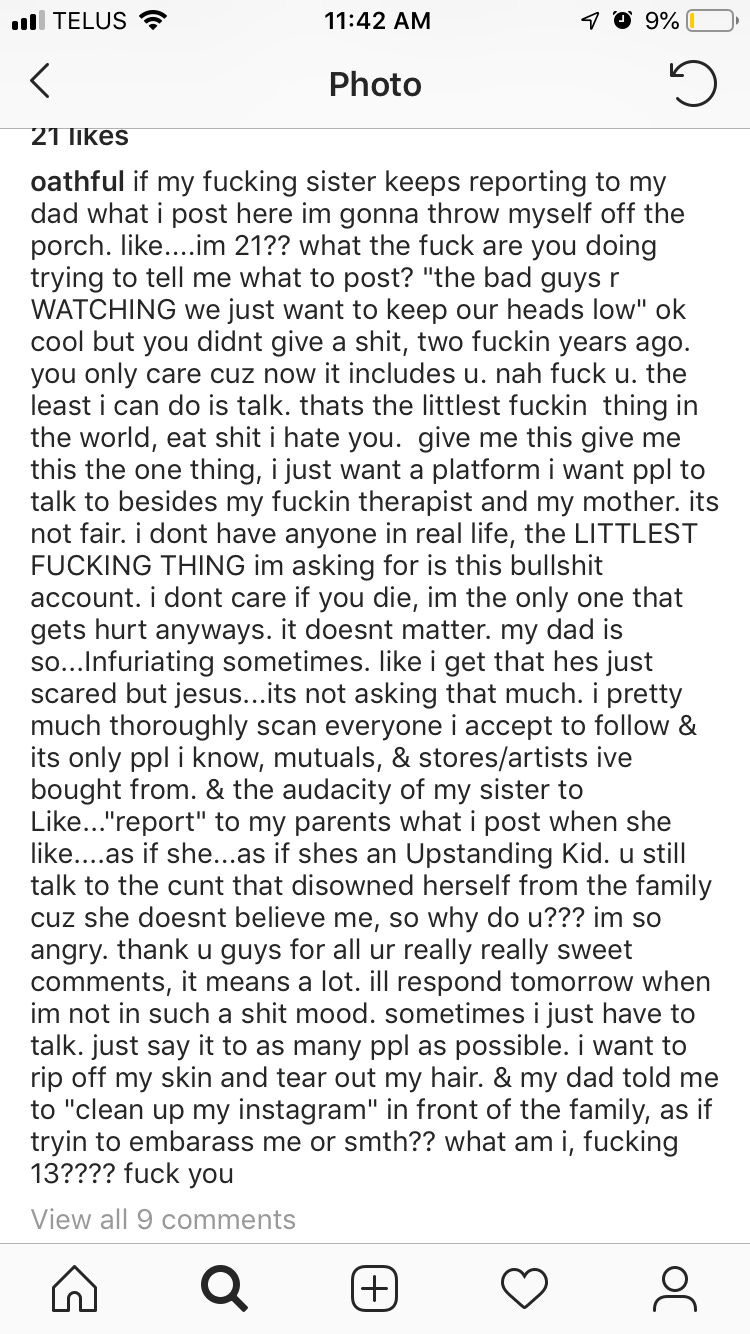
Soren’s older adoptive sister Marley was notified about the online activity on multiple occasions. Community members reached out directly, and the lolcow threads document at least one instance of her being contacted about the trauma narrative and the fake profiles. She acknowledged awareness of the situation and indicated that their parents had been informed as well. What the family actually knew, and to what degree they believed or dismissed it, remains genuinely unclear. Soren’s father reportedly reacted with anger when he discovered the Instagram activity. The mother appears to have been more accommodating, though whether she accepted the narrative at face value or simply chose not to challenge it is unknown. What is documented is that awareness of the situation reached the family repeatedly over the years, and the behavior continued regardless.


Suicide attempts were a recurring feature of Soren’s online presence for years, so frequent, and so frequently survived, that when the real thing came, many observers initially assumed it was another performance. A fake death notice posted by a “brother” in December 2015 had already established the template. The Amazon account showing activity days after the alleged death muddied the waters further.


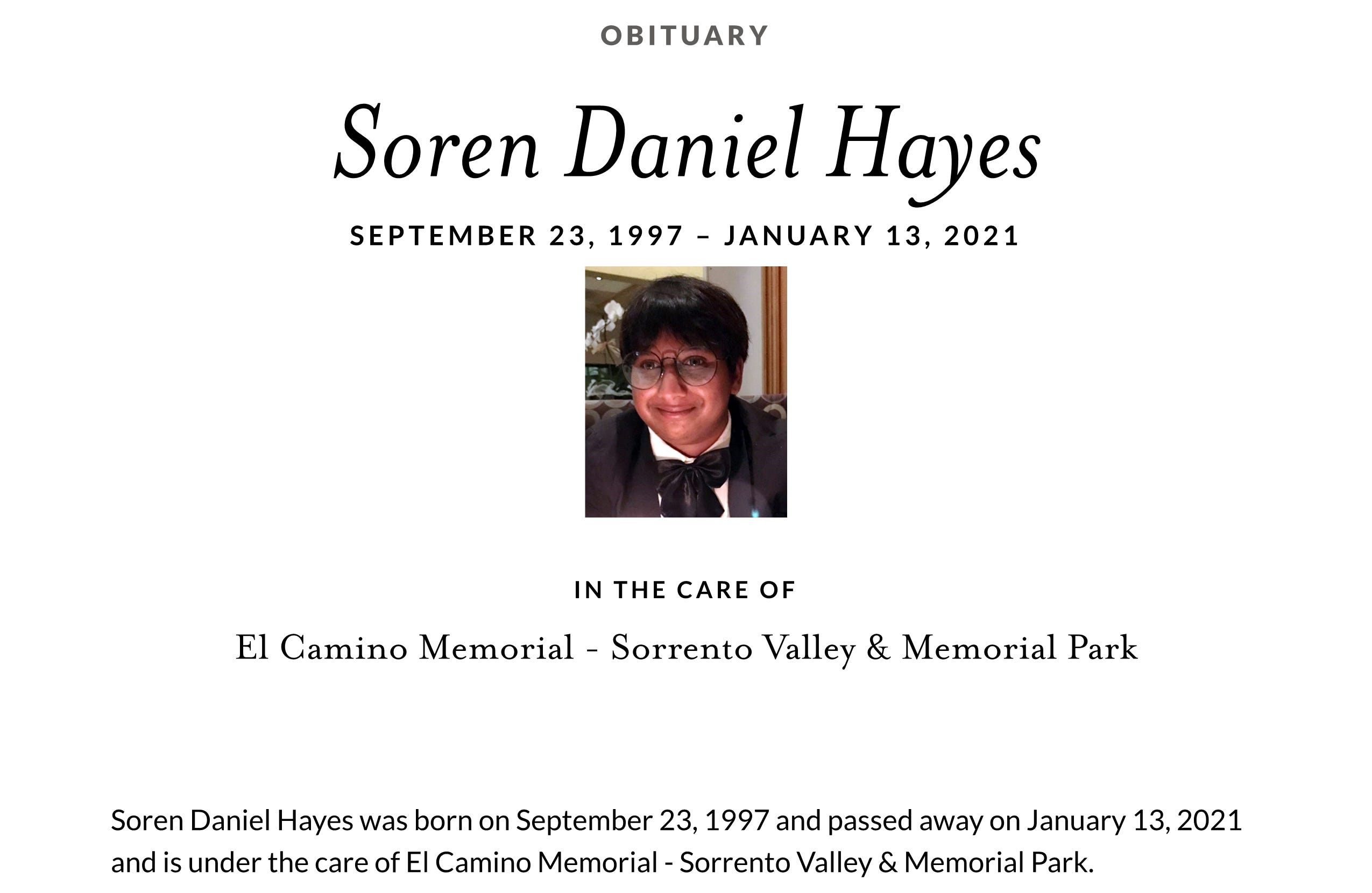
But on January 13, 2021, an obituary appeared on the Dignity Memorial funeral home website. Soren Daniel Hayes, born September 23, 1997. Died January 13, 2021. Age twenty-three. Under the care of El Camino Memorial Park, Sorrento Valley, San Diego. A sister posted a brief tribute on her private Instagram. The wording was careful and not quite warm with references to mental illness, to patience, to no longer suffering. The tone of someone who had been bracing for this for a long time.


Soren received a phalloplasty five months earlier, in August 2020. The surgery had not gone well. The graft failed, and photos posted publicly showed severe necrotic tissue. There were multiple returns to hospital, fabricated texts blaming a transphobic nurse, graphic wound documentation shared on Instagram with the same matter-of-fact exhibitionism that had characterized the trauma narrative for years. And then, eventually, silence.

It is worth noting that phalloplasty carries one of the highest post-operative suicide rates of any gender affirming procedure. The gap between what the surgery is imagined to resolve and what it actually can resolve is, for some people, insurmountable. Whether this was a factor in Soren’s death is unknown. What is known is that the person who had spent a decade writing about wanting to die eventually did.
What Soren actually experienced in childhood remains genuinely unknown. People who knew them in person described a happy-looking kid who became, somewhere in the transition to adolescence, something else entirely. There was almost certainly real pain underneath the fabrication - the compulsiveness of the behavior, the decades of investment in a single narrative, the inability to stop even when lawyers and callouts and public humiliation made stopping the obvious choice, all of this points toward something more than simple cynicism. Whether that something was untreated, psychosis, a personality disorder, genuine trauma elaborated beyond recognition, or some combination of all three, no one outside the family will ever know for certain.

Kingdom Hearts, the game that runs through the trauma narrative like a spine, is about children who lose their worlds and spend years searching for a way back to something that may no longer exist. It is about memory, and constructed realities, and the question of whether a self-built out of borrowed pieces is still a self. Soren named themselves after its protagonist. Used its mythology as the emotional architecture of a document meant to explain, or justify, or simply make bearable, whatever it was they were actually carrying. We don’t get to know what that was. The narrative, in all three versions, was too loud for the truth to be audible.

References