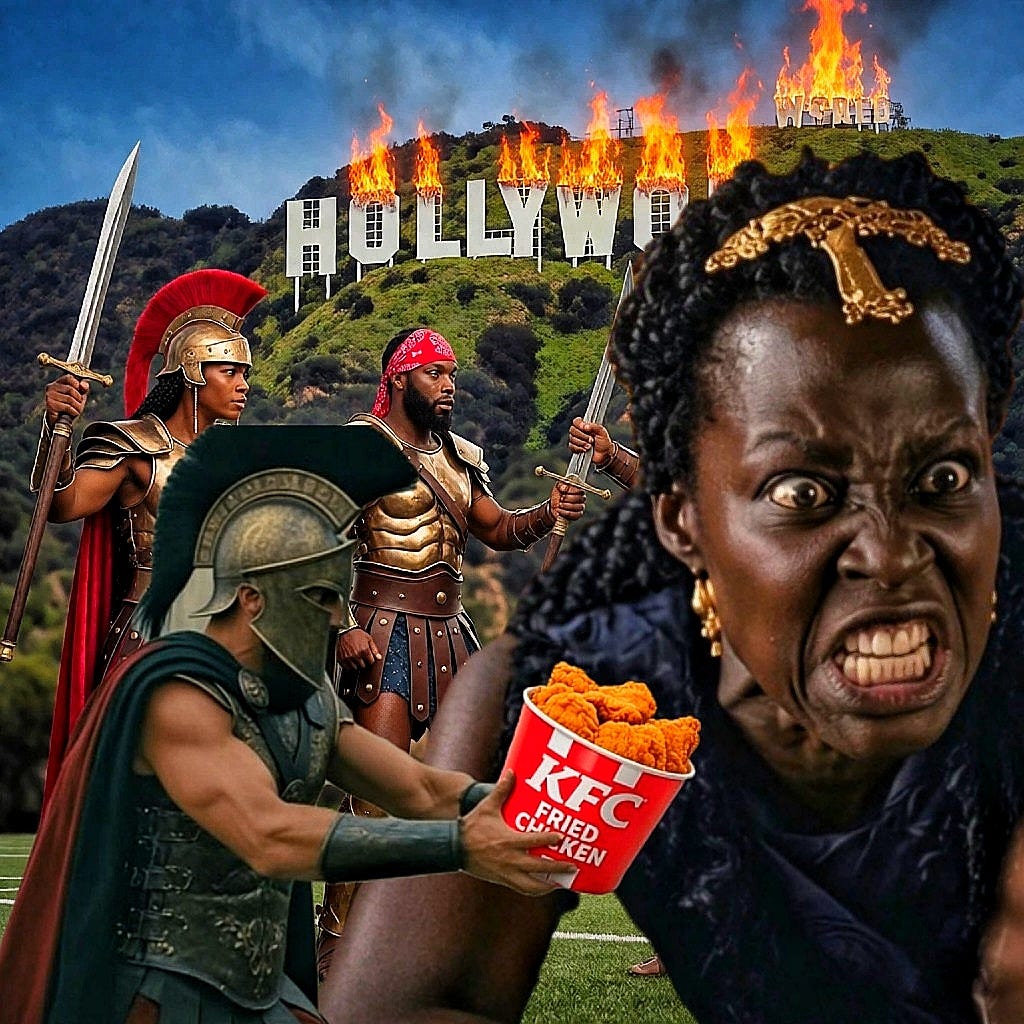
 Christopher Nolan's adaptation of the Odyssey opens with a Black actor cast as an ancient Greek poet, one of several casting choices made with the intention of both winning an Oscar and provoking the public. Nolan has said the casting was meant to draw a line between the oral tradition of Homeric poetry and modern rap, a connection that says more about how modern Hollywood talks about race than it does about the source material. This "rage baiting" marketing strategy has become transparent to anyone who has watched the steady stream of slop coming out of Hollywood since the end of the Obama presidency: take a classic Western story, cast against the material's original context, and let the resulting backlash do the marketing. Hollywood ran the same playbook with Snow White, and most infamously with the widely panned all-female Ghostbusters reboot. It is an inexpensive tactic that insults the intelligence of the audience, converting their reaction into free publicity.
Nolan’s justification for the casting is the more revealing part than the casting itself. He didn’t defend it as an acting decision; he defended it as a symbolic one, explicitly framing rap as the modern equivalent of Homeric oral tradition - an insult to the source material dressed up as a compliment. Homer’s oral tradition carried the entire cultural memory of a civilization across centuries, recited from memory, refined over generations, treated as sacred enough to eventually be written down and preserved as the foundation of Western literature. Reducing that into a rapper’s cameo isn’t elevating rap, it’s flattening three thousand years of epic poetry down to a marketing gesture. And it’s worth asking where that association even came from in the first place, because rap didn’t arrive at that symbolic status on its own. Hollywood and the music industry spent nearly two decades constructing it. Tracing how it was built, and what’s since come undone, means looking at how rap actually got positioned within American culture, and then at what shifted.
During the week of October 25, 2025, for the first time since 1990, there was no Rap or Hip-hop in the top 40 of the Billboard Hot 100. The last time that happened, the top-ranking rap song was “Just a Friend” by Biz Markie. To be fair, Billboard had adopted a new 2026 chart rule that removes songs after 26 weeks if they’ve fallen below No. 25, and the song that had been keeping rap in the top 40, Kendrick Lamar and SZA’s “Luther,” fell off under that rule. Obviously, a single technicality doesn’t prove a genre is dying but, strip the rule change away and the underlying trend is still real: hip-hop’s market share peaked at 30% in 2020 and had stagnated around 24% through 2025, with its share of the Year-End Hot 100 falling from 41% to just 16% over the same stretch. That’s a five-year slide.
Mike Benz, a former State Department official turned commentator, claimed that rap’s declining influence seemed “suspiciously synched” to the Trump administration’s disruption of USAID’s funding pipeline, the implication being that the agency had been quietly propping up rap’s commercial dominance as some sort of soft-power project, and that cutting its funding caused the genre to collapse.
Mike Benz@MikeBenzCyber

This claim doesn’t hold up when you look at the timeline: USAID’s funding freeze began in early 2025, when Musk started publicly targeting the agency and Trump signed an executive order freezing foreign aid. Rap’s market share had already fallen from 30% to 24% before any of that happened. A cause cannot postdate its effect by half a decade. If USAID money was somehow responsible for rap’s chart dominance, the genre should have been sliding in early 2025, not gradually losing ground since 2020.
What actually happened to rap has happened to other genres before, including disco and hair metal. After roughly a decade of the same commercial formula run at full volume, the audience burns out on it. Disco followed that pattern first. It dominated the charts through the mid-to-late 1970s, got replicated by every label with a studio and a drum machine until the sound became interchangeable across artists, and then collapsed almost overnight once listeners decided they’d had enough of hearing the same thing. Hair metal did the same thing a decade later, a genre that ruled MTV and the charts through the 1980s until every band sounded like a slightly different haircut on the same three power ballads. Nobody needed a government agency to kill either genre, instead both imploded by refusing to be anything other than maximally commercial for too long. Rap’s commercial run over the last decade follows the same pattern.
There’s a reason the USAID theory found an audience beyond, and it isn’t a coincidence worth dismissing outright. People sensed, correctly, that rap’s dominance over the last two decades didn’t happen entirely organically. It was built the same way disco was built, and the same way rock was torn down before it: by an industry that identified a commercially exploitable formula and sold it aggressively to the audience with the most disposable income to buy it.
Rock was the genre rap replaced at the top of the charts, and that handoff is worth noting because nobody reached for a conspiracy theory to explain it at the time. Rap and hip-hop’s mainstream breakthrough came in 1991, and by then rock had already been losing ground for years, faltering not because of any outside sabotage but because it had gone stale, standardized, and visually uninteresting next to the decadent, ghettolicious spectacle MTV was peddling instead. Rock died of the same ailment killing rap now: a formula run past the point of freshness, until the audience that made it dominant went looking for something else.
Talib Kweli described this directly, in a 2013 NPR interview: "the stuff that's being promoted and marketed and the corporations are spending major money on is the decadent stuff, which is mostly about drug use and sex. And that's why people get a skewed perception of hip-hop." Labels put their promotional weight behind the same handful of themes, drugs, sex, and excess, because that content was cheap to produce and reliably sold, while artists working outside that framework received less money and influence. Marketing spend doesn't just sell individual records. Over time, it shapes what people believe the genre actually is. An artist pushed onto every playlist and every award show starts to look like the definition of the genre, while everyone working outside that formula starts to look corny at best, or a relic of the past at worst.
Drugs, sex, and excess don’t require range, and they don’t require an artist to grow, which made that lane infinitely easier to staff, promote, and replace than anything built on substance. “Lifestyle,” by Rich Gang, Young Thug, and Rich Homie Quan, is a good early example of the template: a hook built on nothing but slurred ad-libs and a vague brag about having “made it,” mumbled over a beat.
This claim doesn’t hold up when you look at the timeline: USAID’s funding freeze began in early 2025, when Musk started publicly targeting the agency and Trump signed an executive order freezing foreign aid. Rap’s market share had already fallen from 30% to 24% before any of that happened. A cause cannot postdate its effect by half a decade. If USAID money was somehow responsible for rap’s chart dominance, the genre should have been sliding in early 2025, not gradually losing ground since 2020.
What actually happened to rap has happened to other genres before, including disco and hair metal. After roughly a decade of the same commercial formula run at full volume, the audience burns out on it. Disco followed that pattern first. It dominated the charts through the mid-to-late 1970s, got replicated by every label with a studio and a drum machine until the sound became interchangeable across artists, and then collapsed almost overnight once listeners decided they’d had enough of hearing the same thing. Hair metal did the same thing a decade later, a genre that ruled MTV and the charts through the 1980s until every band sounded like a slightly different haircut on the same three power ballads. Nobody needed a government agency to kill either genre, instead both imploded by refusing to be anything other than maximally commercial for too long. Rap’s commercial run over the last decade follows the same pattern.
There’s a reason the USAID theory found an audience beyond, and it isn’t a coincidence worth dismissing outright. People sensed, correctly, that rap’s dominance over the last two decades didn’t happen entirely organically. It was built the same way disco was built, and the same way rock was torn down before it: by an industry that identified a commercially exploitable formula and sold it aggressively to the audience with the most disposable income to buy it.
Rock was the genre rap replaced at the top of the charts, and that handoff is worth noting because nobody reached for a conspiracy theory to explain it at the time. Rap and hip-hop’s mainstream breakthrough came in 1991, and by then rock had already been losing ground for years, faltering not because of any outside sabotage but because it had gone stale, standardized, and visually uninteresting next to the decadent, ghettolicious spectacle MTV was peddling instead. Rock died of the same ailment killing rap now: a formula run past the point of freshness, until the audience that made it dominant went looking for something else.
Talib Kweli described this directly, in a 2013 NPR interview: "the stuff that's being promoted and marketed and the corporations are spending major money on is the decadent stuff, which is mostly about drug use and sex. And that's why people get a skewed perception of hip-hop." Labels put their promotional weight behind the same handful of themes, drugs, sex, and excess, because that content was cheap to produce and reliably sold, while artists working outside that framework received less money and influence. Marketing spend doesn't just sell individual records. Over time, it shapes what people believe the genre actually is. An artist pushed onto every playlist and every award show starts to look like the definition of the genre, while everyone working outside that formula starts to look corny at best, or a relic of the past at worst.
Drugs, sex, and excess don’t require range, and they don’t require an artist to grow, which made that lane infinitely easier to staff, promote, and replace than anything built on substance. “Lifestyle,” by Rich Gang, Young Thug, and Rich Homie Quan, is a good early example of the template: a hook built on nothing but slurred ad-libs and a vague brag about having “made it,” mumbled over a beat.
The sound is so grotesquely hood that it almost plays as a parody of the genre, and yet it went platinum anyway. “Mask Off,” by Future, and “Body,” by Megan Thee Stallion, both massive hits, follow the same pattern years apart - drugs, sex, money, repeat.
The formula worked, which is precisely why the industry kept running it instead of developing anything else. Even the criminal narrative that used to give rap some edge and stakes, like Snoop Dogg and Tupac Shakur back in the early days, has mostly fallen away. What’s left in a lot of the biggest rap songs of the last decade isn’t the epic tradition Nolan gestured at, a story of struggle, survival, or hard-won return. It’s a loop of drugs, parties, and sex, repeated with just enough musical variation to pass as a new single. There’s no journey in it, no stakes, nothing resembling the arc that made oral tradition worth preserving for three thousand years in the first place. Just the same handful of indulgences on repeat. This is where Nolan's comparison of rap to Homeric epics falls apart.
What's left of rap in its most commercially dominant form isn't epic tales of triumph and woe, but an infinite loop of drugs, parties, and sex with none of the struggle, stakes, or arc that made oral tradition worth preserving for three thousand years. A formula that thin doesn’t sustain a decade of dominance forever, and the audience it was built for eventually noticed. That exhaustion isn’t just visible in rap’s own numbers, it’s visible in the genres rushing into the void rap left behind.
Start with the direct chart replacement - Country climbed from a marginal presence to the genre now filling the space rap vacated. Just a few years earlier, country hovered around 4% of Hot 100 top 10 hits from 2021 to early 2022. By the first half of 2025, it accounted for 29% of all top 10 hits, surpassing both hip-hop and pop. Country’s share of the full Hot 100 rose to around 28% in 2025 and 32% in 2024, the same years rap’s share fell from 24% down to 16%. That’s a direct swap at the top of the chart.
A study connecting country listenership to party identification found the association has grown statistically stronger over the past two years, with data showing most listeners of top country artists lean Republican. Reporting on the broader shift went further, describing it as a “political vibe shift” in American pop music since Trump took office, standing in stark contrast to rap and pop’s alignment with Democrats during 2024’s “Brat Summer.” Cardi B, along with Taylor Swift, Beyoncé, Sexyy Red, Bad Bunny, Usher, and GloRilla, publicly endorsed Kamala Harris’s campaign (after receiving generous pay checks from the Democratic party, compliments of the taxpayer).
The lifestyle data points the same direction, independent of politics entirely. By 2026, industry trackers describe moderation as having hardened into something structural, with fewer Americans drinking and those who do drink making more deliberate, selective choices. Eventbrite’s 2026 data shows sober curious gatherings up 92% and coffee-based social events up 478%, while only 54% of American adults report drinking at all, a near 90-year low, down eight points since 2023. Gen Z is consistently identified as the demographic leading that retreat, with researchers noting it shows up in actual behavior rather than just stated intention, the same generation the ghetto decadent-rap formula was built to sell to, now walking away from the lifestyle it was selling.
That retreat from ghetto decadence didn’t happen in isolation, and rap wasn’t the only thing running on the formula that’s now losing its audience. An industry spent two decades manufacturing and rewarding one commercial formula until it saturated the culture and the audience burned out on it, the same thing that happened to disco and to rock before it. Country taking its place isn’t a surprise, either. It’s a genre, and a broader lifestyle shift, built around the traditional values the old formula spent twenty years panning as “boring White people shit.” No agency needed to be defunded for any of this to happen. The cultural zeitgeist simply got tired of ghetto decadence, and went looking for something with more substance.
Which brings us back to were we started: a rapper cast as a Greek poet, and a director defending that choice as some sort of “sophisticated” nod to oral tradition. Nolan wasn’t wrong that rap has roots in oral storytelling, but he was wrong to treat that as equivalence. Three thousand years of Homeric tradition reduced to a rapper’s cameo, as though the two carried the same weight when the “oral tradition” he is gesturing at is a twenty-year commercial formula built, funded, and rewarded by Hollywood and the corporate machine. Rap’s decline isn’t because a government agency stopped paying for it, but because the audience it was manufactured for has spent the last few years visibly walking away from the lifestyle it was selling: less drinking, less excess, more faith, more country, less debauchery. The audience that spent twenty years being sold the inebriated decadence of the ghettofabulous lifestyle is starting to sober up.
References
- Rap falls out of Billboard Top 40 – https://www.cnn.com/2025/10/30/entertainment/rap-falls-out-top-40
- Rap’s chart decline proves it’s still a radical art form (The Fader) – https://www.thefader.com/2025/11/26/rap-disappearance-from-billboard-top-40-is-good
- Is Rap Dying? A Look into the Charts (The Spectrum) – https://www.dhsspectrum.com/showcase/2026/02/10/is-rap-dying-a-look-into-the-charts/
- Deconstructing the Narrative of Rap’s Supposed Decline (Hypebeast) – https://hypebeast.com/2025/11/deconstructing-narrative-rap-supposed-decline
- Rap Fatigue: Is the Genre Losing Its Grip? (Trill Mag) – https://www.trillmag.com/entertainment/music/streaming-data-shows-a-fatigue-and-rap-is-leading-it/
- Is Hip-Hop in Decline? A Statistical Analysis – Is Hip-Hop in Decline? A Statistical Analysis
- Mike Benz on rap and USAID (Headline USA) – https://headlineusa.com/benz-rap-deep-state-conspiracy/
- The Death of USAID (Wiley Public Administration and Development) – https://onlinelibrary.wiley.com/doi/10.1002/pad.70011
- Elon Musk boosted false USAID conspiracy theories (NBC News) – https://www.nbcnews.com/politics/doge/elon-musk-boosted-false-usaid-conspiracy-theories-global-aid-rcna190646
- When Did Rock & Roll Die? A Statistical Analysis –When Did Rock & Roll Die? A Statistical Analysis
- The racial politics of hybridity and neo-eclecticism in popular music (Cambridge) – https://www.cambridge.org/core/journals/popular-music/article/racial-politics-of-hybridity-and-neoeclecticism-in-contemporary-popular-music/8CD898865D05142A2E1F5B51BA806EB2
- Understanding the White, Mainstream Appeal of Hip-Hop Music (UGA thesis) – https://getd.libs.uga.edu/pdfs/blackshear_janise_m_200705_ma.pdf
- Talib Kweli on Mainstream Hip-Hop, Parenting and Honoring the Old School (NPR) – https://www.npr.org/sections/therecord/2013/04/25/178844118/talib-kweli-on-mainstream-hip-hop-parenting-and-honoring-the-old-school
- Behind the Beats: The Hidden Powers Controlling Rap Music (Medium) – https://medium.com/@lovefoods_54026/behind-the-beats-the-hidden-powers-controlling-rap-music-raps-illusion-the-corporate-10545b060612
- Rappity Raps Part 2: The Return of Backpack Rap (Medium) – https://skytaylor.medium.com/rappity-raps-backpack-rap-part-2-79d151b28cc5
- Lifestyle (Rich Gang song) – Wikipedia – https://en.wikipedia.org/wiki/Lifestyle_(Rich_Gang_song)
- Country Music’s Resurgence: Dominating the Billboard Hot 100 in 2025 – https://www.oreateai.com/blog/country-musics-resurgence-dominating-the-billboard-hot-100-in-2025/2b6fec1865dd7f4537d09643b85de3ff
- The Unfiltered Boom: Why Country is Taking Over the Charts – https://www.theriverdalereview.com/home/2026/3/23/the-unfiltered-boom-why-country-is-taking-over-the-charts
- Country’s Back: What Popular Culture Reveals About Political Ideology (Vanderbilt Political Review) – https://vanderbiltpoliticalreview.com/12920/us/countrys-back-what-popular-culture-reveals-about-political-ideology/
- Christian, ‘tradpop’ music making a comeback (Fox News) – https://www.foxnews.com/media/christian-tradpop-music-making-a-comeback-conservative-ideals-become-more-popular-report-says
- The politics behind country music’s comeback (Tufts Daily) – https://www.tuftsdaily.com/article/2025/10/the-politics-behind-country-musics-comeback
- Alcohol Industry Trends & Strategies (Snipp) – https://www.snipp.com/blog/alcohol-industry-trends-strategies
- What Is Soft Clubbing? The 2026 Nightlife Trend Explained – https://divadance.com/blog/soft-clubbing/
- Alcohol Statistics 2025: Sober Curious Nation (Circana) – https://www.circana.com/post/sober-curious-nation-alcohol-survey
- Cardi B Shuts Down Bold Claim Questioning Her Political Endorsement (Parade) – https://parade.com/news/cardi-b-shuts-down-claim-suggesting-paid-for-2024-political-endorsement
- Cardi B’s teleprompter mishap doesn’t stop her endorsement of Harris (Express Tribune) – https://tribune.com.pk/story/2506939/cardi-bs-teleprompter-mishap-doesnt-stop-her-endorsement-of-harris-at-milwaukee-rally
- Cardi B, At Kamala Harris Rally, Warns of Donald Trump’s “Plan to Hustle You” (Deadline) – https://deadline.com/2024/11/cardi-b-trump-kamala-harris-1236165198/
- Christopher Nolan on Casting Travis Scott as a Bard in The Odyssey (Complex) – https://www.complex.com/pop-culture/a/backwoodsaltar/christopher-nolan-travis-scott-odyssey
- The Odyssey Cast Guide (Variety) – https://variety.com/lists/odyssey-cast-characters-christopher-nolan/
- The Odyssey Character Guide & How Nolan’s Casting Fits Greek Mythology (MovieWeb) – https://movieweb.com/the-odyssey-christopher-nolan-complete-cast-character-guide/