
 Being a lover of history, I found myself reading on the Chinese Cultural Revolution this past weekend. A specific episode from Guangxi, in China’s far south caught my attention, a period of time when factional violence between 1967 and 1968 escalated from mass killing into public, ritual cannibalism known as the “Flesh Banquets of Wuxuan”. People were killed and eaten as an ideological act, with the victims denounced as class enemies. Landlords, teachers, intellectuals, and anyone tagged as counter revolutionary. Consuming them worked as public proof of loyalty. This was not the survival cannibalism of earlier famines documented throughout China’s past, caused by war and political instability. By the late 1960s food supplies had recovered from the great famines triggered by Mao’s “Great Leap Forward”. The worst of it was concentrated in Wuxuan, with one of the most notable incidents being the murder of a middle school geography teacher, who was beaten to death by her own students and her organs cut out and eaten.
This is a history lesson you won’t find being taught in an American classroom, and the same goes for the genocide carried out by the Bolsheviks Lenin and Stalin. Communist atrocities occupy a strange blank space in Western historical memory. Far more attention is given to the Holocaust and the crimes of National Socialism, despite Communism having a larger body count. This is deliberate, as it is a well-known fact that much of the intelligentsia that writes the curricula sits on the left side of the aisle. As a result, Most Americans arrive at the word “Socialism” with no working knowledge of what its most committed believers did once they held power.
A politics built on the collective remaking of society tends to look humane on paper but it meets the same obstacle every time it acquires real power, which is that actual people are stubborn, self-interested, and unwilling to be optimized into someone’s blueprint. The Flesh Banquets of Wuxuan are what that collision looked like at its worst. The question is not whether today’s version ends in the same place, but what a movement convinced of its own moral necessity is willing to override when the human material refuses to cooperate.
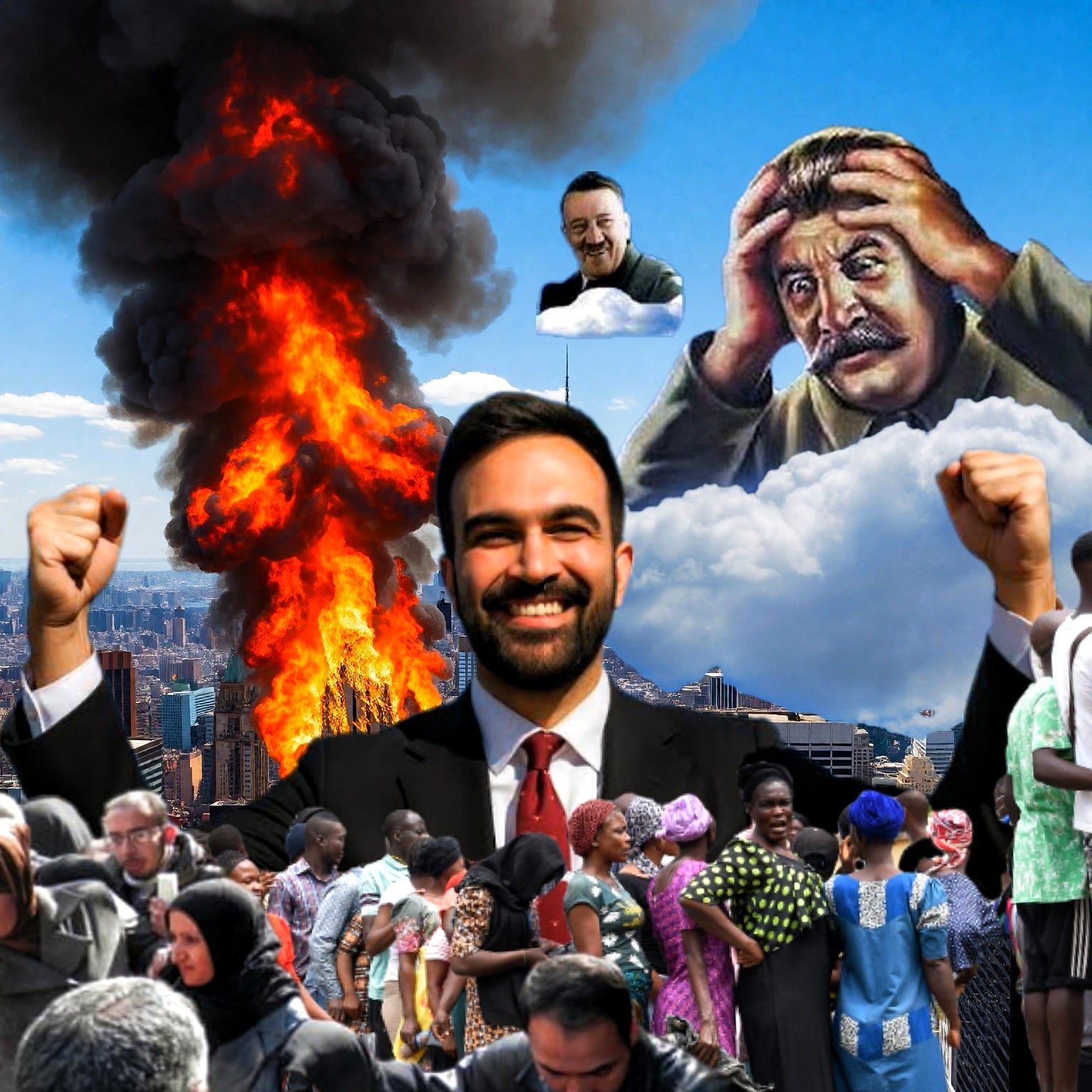
It is worth asking why a milder version of it is selling so well in the United States right now. At first, I treated the revival as a juvenile fashion statement from teenagers and young adults seduced by Soviet-era aesthetics and false promises of class equality. Unfortunately, I’m beginning to realize that my initial reading, while comforting, is mostly wrong. Subversive, Epstein-adjacent Ugandan sandflea, Zorhan Mamdani, a self-described democratic socialist and citizen of the us for 8 years, did not just win the mayoralty of the largest city in the country on nostalgia for the Soviet Union. He won on rent.
In 1975 a typical home cost the average under-40 household about 2.4 times its annual income. By 2024 that ratio had reached 3.5, because prices rose far faster than wages for most of the intervening decade. The median age of a first-time homebuyer hit forty in 2025, an all-time high, up from 29 when the figure was first tracked in 1981. A buyer now needs to earn roughly 112,000 dollars to afford the median-priced American home, about 25,000 dollars more than the median household earns.
A 2025 Cato and YouGov survey found that 62 percent of Americans under thirty held a favorable view of socialism. Gallup’s August 2025 reading put capitalism’s favorability at its lowest since the question was first asked in 2010, and among Democrats socialism now outpolls capitalism by a wide margin. The honest caveat, the one most talking heads on the right leave out because it deflates the panic, is that the same young cohort rates free enterprise at 83 percent, and none of these surveys concretely define the words they are asking about. What the numbers measure is not a worked-out program of nationalized industry, but a diffuse discontent attaching itself to the nearest available label. A person facing the housing math who votes for rent freezes, debt cancellation, and direct public provision is weighting an immediate and concrete relief against a long-run systemic cost that he has little reason to prioritize, because the long run already looks closed to him. That is a rational calculation under conditions of scarcity.
Roughly 90 percent of Americans born in 1940 went on to out-earn their parents, and for those born in the 1980s the figure has fallen to about 50 percent. A society in which advancement has gone from near-certain to a coin flip is one in which more people stay where they started, and staying at the bottom across generations is what turns a statistical category into a permanent class.
Poverty at the bottom is not only a shortage of money but also a physical environment that leaves marks on the people raised in it. Childhood lead exposure, concentrated for decades in the paint and water infrastructure of poor urban housing, has a well-established effect on the developing brain, lowering IQ and degrading impulse control. Chronic stress in early childhood is associated with measurable differences in the development of the prefrontal cortex, the region governing planning and self-regulation, and the broader research on family income and brain development points in the same direction. Early nutritional deficiency carries cognitive costs. Head injuries, more common where violence is common and adequate medical care is not, add another layer. None of this is destiny for any individual, but it describes an environment that makes escape harder and that reproduces itself, because the children raised in it inherit the conditions.
The mechanisms in play that keep the poverty class growing are easiest to observe in a setting with no politics attached. Airport security is built around the worst passenger who ever boarded a plane. Everyone removes their shoes and surrenders their water because a vanishingly small number of people have tried to do harm, and the system cannot identify them in advance. This is risk-based design, calibrated to the tail rather than the median, and against a rare and catastrophic threat it is defensible. The trouble begins when the same logic is applied to ordinary shared institutions whose disruptive minority is neither rare nor catastrophic but persistent and cannot be removed.
Every public institution faces a choice between two ways of handling its most disruptive users. It can exclude them, designing exclusively for the median and removing those who fall outside acceptable behavior, or it can design for the worst case and impose the resulting constraints on everyone. A school that expels every disruptive student invites lawsuits, truancy problems, and political blowback. A school that instead writes rules strict enough to contain its most disruptive students, and applies them to the whole student body, avoids all of that, at the price of governing the many by a standard set by the few. Liberal democratic institutions default almost everywhere to the second option, because removing people from public education, transit, or space raises legal and legitimacy problems that universal restriction does not.
Before the civil rights era, exclusion was freely available as an institutional tool; it was used extensively but the expansion of rights-based law from the 1960s onward ended categorical exclusion. It also raised the general cost of removing anyone from a public system for any reason, and institutions adapted not by getting better at distinguishing the disruptive from the orderly but by lowering standards for everyone.
What makes the pattern self-reinforcing is the dynamic the economist Albert Hirschman described in 1970 as “exit and voice”. When a shared institution degrades, the people who have alternatives leave first and their departure removes not only their stabilizing presence but their voice, the complaints and expectations that might have pulled the institution back toward the standard of the median user. What remains is a population more concentrated in exactly the behavior the restrictions were meant to manage, which lowers the baseline again, which prompts more restriction, which drives out more of the people who could still leave. Public schools lose the families who can afford private tuition or a house in a better district. Transit loses the riders who can afford cars. Public space loses everyone who has somewhere else to be. Retail offers an example closer to home - walk into any modern drugstore in an urban area, and the deodorant and razor blades sit behind locked plastic. Every customer’s experience is therefore degraded, as they wait for an employee with a key because of a disruptive minority.
Put the pieces together, and the picture is of institutions that cannot exclude, and so accommodate, and whose accommodation concentrates the very thing being accommodated. The class is not managed out, but managed around, at rising cost to everyone still inside the shared system, until the people who could leave have left. Which raises the question of who is left cheering the arrangement on from a safe distance, and why.
The voter facing the housing math is reasoning from his conditions rather than failing to understand them, and in the election that produced the country’s most prominent democratic socialist, the poorest voters did not even break his way. In the 2025 New York mayoral race, Zohran Mamdani lost the city’s lowest-income precincts to Andrew Cuomo and ran strongest in the middle and in gentrifying, college-educated neighborhoods. One analysis found that precincts with median household income above roughly 118,000 dollars backed him by 13 points while lower-income areas leaned the other way. The class picture is genuinely mixed, and it is complicated further by race, so it should not be flattened into a slogan about champagne socialists. But the pattern that survives the complications is the one that matters here. The program marketed to the working class drew its most committed energy from people a rung or two above it.
That is where the useful idiot lives, and his defining feature is not stupidity but insulation. It would be inconsistent to call the desperate voter rational for weighting immediate relief and then call the secure professional foolish for wanting the same policies, because the two are not running the same calculation. The impoverished voter has skin in the game and is betting it on relief. The Champaign socialist has none and is spending someone else’s. He supports the rent freeze from an apartment he already holds or a mortgage the policy will not touch, backs the expansion of a public system he does not personally depend on, and treats the whole program as an expression of his values rather than a wager on his own livelihood. The psychologist Rob Henderson has called this category of position a luxury belief, a conviction that confers status on the person holding it while the costs fall on people who do not.
The flagship policy is where the distance between intention and result is best documented, and it is the rent freeze. The most rigorous study of rent control in a major American city, Rebecca Diamond and colleagues’ 2019 analysis of San Francisco, found that landlords covered by the policy cut their supply of rental housing by 15 percent, converting units to condominiums, selling to owner-occupants, and redeveloping buildings to get out from under it. The lost supply pushed market rents up by about 5 percent citywide, and the new and converted housing catered to higher-income residents, so the policy accelerated the gentrification it was meant to resist. Future renters and the city’s lower-income residents paid, absorbing a large share of a multi-billion-dollar transfer, with a substantial portion of the cost falling on people who did not yet live there.
The program looks humane because on paper the landlord simply charges less and the tenant simply pays less. The human material declines to cooperate. The landlord, being a person rather than a variable, sells the building or converts it, and the supply the next tenant needs quietly vanishes. The Champaign Socialist can’t see it coming, or does not weigh it, because he is not the next tenant. His distance from the consequence is precisely what lets him hold the belief with a clear conscience. A person who has mistaken his comfort for his compassion cannot easily be dissuaded because conceding the point would cost him the flattering self-image the belief was there to supply. The desperate reach for relief and the secure reach for meaning, and the two impulses land on the same policies for opposite reasons, one side carrying the risk and the other carrying none. What that arrangement does to a society over time, once its standards are set by that convergence, is the subject of the last section.
There will be no collapse, but a slow recalibration of shared standards toward the bottom of the distribution; one institution at a time, each step locally reasonable and collectively corrosive. The pieces are already in place. Institutions that cannot exclude accommodate, accommodation concentrates the behavior it accommodates, the people with alternatives leave, and a growing class of voters with real grievances supplies steady demand for more of the same, while a secure layer of “intellectuals” (Champaign socialists) supplies the moral cover. Generalized across enough institutions, that produces a public sphere increasingly designed around its least capable and least compliant members.
A case that holds the whole dynamic in miniature, including its limits took place in 2014, when a San Francisco school district removed algebra from eighth grade and eliminated its honors and accelerated math tracks in the name of racial equity. The theory was that grouping students by ability entrenched racial gaps, so the gaps would narrow if the grouping went away. A Stanford analysis found the change did nothing to close the racial enrollment gap and coincided with a decline of roughly 15 percent in advanced math enrollment. Stanford economist Thomas Dee described the district’s approach as an effort to reach equity not by raising the floor, but by lowering the ceiling.
If schools calibrate to the median or below, if transit and public space calibrate to their most disruptive users, and if the price system itself is increasingly managed by controls that contract supply, then the shared version of nearly everything drifts downward in quality while a private tier rises to serve everyone who can afford to escape it. The end state is not ruin but a two-track society in which the public floor keeps dropping, and the people responsible for the policies are insulated, by money or by ideology, from ever standing on it.
Whether a society organized around the needs of its least advantaged is a moral achievement or a slow mistake is a question about values, and reasonable people answer it differently. What the record can establish is narrower and worth stating plainly. The programs sold as compassion often produce the reverse of their promise, the people who suffer most from that failure are rarely the ones who championed it, and a movement convinced of its own righteousness is the kind least likely to notice when the people it means to save have quietly walked out the side door.
Sources
- Consuming Counterrevolution: The Ritual and Culture of Cannibalism in Wuxuan https://www.cambridge.org/core/journals/comparative-studies-in-society-and-history/article/abs/consuming-counterrevolution-the-ritual-and-culture-of-cannibalism-in-wuxuan-guangxi-china-may-to-july-1968/9D7B3DD84CF53C31B35E8C97D99BF9AE
- For under-40 Americans, buying a first home has never been harder https://www.spokesman.com/stories/2026/jul/04/for-under-40-americans-buying-a-first-home-has-nev/
- Housing affordability by generation https://www.redfin.com/news/homeownership-rate-by-generation-2025/
- Survey: Nearly two-thirds of young Americans support socialism https://www.campusreform.org/article/survey-nearly-two-thirds-young-americans-support-socialism/28114
- Big business and capitalism are becoming less popular with Americans https://www.yahoo.com/news/articles/big-business-capitalism-becoming-less-154357019.html
- The Fading American Dream: Trends in Absolute Income Mobility Since 1940 https://www.science.org/doi/10.1126/science.aal4617
- The Lead-Crime Hypothesis: A Meta-Analysis https://www.sciencedirect.com/science/article/pii/S0166046222000667
- The Effects of Rent Control Expansion on Tenants, Landlords, and Inequality: Evidence from San Francisco https://www.aeaweb.org/articles?id=10.1257%2Faer.20181289
- Retailers are actually overstating the extent of theft, report says https://www.cnn.com/2023/10/27/business/crime-spree-retailers-are-actually-overstating-the-extent-of-theft-report-says/index.html
- 5 takeaways from the 2025 NYC election turnout https://www.cityandstateny.com/politics/2025/11/5-takeaways-2025-nyc-election-turnout/409413/
- The voters Mamdani added to the Democratic coalition in New York https://www.cbsnews.com/news/cbs-news-analysis-the-voters-mamdani-added-to-the-democratic-coalition-in-new-york/
- San Francisco’s Detracking Experiment https://www.educationnext.org/san-franciscos-detracking-experiment/
- San Francisco Voters Overwhelmingly Support Algebra’s Return to 8th Grade https://www.the74million.org/article/san-fran-voters-overwhelmingly-support-algebras-return-to-8th-grade/

