Viewing Note: This blog is best viewed on a 1080p or higher resolution display. Mobile and small-viewport browsers are not recommended.
To stay connected with Alice Hall/"Falk Whitaker" and receive future updates, follow @Neolodge on Telegram t.me/neolodge or visit our homepage, FREUDIANDEATHDRIVE.COM
All inquiries may be directed to the author at freudiandeathdrive@outlook.com.

Monday, July 20, 2026

The Flesh Banquets of New York City

Being a lover of history, I found myself reading on the Chinese Cultural Revolution this past weekend. A specific episode from Guangxi, in China’s far south caught my attention, a period of time when factional violence between 1967 and 1968 escalated from mass killing into public, ritual cannibalism known as the “Flesh Banquets of Wuxuan”. People were killed and eaten as an ideological act, with the victims denounced as class enemies. Landlords, teachers, intellectuals, and anyone tagged as counter revolutionary. Consuming them worked as public proof of loyalty. This was not the survival cannibalism of earlier famines documented throughout China’s past, caused by war and political instability. By the late 1960s food supplies had recovered from the great famines triggered by Mao’s “Great Leap Forward”. The worst of it was concentrated in Wuxuan, with one of the most notable incidents being the murder of a middle school geography teacher, who was beaten to death by her own students and her organs cut out and eaten.

This is a history lesson you won’t find being taught in an American classroom, and the same goes for the genocide carried out by the Bolsheviks Lenin and Stalin. Communist atrocities occupy a strange blank space in Western historical memory. Far more attention is given to the Holocaust and the crimes of National Socialism, despite Communism having a larger body count. This is deliberate, as it is a well-known fact that much of the intelligentsia that writes the curricula sits on the left side of the aisle. As a result, Most Americans arrive at the word “Socialism” with no working knowledge of what its most committed believers did once they held power.

A politics built on the collective remaking of society tends to look humane on paper but it meets the same obstacle every time it acquires real power, which is that actual people are stubborn, self-interested, and unwilling to be optimized into someone’s blueprint. The Flesh Banquets of Wuxuan are what that collision looked like at its worst. The question is not whether today’s version ends in the same place, but what a movement convinced of its own moral necessity is willing to override when the human material refuses to cooperate.

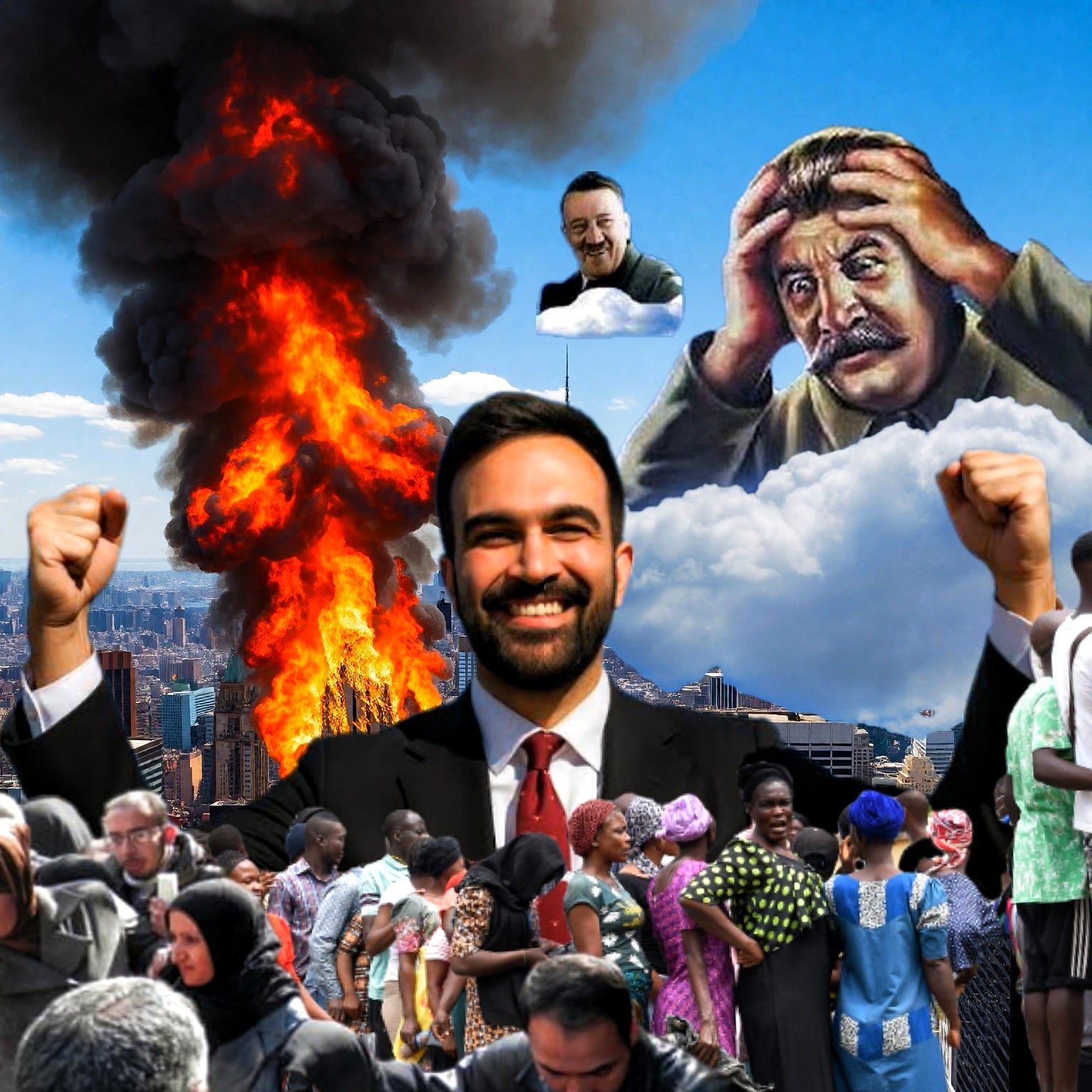
It is worth asking why a milder version of it is selling so well in the United States right now. At first, I treated the revival as a juvenile fashion statement from teenagers and young adults seduced by Soviet-era aesthetics and false promises of class equality. Unfortunately, I’m beginning to realize that my initial reading, while comforting, is mostly wrong. Subversive, Epstein-adjacent Ugandan sandflea, Zorhan Mamdani, a self-described democratic socialist and citizen of the us for 8 years, did not just win the mayoralty of the largest city in the country on nostalgia for the Soviet Union. He won on rent.

In 1975 a typical home cost the average under-40 household about 2.4 times its annual income. By 2024 that ratio had reached 3.5, because prices rose far faster than wages for most of the intervening decade. The median age of a first-time homebuyer hit forty in 2025, an all-time high, up from 29 when the figure was first tracked in 1981. A buyer now needs to earn roughly 112,000 dollars to afford the median-priced American home, about 25,000 dollars more than the median household earns.

A 2025 Cato and YouGov survey found that 62 percent of Americans under thirty held a favorable view of socialism. Gallup’s August 2025 reading put capitalism’s favorability at its lowest since the question was first asked in 2010, and among Democrats socialism now outpolls capitalism by a wide margin. The honest caveat, the one most talking heads on the right leave out because it deflates the panic, is that the same young cohort rates free enterprise at 83 percent, and none of these surveys concretely define the words they are asking about. What the numbers measure is not a worked-out program of nationalized industry, but a diffuse discontent attaching itself to the nearest available label. A person facing the housing math who votes for rent freezes, debt cancellation, and direct public provision is weighting an immediate and concrete relief against a long-run systemic cost that he has little reason to prioritize, because the long run already looks closed to him. That is a rational calculation under conditions of scarcity.

Roughly 90 percent of Americans born in 1940 went on to out-earn their parents, and for those born in the 1980s the figure has fallen to about 50 percent. A society in which advancement has gone from near-certain to a coin flip is one in which more people stay where they started, and staying at the bottom across generations is what turns a statistical category into a permanent class.

Poverty at the bottom is not only a shortage of money but also a physical environment that leaves marks on the people raised in it. Childhood lead exposure, concentrated for decades in the paint and water infrastructure of poor urban housing, has a well-established effect on the developing brain, lowering IQ and degrading impulse control. Chronic stress in early childhood is associated with measurable differences in the development of the prefrontal cortex, the region governing planning and self-regulation, and the broader research on family income and brain development points in the same direction. Early nutritional deficiency carries cognitive costs. Head injuries, more common where violence is common and adequate medical care is not, add another layer. None of this is destiny for any individual, but it describes an environment that makes escape harder and that reproduces itself, because the children raised in it inherit the conditions.

The mechanisms in play that keep the poverty class growing are easiest to observe in a setting with no politics attached. Airport security is built around the worst passenger who ever boarded a plane. Everyone removes their shoes and surrenders their water because a vanishingly small number of people have tried to do harm, and the system cannot identify them in advance. This is risk-based design, calibrated to the tail rather than the median, and against a rare and catastrophic threat it is defensible. The trouble begins when the same logic is applied to ordinary shared institutions whose disruptive minority is neither rare nor catastrophic but persistent and cannot be removed.

Every public institution faces a choice between two ways of handling its most disruptive users. It can exclude them, designing exclusively for the median and removing those who fall outside acceptable behavior, or it can design for the worst case and impose the resulting constraints on everyone. A school that expels every disruptive student invites lawsuits, truancy problems, and political blowback. A school that instead writes rules strict enough to contain its most disruptive students, and applies them to the whole student body, avoids all of that, at the price of governing the many by a standard set by the few. Liberal democratic institutions default almost everywhere to the second option, because removing people from public education, transit, or space raises legal and legitimacy problems that universal restriction does not.

Before the civil rights era, exclusion was freely available as an institutional tool; it was used extensively but the expansion of rights-based law from the 1960s onward ended categorical exclusion. It also raised the general cost of removing anyone from a public system for any reason, and institutions adapted not by getting better at distinguishing the disruptive from the orderly but by lowering standards for everyone.

What makes the pattern self-reinforcing is the dynamic the economist Albert Hirschman described in 1970 as “exit and voice”. When a shared institution degrades, the people who have alternatives leave first and their departure removes not only their stabilizing presence but their voice, the complaints and expectations that might have pulled the institution back toward the standard of the median user. What remains is a population more concentrated in exactly the behavior the restrictions were meant to manage, which lowers the baseline again, which prompts more restriction, which drives out more of the people who could still leave. Public schools lose the families who can afford private tuition or a house in a better district. Transit loses the riders who can afford cars. Public space loses everyone who has somewhere else to be. Retail offers an example closer to home - walk into any modern drugstore in an urban area, and the deodorant and razor blades sit behind locked plastic. Every customer’s experience is therefore degraded, as they wait for an employee with a key because of a disruptive minority.

Put the pieces together, and the picture is of institutions that cannot exclude, and so accommodate, and whose accommodation concentrates the very thing being accommodated. The class is not managed out, but managed around, at rising cost to everyone still inside the shared system, until the people who could leave have left. Which raises the question of who is left cheering the arrangement on from a safe distance, and why.

The voter facing the housing math is reasoning from his conditions rather than failing to understand them, and in the election that produced the country’s most prominent democratic socialist, the poorest voters did not even break his way. In the 2025 New York mayoral race, Zohran Mamdani lost the city’s lowest-income precincts to Andrew Cuomo and ran strongest in the middle and in gentrifying, college-educated neighborhoods. One analysis found that precincts with median household income above roughly 118,000 dollars backed him by 13 points while lower-income areas leaned the other way. The class picture is genuinely mixed, and it is complicated further by race, so it should not be flattened into a slogan about champagne socialists. But the pattern that survives the complications is the one that matters here. The program marketed to the working class drew its most committed energy from people a rung or two above it.

That is where the useful idiot lives, and his defining feature is not stupidity but insulation. It would be inconsistent to call the desperate voter rational for weighting immediate relief and then call the secure professional foolish for wanting the same policies, because the two are not running the same calculation. The impoverished voter has skin in the game and is betting it on relief. The Champaign socialist has none and is spending someone else’s. He supports the rent freeze from an apartment he already holds or a mortgage the policy will not touch, backs the expansion of a public system he does not personally depend on, and treats the whole program as an expression of his values rather than a wager on his own livelihood. The psychologist Rob Henderson has called this category of position a luxury belief, a conviction that confers status on the person holding it while the costs fall on people who do not.

The flagship policy is where the distance between intention and result is best documented, and it is the rent freeze. The most rigorous study of rent control in a major American city, Rebecca Diamond and colleagues’ 2019 analysis of San Francisco, found that landlords covered by the policy cut their supply of rental housing by 15 percent, converting units to condominiums, selling to owner-occupants, and redeveloping buildings to get out from under it. The lost supply pushed market rents up by about 5 percent citywide, and the new and converted housing catered to higher-income residents, so the policy accelerated the gentrification it was meant to resist. Future renters and the city’s lower-income residents paid, absorbing a large share of a multi-billion-dollar transfer, with a substantial portion of the cost falling on people who did not yet live there.

The program looks humane because on paper the landlord simply charges less and the tenant simply pays less. The human material declines to cooperate. The landlord, being a person rather than a variable, sells the building or converts it, and the supply the next tenant needs quietly vanishes. The Champaign Socialist can’t see it coming, or does not weigh it, because he is not the next tenant. His distance from the consequence is precisely what lets him hold the belief with a clear conscience. A person who has mistaken his comfort for his compassion cannot easily be dissuaded because conceding the point would cost him the flattering self-image the belief was there to supply. The desperate reach for relief and the secure reach for meaning, and the two impulses land on the same policies for opposite reasons, one side carrying the risk and the other carrying none. What that arrangement does to a society over time, once its standards are set by that convergence, is the subject of the last section.

There will be no collapse, but a slow recalibration of shared standards toward the bottom of the distribution; one institution at a time, each step locally reasonable and collectively corrosive. The pieces are already in place. Institutions that cannot exclude accommodate, accommodation concentrates the behavior it accommodates, the people with alternatives leave, and a growing class of voters with real grievances supplies steady demand for more of the same, while a secure layer of “intellectuals” (Champaign socialists) supplies the moral cover. Generalized across enough institutions, that produces a public sphere increasingly designed around its least capable and least compliant members.

A case that holds the whole dynamic in miniature, including its limits took place in 2014, when a San Francisco school district removed algebra from eighth grade and eliminated its honors and accelerated math tracks in the name of racial equity. The theory was that grouping students by ability entrenched racial gaps, so the gaps would narrow if the grouping went away. A Stanford analysis found the change did nothing to close the racial enrollment gap and coincided with a decline of roughly 15 percent in advanced math enrollment. Stanford economist Thomas Dee described the district’s approach as an effort to reach equity not by raising the floor, but by lowering the ceiling.

If schools calibrate to the median or below, if transit and public space calibrate to their most disruptive users, and if the price system itself is increasingly managed by controls that contract supply, then the shared version of nearly everything drifts downward in quality while a private tier rises to serve everyone who can afford to escape it. The end state is not ruin but a two-track society in which the public floor keeps dropping, and the people responsible for the policies are insulated, by money or by ideology, from ever standing on it.

Whether a society organized around the needs of its least advantaged is a moral achievement or a slow mistake is a question about values, and reasonable people answer it differently. What the record can establish is narrower and worth stating plainly. The programs sold as compassion often produce the reverse of their promise, the people who suffer most from that failure are rarely the ones who championed it, and a movement convinced of its own righteousness is the kind least likely to notice when the people it means to save have quietly walked out the side door.

Sources

Sunday, July 19, 2026

The Flesh Banquets of Wuxuan

During China's Cultural Revolution, factional violence in Guangxi province (1967–68) escalated past mass killing into public cannibalism. Official death toll: 100,000–150,000 (some estimates go to 500,000). At least 421 named victims were killed and eaten, not from famine, but as an ideological act. Victims were "class enemies": landlords, intellectuals, anyone denounced as counter-revolutionary. Eating them was a public proof of revolutionary loyalty.

In towns like Wuxuan, organs were cut from victims, sometimes while still alive, and eaten communally at what witnesses called "flesh banquets." One teacher, Wu Shufang, was denounced by her own students, killed, and had her heart and liver cut out and barbecued by them at their school.

It stayed hidden for nearly 20 years until writer Zheng Yi investigated and published Scarlet Memorial (1993) under a pseudonym after fleeing China. The book is still banned there. A government probe (1981–88) compiled an 18-volume internal archive; only 15 people were ever jailed. China has never publicly acknowledged it.

Reference

  • Zheng Yi's Scarlet Memorial
  • Donald Sutton, "Consuming Counterrevolution" (Cambridge)
  • Andrew Walder, "Anatomy of a Regional Civil War: Guangxi 1967–1968."

Ritual Murder Trade in Africa

Nigeria has an active, ongoing pattern of ritual killings tied to "juju", the belief that human body parts or blood, obtained through prescribed ritual, can generate wealth, business success, or power. Targeted body parts (head, tongue, eyes, genitals) are believed most potent when taken from a living victim, since the screaming is thought to increase the ritual's power.
  
The reference case is the 1996 Otokoto scandal: an 11-year-old boy, lured with a Coca-Cola into the Otokoto Hotel in Owerri, was murdered and beheaded; his killer was later caught delivering the head to a local "patron." When the story broke, Owerri erupted into two days of rioting. The hotel and the owner's mansion were burned, along with properties of other suspected ritualists. The killer died mysteriously in police custody (poisoned) before trial; three officers were later convicted for his death. The hotel owner and six others were eventually sentenced to death, some hanged decades later. It hasn't stopped.

Recent cases

  • Feb 2025, Kwara State — a college student murdered and dismembered for ritual purposes
  • Jan 2025, Rivers State — two pastors arrested with skulls, carved skeletons, and ritual items inside their churches
  • Dec 2024, Ogun State — twin brothers arrested for killing and dismembering a woman
  • 2024, Ondo State — an Islamic cleric caught with human hands, kidneys, and tongues
  • Jan 2025, Cross River State — a man murdered his own mother for ritual material, arrested at a native doctor's shrine
  • 2023, Niger State — five men arrested with an exhumed skull, sent by a ritual practitioner
A newer thread ties this to Nigeria's "Yahoo boy" internet fraud scene — online scammers turning to ritual practitioners for wealth rituals, in some cases murdering girlfriends or family members as the "sacrifice."Legal response remains weak: prosecutions are infrequent, sentences are widely seen as too lenient, and Nigerian commentators describe public reaction shifting from outrage (1996) to grim normalization.

Reference

  • The Street Journal, "History: The story of Otokoto money ritual killings of 1996", Wikipedia
  • "1996 Otokoto Riots", Punch Nigeria
  • "Otokoto ritual murder: 20 things to know about convict hanged 20 years after crime”, AllAfrica
  • "Nigeria: Disturbing Trend of Youths and Ritual Killings”,
  • ritualkillinginafrica.org (Kwara State, human trafficking category archives), Skeptical Inquirer
  • "Ritual Killing and Pseudoscience in Nigeria”, EASO/EUAA, "Country Guidance Nigeria" (2021)

Friday, July 17, 2026

Jaquarious & The Golden Doo-Rag

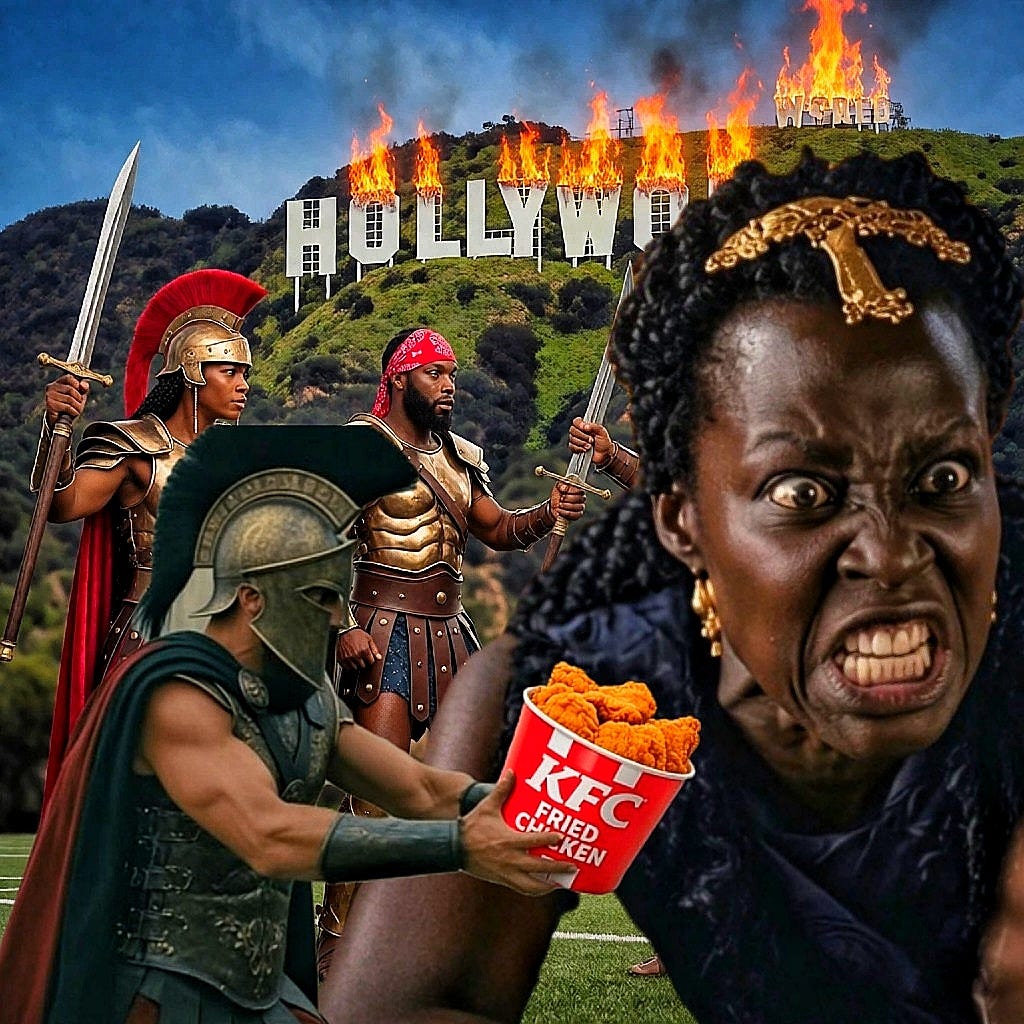
Christopher Nolan's adaptation of the Odyssey opens with a Black actor cast as an ancient Greek poet, one of several casting choices made with the intention of both winning an Oscar and provoking the public. Nolan has said the casting was meant to draw a line between the oral tradition of Homeric poetry and modern rap, a connection that says more about how modern Hollywood talks about race than it does about the source material. This "rage baiting" marketing strategy has become transparent to anyone who has watched the steady stream of slop coming out of Hollywood since the end of the Obama presidency: take a classic Western story, cast against the material's original context, and let the resulting backlash do the marketing. Hollywood ran the same playbook with Snow White, and most infamously with the widely panned all-female Ghostbusters reboot. It is an inexpensive tactic that insults the intelligence of the audience, converting their reaction into free publicity.

Nolan’s justification for the casting is the more revealing part than the casting itself. He didn’t defend it as an acting decision; he defended it as a symbolic one, explicitly framing rap as the modern equivalent of Homeric oral tradition - an insult to the source material dressed up as a compliment. Homer’s oral tradition carried the entire cultural memory of a civilization across centuries, recited from memory, refined over generations, treated as sacred enough to eventually be written down and preserved as the foundation of Western literature. Reducing that into a rapper’s cameo isn’t elevating rap, it’s flattening three thousand years of epic poetry down to a marketing gesture. And it’s worth asking where that association even came from in the first place, because rap didn’t arrive at that symbolic status on its own. Hollywood and the music industry spent nearly two decades constructing it. Tracing how it was built, and what’s since come undone, means looking at how rap actually got positioned within American culture, and then at what shifted.

During the week of October 25, 2025, for the first time since 1990, there was no Rap or Hip-hop in the top 40 of the Billboard Hot 100. The last time that happened, the top-ranking rap song was “Just a Friend” by Biz Markie. To be fair, Billboard had adopted a new 2026 chart rule that removes songs after 26 weeks if they’ve fallen below No. 25, and the song that had been keeping rap in the top 40, Kendrick Lamar and SZA’s “Luther,” fell off under that rule. Obviously, a single technicality doesn’t prove a genre is dying but, strip the rule change away and the underlying trend is still real: hip-hop’s market share peaked at 30% in 2020 and had stagnated around 24% through 2025, with its share of the Year-End Hot 100 falling from 41% to just 16% over the same stretch. That’s a five-year slide.

Mike Benz, a former State Department official turned commentator, claimed that rap’s declining influence seemed “suspiciously synched” to the Trump administration’s disruption of USAID’s funding pipeline, the implication being that the agency had been quietly propping up rap’s commercial dominance as some sort of soft-power project, and that cutting its funding caused the genre to collapse.

Mike Benz@MikeBenzCyber


This claim doesn’t hold up when you look at the timeline: USAID’s funding freeze began in early 2025, when Musk started publicly targeting the agency and Trump signed an executive order freezing foreign aid. Rap’s market share had already fallen from 30% to 24% before any of that happened. A cause cannot postdate its effect by half a decade. If USAID money was somehow responsible for rap’s chart dominance, the genre should have been sliding in early 2025, not gradually losing ground since 2020.

What actually happened to rap has happened to other genres before, including disco and hair metal. After roughly a decade of the same commercial formula run at full volume, the audience burns out on it. Disco followed that pattern first. It dominated the charts through the mid-to-late 1970s, got replicated by every label with a studio and a drum machine until the sound became interchangeable across artists, and then collapsed almost overnight once listeners decided they’d had enough of hearing the same thing. Hair metal did the same thing a decade later, a genre that ruled MTV and the charts through the 1980s until every band sounded like a slightly different haircut on the same three power ballads. Nobody needed a government agency to kill either genre, instead both imploded by refusing to be anything other than maximally commercial for too long. Rap’s commercial run over the last decade follows the same pattern.

There’s a reason the USAID theory found an audience beyond, and it isn’t a coincidence worth dismissing outright. People sensed, correctly, that rap’s dominance over the last two decades didn’t happen entirely organically. It was built the same way disco was built, and the same way rock was torn down before it: by an industry that identified a commercially exploitable formula and sold it aggressively to the audience with the most disposable income to buy it.

Rock was the genre rap replaced at the top of the charts, and that handoff is worth noting because nobody reached for a conspiracy theory to explain it at the time. Rap and hip-hop’s mainstream breakthrough came in 1991, and by then rock had already been losing ground for years, faltering not because of any outside sabotage but because it had gone stale, standardized, and visually uninteresting next to the decadent, ghettolicious spectacle MTV was peddling instead. Rock died of the same ailment killing rap now: a formula run past the point of freshness, until the audience that made it dominant went looking for something else.

Talib Kweli described this directly, in a 2013 NPR interview: "the stuff that's being promoted and marketed and the corporations are spending major money on is the decadent stuff, which is mostly about drug use and sex. And that's why people get a skewed perception of hip-hop." Labels put their promotional weight behind the same handful of themes, drugs, sex, and excess, because that content was cheap to produce and reliably sold, while artists working outside that framework received less money and influence. Marketing spend doesn't just sell individual records. Over time, it shapes what people believe the genre actually is. An artist pushed onto every playlist and every award show starts to look like the definition of the genre, while everyone working outside that formula starts to look corny at best, or a relic of the past at worst.

Drugs, sex, and excess don’t require range, and they don’t require an artist to grow, which made that lane infinitely easier to staff, promote, and replace than anything built on substance. “Lifestyle,” by Rich Gang, Young Thug, and Rich Homie Quan, is a good early example of the template: a hook built on nothing but slurred ad-libs and a vague brag about having “made it,” mumbled over a beat.


The sound is so grotesquely hood that it almost plays as a parody of the genre, and yet it went platinum anyway. “Mask Off,” by Future, and “Body,” by Megan Thee Stallion, both massive hits, follow the same pattern years apart - drugs, sex, money, repeat.


The formula worked, which is precisely why the industry kept running it instead of developing anything else. Even the criminal narrative that used to give rap some edge and stakes, like Snoop Dogg and Tupac Shakur back in the early days, has mostly fallen away. What’s left in a lot of the biggest rap songs of the last decade isn’t the epic tradition Nolan gestured at, a story of struggle, survival, or hard-won return. It’s a loop of drugs, parties, and sex, repeated with just enough musical variation to pass as a new single. There’s no journey in it, no stakes, nothing resembling the arc that made oral tradition worth preserving for three thousand years in the first place. Just the same handful of indulgences on repeat. This is where Nolan's comparison of rap to Homeric epics falls apart.

What's left of rap in its most commercially dominant form isn't epic tales of triumph and woe, but an infinite loop of drugs, parties, and sex with none of the struggle, stakes, or arc that made oral tradition worth preserving for three thousand years. A formula that thin doesn’t sustain a decade of dominance forever, and the audience it was built for eventually noticed. That exhaustion isn’t just visible in rap’s own numbers, it’s visible in the genres rushing into the void rap left behind.

Start with the direct chart replacement - Country climbed from a marginal presence to the genre now filling the space rap vacated. Just a few years earlier, country hovered around 4% of Hot 100 top 10 hits from 2021 to early 2022. By the first half of 2025, it accounted for 29% of all top 10 hits, surpassing both hip-hop and pop. Country’s share of the full Hot 100 rose to around 28% in 2025 and 32% in 2024, the same years rap’s share fell from 24% down to 16%. That’s a direct swap at the top of the chart.

A study connecting country listenership to party identification found the association has grown statistically stronger over the past two years, with data showing most listeners of top country artists lean Republican. Reporting on the broader shift went further, describing it as a “political vibe shift” in American pop music since Trump took office, standing in stark contrast to rap and pop’s alignment with Democrats during 2024’s “Brat Summer.” Cardi B, along with Taylor Swift, Beyoncé, Sexyy Red, Bad Bunny, Usher, and GloRilla, publicly endorsed Kamala Harris’s campaign (after receiving generous pay checks from the Democratic party, compliments of the taxpayer).

The lifestyle data points the same direction, independent of politics entirely. By 2026, industry trackers describe moderation as having hardened into something structural, with fewer Americans drinking and those who do drink making more deliberate, selective choices. Eventbrite’s 2026 data shows sober curious gatherings up 92% and coffee-based social events up 478%, while only 54% of American adults report drinking at all, a near 90-year low, down eight points since 2023. Gen Z is consistently identified as the demographic leading that retreat, with researchers noting it shows up in actual behavior rather than just stated intention, the same generation the ghetto decadent-rap formula was built to sell to, now walking away from the lifestyle it was selling.

That retreat from ghetto decadence didn’t happen in isolation, and rap wasn’t the only thing running on the formula that’s now losing its audience. An industry spent two decades manufacturing and rewarding one commercial formula until it saturated the culture and the audience burned out on it, the same thing that happened to disco and to rock before it. Country taking its place isn’t a surprise, either. It’s a genre, and a broader lifestyle shift, built around the traditional values the old formula spent twenty years panning as “boring White people shit.” No agency needed to be defunded for any of this to happen. The cultural zeitgeist simply got tired of ghetto decadence, and went looking for something with more substance.

Which brings us back to were we started: a rapper cast as a Greek poet, and a director defending that choice as some sort of “sophisticated” nod to oral tradition. Nolan wasn’t wrong that rap has roots in oral storytelling, but he was wrong to treat that as equivalence. Three thousand years of Homeric tradition reduced to a rapper’s cameo, as though the two carried the same weight when the “oral tradition” he is gesturing at is a twenty-year commercial formula built, funded, and rewarded by Hollywood and the corporate machine. Rap’s decline isn’t because a government agency stopped paying for it, but because the audience it was manufactured for has spent the last few years visibly walking away from the lifestyle it was selling: less drinking, less excess, more faith, more country, less debauchery. The audience that spent twenty years being sold the inebriated decadence of the ghettofabulous lifestyle is starting to sober up.

References

Thursday, July 16, 2026

On Natural Selection vs. "Social Murder"

There is nothing wrong with letting natural selection run its course. The only people who disagree are either virtue signaling for personal gain or know they wouldn't be alive without state intervention.

The homeless are often drug addicts, for whom contact between themselves and their family/friends has been severed through their own actions. It is often the case that, when provided with the opportunity to sleep in a shelter or complimentary hotel room, they will chose to sleep rough because it allows them easier access to drugs on the street. Why should we provide assistance to those who reject it, often resenting us for offering it in the first place? If the left beleives that these people should not be forced off the street against their will (“criminalizing homelessness”), then surely they must be of the opinion that they have a right to die on the street if they wish. There is no “in between” or compromise between letting them die of their own volution or forcing them into state institutions to be rehabilitated against their will.

Then again, the homeless are moved around California to farm votes and maintain the current (corrupt) power structure, so there is that factor, too. Its highly likely that the powers that be don't give a fuck either way as long as they can get a signature from them.

Do Laura Loomer fans even actually exist?

I understand listening to Fox News hosts and mid-2010s "skeptic" and alt-right YouTube figures, because we tend to subconsciously gravitate toward names we already recognize. But who is actually a Laura Loomer fan? I've come across enough obviously fake "Laura Loomer Fan Page" sock puppet accounts across conservative platforms and niches now that the question feels worth asking directly.

Do Laura Loomer fans even actually exist?

The first time I heard her name, Jim "Metokur" was covering a moment where she'd blamed a flat tire on "the libs," back in 2015. She'd also crashed some sort of "Shakespeare in the Park" performance with a megaphone, purely for notoriety. Her obnoxious, attention-seeking behavior got her immediately declared a "lolcow" and written off by the broader alt-right sphere at the time.

She has always come off as the "ugly girl" punchline of Con, Inc. Like Pearl Davis, Laura carries an air of misery and wretchedness that makes her a pitifully easy target for mockery. She's lost both of her congressional runs, she's been banned from nearly every major platform, and by her own account she's struggled to keep basic services like Uber and PayPal running. And yet, somehow, she keeps turning up in photos next to people who actually hold real political power and influence. She has real, documented proximity to Trump.

So what's actually going on with Laura Loomer? Is she as botched of an industry plant as the plastic surgery that's left her looking like Glenn Quagmire from Family Guy? A plastic person manufactured for a role that never quite fit her, propped up by her handlers rather than any earned credibility or talent of her own?

Tuesday, July 14, 2026

A Note on Authorship *Satire*

It is with a heavy heart that I announce the passing of my colleague, Alice Hall.

She was summarily executed by lethal injection on the steps of the Substack headquarters at approximately 5:50 AM Pacific Standard Time, having been found guilty of the capital offense of Spam and Phishing. The Substack Team showed no leniency. May God have mercy on her soul.

In accordance with Substack’s Terms of Service, Section 12, Paragraph 4 (the so-called “Spam Clause”), no appeal was permitted. Alice was pronounced dead at the scene by a moderator.

I, Falk Whitaker, will be assuming authorship of Freudian Death Drive effective immediately. I have no known history of phishing, spamming, or unsolicited newsletters of any kind, and the Substack Team has assured me my account is in good standing.

The blog continues. Alice would have wanted it this way, or so I am told by the estate’s executor, who is also me.

Originally published July 16, 2026 to Substack in response to my unwarrented ban for "Spam and Phishing", my Appeals remaine unanswered. 

Monday, July 6, 2026

Whatever Happened to Daveigh Chase?

On June 16, 2026, Daveigh Chase died in Los Angeles at 35 years old. She was homeless, having been living on Skid Row, or taking shelter inside one of the many mobile crack houses that line the sidewalks nearby, depending on who you ask. The Los Angeles County Medical Examiner’s Office later listed the cause of death as AIDS, with chronic polysubstance use noted as a contributing condition.

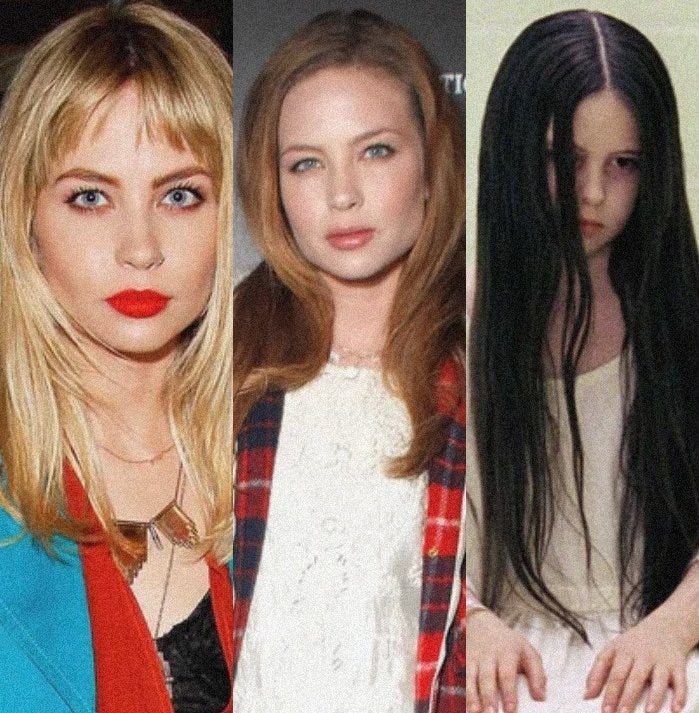
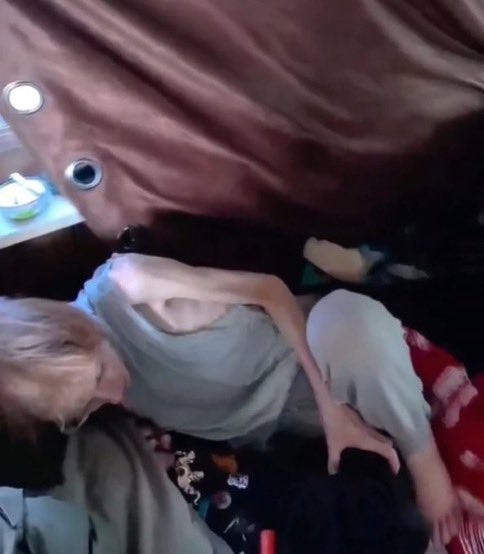
If you were a kid in 2002, you knew her face. She voiced Lilo in Lilo & Stitch, Chihiro in the English dub of Spirited Away and she played Samara Morgan in The Ring. Daveigh Chase won an MTV Movie Award for Best Villain for her performance in the English Adaptation of Ringu. She was everywhere for about four years, and then, suddenly, she wasn’t. She stopped acting by 2016, and by 2019, her mother had lost contact with her entirely. In December 2025, six months before her death, her mother saw what she believed was a video of Daveigh on Reddit. She was severely emaciated, slumped over, trying to push the camera away.

[VIDEO]

Daveigh Chase started in commercials at age three. Her mother, a former nurse, relocated from Oregon to Los Angeles for her daughter’s career. By twelve, she had voiced two of the most iconic animated characters of the early 2000s and starred in one of the decade’s defining horror films. She had also won an Annie Award and an MTV Movie Award before she was old enough to drive.

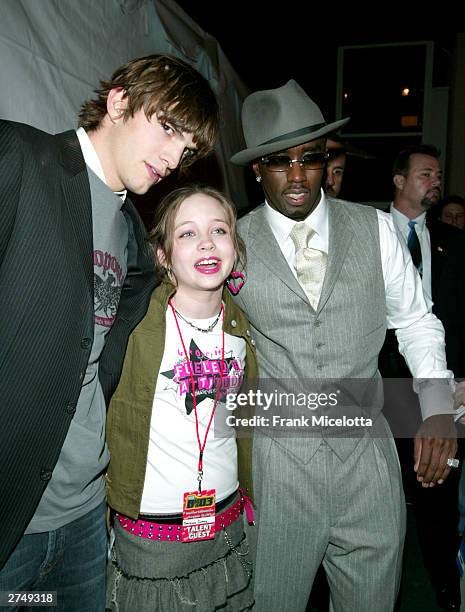
An interesting moment worth noting is that, at the 2003 MTV Movie Awards, Shaun “P Diddy” Combs presented Daveigh, then 12, with the Best Villain award alongside Ashton Kutcher. On camera, backstage, he asked her if she was “coming to the afterparty tonight.” She nodded yes. Combs laughed and yelled “Yeah!”

[VIDEO]

Whether she actually attended is unknown.

By the time the clip resurfaced, Combs had already been arrested on federal sex trafficking and racketeering charges. Attorney Tony Buzbee was representing 120 accusers, 25 of whom were minors at the time of the alleged incidents. The youngest was nine years old, allegedly approached at a Bad Boy Records audition. Buzbee described a consistent pattern: luring young people pursuing entertainment careers with promises of stardom, then taking them somewhere private. Combs was ultimately convicted on two prostitution-related charges and sentenced to just over four years, though he was acquitted on the trafficking and racketeering counts.


None of that connects Daveigh to anything specific. The clip is what it is: a 33-year-old man, at an industry event, asking a twelve-year-old girl to come to his party. In 2003, it aired without comment.
Chronology of Use

So far, two versions of Daveigh’s addiction origin exist in the public record.

Her father, John David Schwallier, told the New York Times that she had been struggling with drug addiction since age 13, around 2003. He said he became estranged from her around the time she turned nineteen in 2009, and that she became distanced from her mother around the same time. His account implies a long, continuous addiction history.

Daveigh’s mother, Cathy, tells a different story. In her account, the downward spiral began after a 2016 motorcycle accident, when doctors prescribed oxycodone for a back injury. The addiction, by her telling, was iatrogenic: a medical intervention that opened a door Daveigh couldn’t close. “She was seeking drugs and was partying with the wrong people,” Cathy told the Daily Mail. “I never kicked my daughter out. She wanted freedom and these people got her hooked on some drugs. That was the beginning.”


Daveigh’s mother spent years watching her daughter collapse at a distance, with countless nights scrolling through Reddit, Google, and the Los Angeles County Medical Examiner’s website, searching for any trace of her. She was checking the coroner’s unidentified bodies list, hoping Daveigh wouldn’t appear.

These accounts don’t just differ in degree — they locate the problem in completely different periods of Daveigh’s life and assign it completely different causes. One version has addiction running through the height of her career. The other has her career ending more or less cleanly, with a pharmaceutical trigger arriving years later.

Daveigh may have been on prescription stimulants (Adderall being the obvious candidate for a working child actor navigating a demanding schedule, as seen with Amanda Bynes) that her mother categorized separately from “drugs,” while her father counted everything together. At minimum, that’s the most generous explanation for the discrepancy that doesn’t require either parent to be lying. It also fits a pattern that recurs throughout child star history: legal prescriptions serving as the on-ramp, the line between “medication” and “addiction” blurring slowly enough that no one notices until it’s too late.


Neither version is definitively sourced. Both come from grieving, estranged parents who had limited contact with their daughter for years. What they agree on matters more anyway: by the time anyone tried to intervene, there was nothing left to grab onto.
Business as Usual

The Hollywood child-actor pipeline is designed around output, and children who move through it fastest are the ones with parents who subordinate everything else to the industry’s demands. This is something that Melissa Gilbert, who worked briefly with Daveigh, observed publicly after her death. “When a parent or parents lose sight of who they are, of what their true responsibility is, and their lives revolve solely around their little star child,” Gilbert wrote on Instagram, “that’s where the trouble begins.” Gilbert was careful not to name names.

It goes without saying that a child star is famous before they have any framework for understanding what “fame” is. In some cases, their income supports the family, and their performance schedule shapes the household calendar. They are told they are talented, special, and all of that is contingent on continued performance. When the roles dry up, as they inevitably do, the identity scaffolding collapses with them.

For Daveigh, the roles started drying up around 2012. She made her last film credit in 2016. According to her former manager John Ryan, she had been “sober a while” before they lost contact in late 2015. Ryan had been developing a documentary about her disappearance from Hollywood before her death.


In the days following Daveigh’s death, a man named Roy Hernandez identified himself to TMZ as her boyfriend. He launched a GoFundMe to cover cremation expenses, writing that after “a difficult childhood and a painful falling out with her family, Daveigh was bullied and struggled to find safety and happiness in downtown L.A.” He framed their relationship as protective: “When we met, I promised to protect her and give her the love and comfort she deserved.”

Her former manager John Ryan responded directly, urging fans not to donate. “That GoFundMe is not going toward ANY expenses for Daveigh,” Ryan told Deadline. He stated that Hernandez “brought her into the hospital in terrible condition and didn’t let any of the family know until she passed so he can control the dialogue,” and characterized the fundraiser as an attempt to “make it look like a Romeo and Juliet situation to benefit his own pockets.” Ryan noted there were no medical or funeral expenses to cover.

Hernandez had initially told TMZ that Chase died of meningitis and sepsis. The coroner’s office later determined the cause was AIDS.

The cause of death is worth sitting with, because it tells you something specific about the conditions Daveigh was living in. HIV transmission via shared needles is possible but statistically less likely than other bloodborne infections. Hepatitis B and C transmit far more efficiently through the same route. The baseline risk per needle-sharing exposure is roughly 0.3 percent, though that rises to around 5 percent with a high-viral-load source. Reaching an AIDS diagnosis (late-stage HIV, CD4 count below 200) requires years of untreated infection. It means no access to antiretroviral treatment, no consistent healthcare, no one who could intervene at any earlier point in the disease’s progression.

The entertainment industry generates enormous cultural meaning through the labor of children, and then, when those children are no longer commercially viable, it generates no infrastructure for what comes next. There is no off-ramp, but instead an assumption, that normal adolescence and early adulthood can proceed in parallel with an all-consuming, Hollywood career.

The people who knew Daveigh describe someone who was talented, warm, and funny, and who found herself increasingly surrounded by people with no interest in her wellbeing. “She was surrounding herself with the worst of the worst people,” said a musician who had been close to her between 2018 and 2023. “It’s such a tragedy because no one cared for her best interests at all.” He got clean in 2023 and hadn’t seen her since. The industry that made her famous at twelve did not consider itself responsible for what happened at thirty-five. The credits rolled, the contracts ended, and the rest became someone else’s problem.
Sources

Sources

Monday, June 29, 2026

The Death of Kosher Conservatism


There is a specific kind of political commentator that dominated the mid-2010s. He was smart enough to sound credible, careful enough to stay monetized, and vague enough to avoid committing to anything that might cost him a sponsor. He talked about facts and logic, debated college students, building his brand around being the reasonable one in the room. These operations peaked around 2021 and have been quietly contracting ever since. The through-line connecting all of them is the use of bot networks to simulate cultural relevance and careful brand management to stay palatable to advertisers. If you want to understand how this brand of conservatism operates, and why it is failing, the Daily Wire is the most instructive place to start.

The Daily Wire was built by Orthodox Jewish conservative Ben Shapiro alongside co-founder Jeremy Boreing, with funding from Texas oil billionaires Farris and Dan Wilks, who also bankrolled Dennis Prager. What they got for their investment was the institutional home of what you might call Kosher conservatism: pro-Israel, willing to fight meaningless culture war battles on trans issues, DEI, and Hollywood, but careful to stay within certain limits. Never too edgy, and always advertiser friendly. The kind of conservatism that wins debates and changes absolutely nothing.

For a while, it worked spectacularly. The Daily Wire became one of the most-watched conservative media operations in the country. Then Facebook substantially altered its algorithm in 2021 in ways that disadvantaged political content on the platform. The Daily Wire’s subscriber count peaked that year and has been declining since.

The audience moved on but the Daily Wire did not. The culture kept shifting. The institutions kept going in the same direction. Facts and logic, it turned out, are not a functional counterstrategy when the people running things do not care about them.

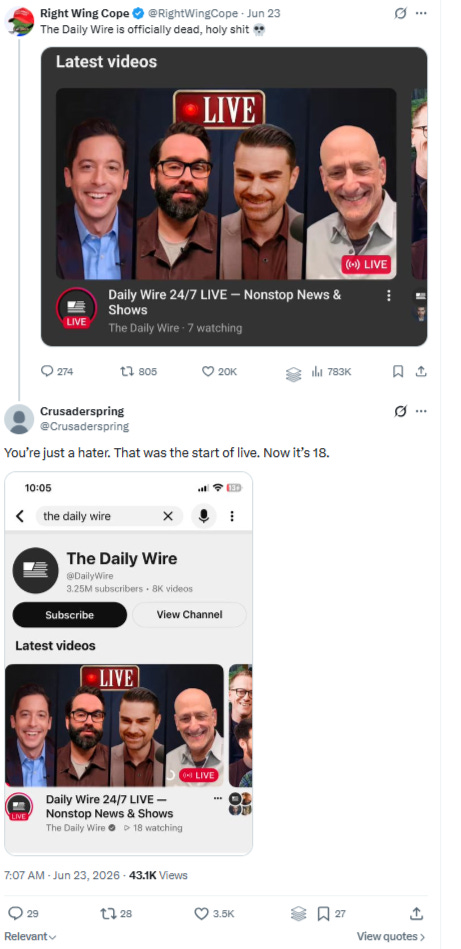
There is also the question of authenticity that the bot situation raises. The view counts that made the Daily Wire look like a thriving operation appear to have been substantially assisted by purchased traffic. When the spending on that stopped, the numbers reflected something closer to reality. A video featuring both Shapiro and his beloved Shabbos goy Matt Walsh pulling 7 live viewers is not the signature of a healthy media empire.


Boreing stepped down in early 2025 amid rumors of internal drama and serious concerns about the company’s financial health. The vanity projects, particularly the film division and the broader attempt to build a conservative Hollywood, had reportedly burned through enormous resources without producing equivalent returns. Shapiro’s daily program still has an audience, but the trajectory is clearly trending downward with no obvious path back up. His pro-Israel positioning has become a liability.

Shapiro is not the only figure whose brand of careful, advertiser-friendly conservatism is running out of road. The same audience attrition, the same gap between the performance of relevance and the reality of declining numbers, shows up across every major figure who built their career on the same model.

Tim Pool started his career during the Occupy Wall Street protests in 2011, when he rigged a consumer drone with a camera and streamed live footage to the internet, giving people a view of the demonstrations that the mainstream press could not easily block. The Guardian called it a clever loophole. He was twenty-five years old, working as a citizen journalist, and producing content that actually mattered. He went on to work for Vice and Fusion, building a reputation as an on-the-ground reporter willing to go places other journalists would not.

Then, somewhere around 2017, he stopped going anywhere and started sitting in a room reading other people’s articles into a camera.

The transition happened gradually and then all at once. Pool built a YouTube channel around a carefully maintained persona: the left-leaning skater kid from Chicago who was so troubled by what the left was becoming that he felt compelled to document its excesses. He called himself a liberal. He insisted he was not right-wing. He said “I don’t know” and “it’s complicated” so frequently that it became a running joke among his critics and eventually among his own audience.

Tim’s fence-sitting was deliberate. He must have known on some level that his audience was watching because he gave them permission to drift rightward while maintaining plausible deniability about having done so. If Tim Pool, a self-described liberal, thought the left had gone too far, then maybe you were not a bad person for thinking the same thing. This worked well through the early Trump years, until Pool’s content calcified into a formula so predictable that multiple people independently charted it out. Minute one introduces a topic. Minutes two through ten repeat that topic in slightly different words. A Marvel reference appears somewhere in the middle. Civil war gets mentioned at some point. The audience is reminded to buy doomsday prepper food buckets from that day’s sponsor. Every day, five videos a day at peak output, the same topics recycled endlessly with the energy of a man who had long since stopped caring.

Meanwhile, the compound he built in rural West Virginia, which acquired the affectionate nickname Beanie Ridge among the people tracking his career, became a soap opera unto itself. His million-dollar crowdfunded news venture, SCNR, collapsed after co-founders accused him and his brother Chris of botting and promoting fraudulent sponsors. Tim fired the entire staff and revoked their access to the YouTube channel, the AdSense account, and the bank account. He allegedly held his former business partner’s cat as leverage in the subsequent dispute, which required police involvement and got covered by the Daily Beast.

In 2023, Tenet Media, a content venture Pool entered alongside Dave Rubin and Lauren Chen, was allegedly funded by $9.7 million from RT through shell companies and fabricated investor identities. Two RT employees were federally indicted over it. The DOJ indictment names Pool as “Commentator-2” and reveals he had negotiated $100,000 per weekly episode before signing on. Lauren Chen and her husband appear to have known where the money was coming from. Pool claims he did not. What the indictment also reveals, almost incidentally, is that RT was frustrated with him because he only shared one Tenet video that week. He was a bad return on investment for a foreign intelligence operation, which is either exculpatory or just a different kind of damning depending on how you look at it.

Meanwhile, at Beanie Ridge, Pool employed a dedicated skate park manager, listed his girlfriend as COO, and built out a roster of dozens of employees and contractors across multiple overlapping projects with no apparent organizational structure holding any of it together. He invested roughly half a million dollars in a coffee shop venture, spent around a million on the skate park, and put $15,000 into a sword. His Pop Culture Crisis side channel, which he promoted heavily as a brand expansion, was pulling under 5,000 views per video. When a graphics card died on set and nobody replaced it, he threatened on air to shut the entire IRL operation down, then spent the episode cataloguing how nobody he had hired was managing anything while acknowledging that he had made every hiring decision himself.

His music career is worth a brief mention. In 2022 he released an official music video called “Only Ever Wanted,” recorded while wearing the beanie, which sounded like late-era Linkin Park attempting to be U2. The production buried what was apparently a decent natural singing voice under layers of autotune, and the drummer’s practice pads were visible in the shot, indicating the recording space had not been properly soundproofed. He spent multiple consecutive episodes responding to the mockery the video received, which made everything considerably worse.


By the time Pool appeared in the White House press pool in April 2025, still wearing the beanie he has not visibly removed for the better part of a decade, the distance between where he started and where he ended up was almost too large to process. He used his White House question to complain that journalists had been mean about the new media seating arrangement. He did not ask about policy. He reportedly only removes the beanie in the presence of Jewish interviewers, a detail that is either deeply funny or deeply revealing, and is probably both.

The core grievance Pool cannot let go of is that the mainstream press refuses to take him seriously. The problem, which he has never appeared to fully reckon with, is that he spent a decade positioning himself as an enemy of the establishment press and is now confused that they treat him accordingly. He mistakes being contrarian for being insightful, which is exactly what happens to the kind of person who intellectually peaks in college.

Pool’s arc, from citizen journalist with a drone to a man reading Daily Mail articles about a train derailment thirty miles from his house, is at minimum the story of someone who started with something real and lost it. Jeremy Hambly never had the something real to begin with, which makes his version of the same trajectory somehow even less flattering. He watched what the bigger channels were doing, identified the formula, and copied it. The problem is that he was copying Tim Pool at Tim’s lowest-effort period, which meant he was already working from a degraded template before he even began.

The mechanics of Jeremy’s operation were straightforward once exposed. He purchased bot engagement to inflate his YouTube analytics, tailored his uploads to whatever was trending on Google or Twitter, and built his entire content strategy around latching onto popular topics and grinding them into dust. Star Wars. Marvel. Brie Larson. The Karmelo Anthony case. He produced dozens of videos on each; some built on speculation presented as fact, with tweets and comments sections treated as sourced reporting.

What makes Jeremy a genuinely interesting case study, rather than just another mid-tier grifter cycling through the same outrage topics, is how transparent the envy became over time. The deeper you look into his career, the more obvious it is that he wanted what Tim Pool had: the compound, the audience, the aesthetic of being part of a movement rather than merely adjacent to one. The difference is that Tim Pool, whatever his considerable failures, was once a working journalist with real sources and real networking ability. Jeremy is a guy from Wisconsin who would be more naturally suited behind IT help desk.

For the full drama breakdown, MikeyNoMoh covers it in far more entertaining detail than I could manage.

Jeremy Hambly is the furthest this business model could degrade before it stopped functioning entirely, which makes him a useful place to stop and take stock of what all three of these careers actually have in common. The through-line is not an ideology. It is the specific way each of them mistook audience capture for influence. Shapiro won debates, built a company, and changed nothing about the culture he was supposedly fighting. Pool positioned himself as a journalist while building an increasingly elaborate compound from which he covered the news by reading newspaper articles out loud. Hambly watched both of them and concluded that the formula was the point, that you could skip the credential entirely and go straight to the content farm.

They were all, in different ways, right about that for a while until the algorithm changed, the bot spending dried up, and the audience that remained started noticing what they were actually getting in exchange for their time and money. The reasonable conservative brand, the one built on facts and logic and careful brand management, pro-Israel positioning and never saying anything that would get you demonetized, turned out to be a product the market eventually stopped wanting.

References

Monday, June 15, 2026

When Did Punk Become so Fucking Lame?

As you walk into one of your old favorite punk venues, the smell hits you first: stale beer, cigarettes, weed, and whatever they’re burning on the grill in back. The walls are a collage of band flyers and stickers, old and new. The kind of visual noise that used to mean something dangerous was happening here, and you let yourself believe that it still does for a moment, until you spy that familiar set of flags on the wall.

The progress pride flag, often accompanied by the trans flag, with that triangular stripe of black, white, brown, pink and blue bolted onto the front of the original rainbow like a bumper sticker on a bumper sticker. The flags are positioned at eye level, which is how you know they aren’t simply decoration but active indicators of the politics and policies of the space you’ve just walked into. Next to it, or near the door, or sometimes on its own folding signage, is often a list of rules: No racism. No sexism. No homophobia. No transphobia.

I have become accustomed to finding these same symbols in any space that advertises itself as a home for alternative culture: the pride flags, the posted rules, the promise of radical inclusivity extended warmly to every conceivable identity.

It’s in these moments I stop and ask myself: when did punk become so fucking lame?

The original punk venue was not a safe space and was never meant to be. The crowd was unpredictable, the bands were hostile, and nobody was particularly interested in making you feel validated. Punk was antagonistic toward everything and everyone, including the left, and especially including you. It was nihilistic, uncomfortable, and deliberately offensive, and that was entirely the point.

There’s a specific moment in the life of every subculture where it stops being a place people escape to and starts being a place people escape from their own boredom. Punk hit that moment somewhere in the mid-2000s and it’s been accelerating ever since. The kids showing up weren’t running from anything real. They were running from comfort. When the primary audience of a subculture is suburban kids looking for an identity that feels dangerous without actually being dangerous, the subculture reorganizes itself to serve that market. The edges get sanded down, the hostility becomes performative, and the danger becomes an aesthetic choice rather than an unavoidable consequence of showing up.
The Underdog Myth Killed Punk from the Inside


The underdog myth didn’t originate in punk spaces but it fed directly into them. Lauren Southern’s recent essay traces how Hollywood spent two decades building a cultural framework where social failure was repackaged as moral virtue, where the outcast wasn’t just misunderstood but secretly superior to everyone around them. Punk absorbed that mythology completely. The aesthetic of marginalization became aspirational, which is a contradiction that should have been fatal but instead became the product.

Once being an outsider is something you can purchase and perform, the outsider has become the establishment. The patch collection, the record crate, the right zines, all of it functions as the underdog myth made wearable. You’re not rebelling. You’re cosplaying someone who did.
Retail Therapy for Radicals


Stores like Hot Topic are underrated villains in this story, and not for the reason people usually cite. The standard critique is that they commercialized punk, that they took something raw and sold it to mall kids, and while that’s true as far as it goes, the more interesting and more damaging thing Hot Topic did was engineer the order of operations in a way that made the politics feel like a natural conclusion rather than a sales pitch.

Growing up in the 2010s, you didn’t buy the politics first, you bought the aesthetic: the “Blood on the Dancefloor” band tee, the rainbow-studded belt, the black skinny jeans. The aesthetic came pre-loaded with a set of cultural associations, a tribe, a vocabulary, and a list of acceptable opinions that nobody handed you directly but that you absorbed through proximity the same way you learned the words to songs you never consciously memorized. By the time the politics arrived, the groundwork was already laid, you had already self-sorted into the tribe and already knew what the tribe believed, and dissenting from those beliefs didn’t just mean having a different opinion. It meant losing the aesthetic, the community, and the identity simultaneously, which for a teenager is not a political cost but an existential one.

Counterculture has always had a complicated relationship with commercialization, but there’s a specific cynicism in selling dissent as a lifestyle product when the dissent in question is fully aligned with the dominant institutions of the moment. A patch that says “smash the patriarchy” is not threatening to anyone with actual power in 2026, and everyone in the room knows it, even if nobody says so out loud. It is a loyalty signal, a way of communicating party membership and tribal affiliation to the other people in the room who already agree with you, which is the opposite of resistance in every way that actually matters.
Defanged, Declawed & Neutered


The visual language of punk, the aesthetics, the venues, the zines, got repurposed to carry a value system that is, at its core, deeply institutional. Academia preaches it, corporate HR enforces it, and legacy media publishes it, and the fact that it arrives wearing a leather jacket and a circle-A patch does not change what it is or who it serves. It was absorbed by a new establishment that learned to speak the language of rebellion while building its own rigid orthodoxy underneath it, and when the New York Times, Human Resources departments, and your local punk venue all agree on the rules, you are not looking at a countercultural movement anymore.

If punk is defined by antagonizing the dominant cultural institution, then the genuinely countercultural position right now is not what’s being sold in those venues, on those shirts, or in those zines. The punk spaces you can find on Google Maps, with their posted rules and their progress flags and their promise of radical inclusivity, are not places where anything threatening to power is actually happening. They are where the narcissistic queers in power go to feel edgy on a Friday night, after a couple of poppers and a Slippery Nipple, surrounded by sycophantic handmaidens who all showed up wearing the same uniform of dissent and call it a revolution.

Real counterculture doesn’t advertise itself, doesn’t have a dress code or a flag or a posted list of approved opinions by the door, and it was never designed to make you feel safe or validated or welcome.

Thursday, May 28, 2026

From the TikTok Slop Abyss: Xiao Xiao, the "Chinese Kick/Junk Food" Girl

One of the most revealing TikToks of Xiao Xiao, the “Chinese Kick Girl”, is one in which she hauls a large speaker through the street, dressed in traditional Chinese children’s clothing. An AI narration explains in that familiar hollow, robotic female voice that she is off to work. We cut to her performing TikTok dances in a crowded street while passersby poke and prod her, smartphones raised, each hoping to capture their own viral moment.

[VIDEO]

“Girl” is hardly an appropriate word for Xiao Xiao as she is 39 years old. She is a street performer from rural Sichuan, China, born with Seckel syndrome and primordial dwarfism. She stands just over a meter tall and weighs less than fourteen kilograms. Xaio Xaio’s father left when she was young, with her disability being given as the reason, so her mother raised her alone. The two receive modest government allowances from the local Disabled Persons Federation and Women’s Federation, which have supported them since 2011.

[VIDEO]

Her body always appears worn, pained, covered in scrapes and bruises. Whether self-inflicted from the kicking and flailing that won her Western internet fame is unclear. In several videos she appears with a large wound across her face, which heals slowly over time into what looks like an unset broken nose. What caused it is never addressed, of course nobody in the comments section thinks to ask.


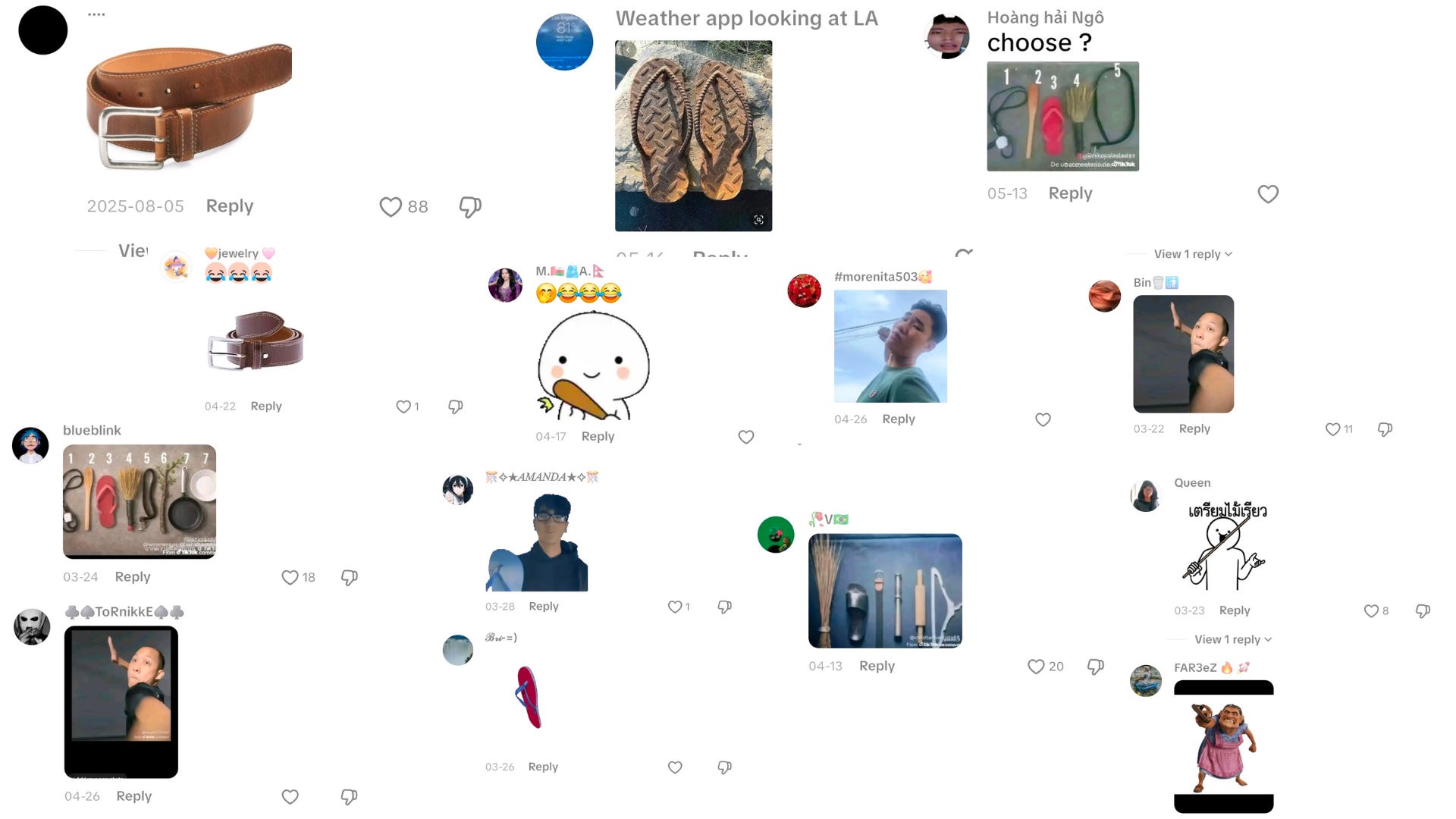
Scroll through the comments of any Xiao Xiao video and you will find image after image of shoes, switches, and paddles, objects associated with corporal punishment in the rural, impoverished households of the Global South, posted with gleeful suggestions of beatings. It is a particular kind of cruelty, one that reveals more about the commenters than they intend. There is something about Xiao Xiao, be it her size, her volatility, her unruliness, that triggers in a certain type of viewer a sadistic, primal desire to inflict pain. The same impulse drives the monkey torture communities that have flourished in the obscure corners of YouTube and TikTok: small, vulnerable, visibly distressed creatures made into objects of entertainment for a perversely sadistic audience.


It doesn’t seem that Xaio Xaio’s mother initially set out to become her exploiter. When her mother began selling homemade honey, she began filming her daughter to help sell it on a social media platform called Kuaishou. Their profile was a way to document their lives, build an audience, and sell honey that supplemented their government allowance. It worked well, and the account grew to 140,000 followers. People were drawn to Xiao Xiao, intrigued by her size, her expressiveness, and her volatility.

It was not the first time Xiao Xiao had been put in front of a camera – as a child she had appeared on television, paraded as a curiosity, her small body treated as spectacle. Her mother claims she was never compensated for these appearances.

[VIDEO]

There are reports, difficult to verify, of a Chinese documentary or television segment featuring a child matching her description, a small girl from rural Sichuan with primordial dwarfism. Whether this is Xiao Xiao is not certain. Her name translates roughly to “little little,” a generic term of endearment applied to small children, which makes tracing her history through Chinese-language sources considerably difficult. She is not the only girl with primordial dwarfism to have received media attention in China under that name.

In August 2022, village officials reviewed the Kuaishou profile, found several videos to be inappropriate, and requested its removal. The Chinese government had begun cracking down on accounts deemed to showcase antisocial or inappropriate behavior around this period, so the account was permanently banned. When Xiao Xiao’s Kuaishou account was banned, rumors of her death began circulating online. She later resurfaced through Mei Niang Xinxin’s Douyin lives in mid-2023, and by September of that year a clip of the two was circulating across every platform globally.

Mei Niang Xinxin is a man in his forties from Sichuan who began featuring Xiao Xiao in his Douyin livestreams. A cross-dresser and singer with an established following, he is known for his loud, performative energy. Douyin live performance operates on a gift economy: viewers send virtual gifts during streams which convert into real money for the performers. The more compelling the content, the more gifts flow. Xiao Xiao’s presence, her dancing and the unpredictability of her outbursts, helped the streams generate significant engagement. Wolong appears in the background of several of these videos as well. She is another woman who exists in Xiao Xiao’s orbit without ever quite entering the frame fully.

[VIDEO]

[VIDEO]

[VIDEO]

The power differential is obvious, but Xaio Xaio is a middle-aged woman who has been navigating these arrangements her entire life. She seemingly has spent nearly four decades being poked, prodded, filmed, monetized, and managed by people who benefit from her presence more than she does. Xaio Xaio naturally has a short temper, something local officials noted in their 2022 investigation.

The TikTok account @chinesejunkfood2023 reposted the clip with Mei Niang Xinxin in September 2023. It received 16 million views. Within days of the clip going viral, Western TikTok had named her “Kick Girl” first, then “Chinese Kick Girl,” then “Chinese Junk Food Girl” after the account that had introduced her to them. On FlopTok, a corner of TikTok organized around ironic celebrity worship and heavily edited fan content, she was absorbed into an existing collection of meme figures. Fancams were created, edits circulated, and a whole aesthetic apparatus was built around her image by people who had watched a twenty-five second video.

[VIDEO]

In Latin America, Xaio Xaio’s distinctive hairstyle, her high pigtails bound with multiple rubber bands, loose pieces hanging down, spawned a trend called “Penteado Xiao Xiao,” were young women recreate the look on TikTok for their own engagement. During Halloween, Japanese TikTok users dressed as her, performing street dances in qipao, which generated its own cycle of “cultural appropriation” outrage from Chinese media.

In 2024, Xiao Xiao’s mother was allegedly jailed for exploitation. The details beyond this are sparse on English language Tiktok and the Chinese sources are difficult to verify through translation alone (a caveat that applies to much of what is known about Xiao Xiao’s life) where the distance between what happened and what was reported and what was then translated and then paraphrased on TikTok by an AI voice narration is considerable and worth keeping in mind.

[VIDEO]

What is known is that someone stepped in to fill the vacancy her mother left. Reports variously identify this person as a coworker, a neighbor, a cousin, a collegue she had a crush on. The inconsistency is either a translation problem or a reporting problem or both.


[VIDEO]

[VIDEO]

[VIDEO]


She is still livestreaming on TikTok. Recent videos confirm she is alive, which is worth stating plainly given that rumors of her death have circulated more than once. Whoever her current handlers are appear to be leaning into deliberate ambiguity about her age, listing it anywhere from 9 to 26 on her English-language profile. Xiao Xiao is being dressed in increasingly juvenile outfits: toddler-style princess dresses in soft pastel colors. The AI narrations added to her TikToks push the same angle, framing her circumstances as maximally pitiable to drive engagement. All of it is calculated to reframe her on-camera meltdowns as the endearing fits of a child rather than the justified rage of a grown woman who has spent four decades being managed by people who profit from her presence more than she does.


Sources