There is a specific kind of political commentator that dominated the mid-2010s. He was smart enough to sound credible, careful enough to stay monetized, and vague enough to avoid committing to anything that might cost him a sponsor. He talked about facts and logic, debated college students, building his brand around being the reasonable one in the room. These operations peaked around 2021 and have been quietly contracting ever since. The through-line connecting all of them is the use of bot networks to simulate cultural relevance and careful brand management to stay palatable to advertisers. If you want to understand how this brand of conservatism operates, and why it is failing, the Daily Wire is the most instructive place to start.
The Daily Wire was built by Orthodox Jewish conservative Ben Shapiro alongside co-founder Jeremy Boreing, with funding from Texas oil billionaires Farris and Dan Wilks, who also bankrolled Dennis Prager. What they got for their investment was the institutional home of what you might call Kosher conservatism: pro-Israel, willing to fight meaningless culture war battles on trans issues, DEI, and Hollywood, but careful to stay within certain limits. Never too edgy, and always advertiser friendly. The kind of conservatism that wins debates and changes absolutely nothing.
For a while, it worked spectacularly. The Daily Wire became one of the most-watched conservative media operations in the country. Then Facebook substantially altered its algorithm in 2021 in ways that disadvantaged political content on the platform. The Daily Wire’s subscriber count peaked that year and has been declining since.
The audience moved on but the Daily Wire did not. The culture kept shifting. The institutions kept going in the same direction. Facts and logic, it turned out, are not a functional counterstrategy when the people running things do not care about them.
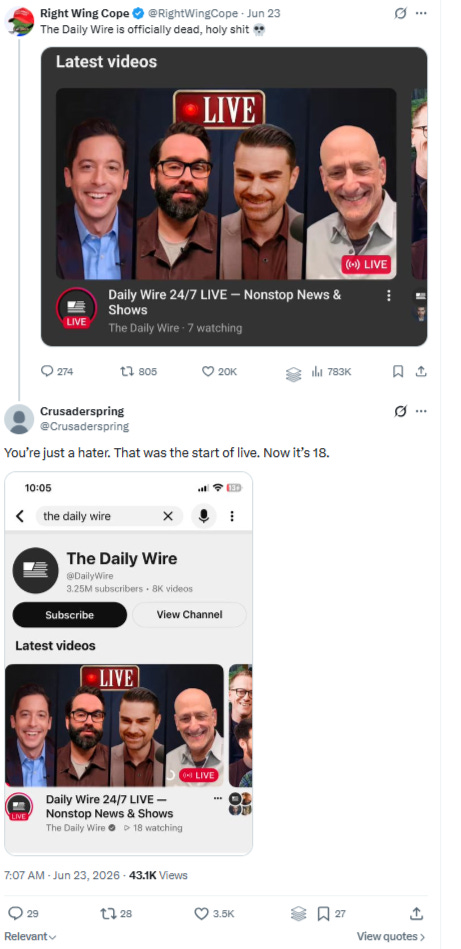
There is also the question of authenticity that the bot situation raises. The view counts that made the Daily Wire look like a thriving operation appear to have been substantially assisted by purchased traffic. When the spending on that stopped, the numbers reflected something closer to reality. A video featuring both Shapiro and his beloved Shabbos goy Matt Walsh pulling 7 live viewers is not the signature of a healthy media empire.
Boreing stepped down in early 2025 amid rumors of internal drama and serious concerns about the company’s financial health. The vanity projects, particularly the film division and the broader attempt to build a conservative Hollywood, had reportedly burned through enormous resources without producing equivalent returns. Shapiro’s daily program still has an audience, but the trajectory is clearly trending downward with no obvious path back up. His pro-Israel positioning has become a liability.
Shapiro is not the only figure whose brand of careful, advertiser-friendly conservatism is running out of road. The same audience attrition, the same gap between the performance of relevance and the reality of declining numbers, shows up across every major figure who built their career on the same model.
Tim Pool started his career during the Occupy Wall Street protests in 2011, when he rigged a consumer drone with a camera and streamed live footage to the internet, giving people a view of the demonstrations that the mainstream press could not easily block. The Guardian called it a clever loophole. He was twenty-five years old, working as a citizen journalist, and producing content that actually mattered. He went on to work for Vice and Fusion, building a reputation as an on-the-ground reporter willing to go places other journalists would not.
Then, somewhere around 2017, he stopped going anywhere and started sitting in a room reading other people’s articles into a camera.
The transition happened gradually and then all at once. Pool built a YouTube channel around a carefully maintained persona: the left-leaning skater kid from Chicago who was so troubled by what the left was becoming that he felt compelled to document its excesses. He called himself a liberal. He insisted he was not right-wing. He said “I don’t know” and “it’s complicated” so frequently that it became a running joke among his critics and eventually among his own audience.
Tim’s fence-sitting was deliberate. He must have known on some level that his audience was watching because he gave them permission to drift rightward while maintaining plausible deniability about having done so. If Tim Pool, a self-described liberal, thought the left had gone too far, then maybe you were not a bad person for thinking the same thing. This worked well through the early Trump years, until Pool’s content calcified into a formula so predictable that multiple people independently charted it out. Minute one introduces a topic. Minutes two through ten repeat that topic in slightly different words. A Marvel reference appears somewhere in the middle. Civil war gets mentioned at some point. The audience is reminded to buy doomsday prepper food buckets from that day’s sponsor. Every day, five videos a day at peak output, the same topics recycled endlessly with the energy of a man who had long since stopped caring.
Meanwhile, the compound he built in rural West Virginia, which acquired the affectionate nickname Beanie Ridge among the people tracking his career, became a soap opera unto itself. His million-dollar crowdfunded news venture, SCNR, collapsed after co-founders accused him and his brother Chris of botting and promoting fraudulent sponsors. Tim fired the entire staff and revoked their access to the YouTube channel, the AdSense account, and the bank account. He allegedly held his former business partner’s cat as leverage in the subsequent dispute, which required police involvement and got covered by the Daily Beast.
In 2023, Tenet Media, a content venture Pool entered alongside Dave Rubin and Lauren Chen, was allegedly funded by $9.7 million from RT through shell companies and fabricated investor identities. Two RT employees were federally indicted over it. The DOJ indictment names Pool as “Commentator-2” and reveals he had negotiated $100,000 per weekly episode before signing on. Lauren Chen and her husband appear to have known where the money was coming from. Pool claims he did not. What the indictment also reveals, almost incidentally, is that RT was frustrated with him because he only shared one Tenet video that week. He was a bad return on investment for a foreign intelligence operation, which is either exculpatory or just a different kind of damning depending on how you look at it.
Meanwhile, at Beanie Ridge, Pool employed a dedicated skate park manager, listed his girlfriend as COO, and built out a roster of dozens of employees and contractors across multiple overlapping projects with no apparent organizational structure holding any of it together. He invested roughly half a million dollars in a coffee shop venture, spent around a million on the skate park, and put $15,000 into a sword. His Pop Culture Crisis side channel, which he promoted heavily as a brand expansion, was pulling under 5,000 views per video. When a graphics card died on set and nobody replaced it, he threatened on air to shut the entire IRL operation down, then spent the episode cataloguing how nobody he had hired was managing anything while acknowledging that he had made every hiring decision himself.
His music career is worth a brief mention. In 2022 he released an official music video called “Only Ever Wanted,” recorded while wearing the beanie, which sounded like late-era Linkin Park attempting to be U2. The production buried what was apparently a decent natural singing voice under layers of autotune, and the drummer’s practice pads were visible in the shot, indicating the recording space had not been properly soundproofed. He spent multiple consecutive episodes responding to the mockery the video received, which made everything considerably worse.
By the time Pool appeared in the White House press pool in April 2025, still wearing the beanie he has not visibly removed for the better part of a decade, the distance between where he started and where he ended up was almost too large to process. He used his White House question to complain that journalists had been mean about the new media seating arrangement. He did not ask about policy. He reportedly only removes the beanie in the presence of Jewish interviewers, a detail that is either deeply funny or deeply revealing, and is probably both.
The core grievance Pool cannot let go of is that the mainstream press refuses to take him seriously. The problem, which he has never appeared to fully reckon with, is that he spent a decade positioning himself as an enemy of the establishment press and is now confused that they treat him accordingly. He mistakes being contrarian for being insightful, which is exactly what happens to the kind of person who intellectually peaks in college.
Pool’s arc, from citizen journalist with a drone to a man reading Daily Mail articles about a train derailment thirty miles from his house, is at minimum the story of someone who started with something real and lost it. Jeremy Hambly never had the something real to begin with, which makes his version of the same trajectory somehow even less flattering. He watched what the bigger channels were doing, identified the formula, and copied it. The problem is that he was copying Tim Pool at Tim’s lowest-effort period, which meant he was already working from a degraded template before he even began.
The mechanics of Jeremy’s operation were straightforward once exposed. He purchased bot engagement to inflate his YouTube analytics, tailored his uploads to whatever was trending on Google or Twitter, and built his entire content strategy around latching onto popular topics and grinding them into dust. Star Wars. Marvel. Brie Larson. The Karmelo Anthony case. He produced dozens of videos on each; some built on speculation presented as fact, with tweets and comments sections treated as sourced reporting.
What makes Jeremy a genuinely interesting case study, rather than just another mid-tier grifter cycling through the same outrage topics, is how transparent the envy became over time. The deeper you look into his career, the more obvious it is that he wanted what Tim Pool had: the compound, the audience, the aesthetic of being part of a movement rather than merely adjacent to one. The difference is that Tim Pool, whatever his considerable failures, was once a working journalist with real sources and real networking ability. Jeremy is a guy from Wisconsin who would be more naturally suited behind IT help desk.
For the full drama breakdown, MikeyNoMoh covers it in far more entertaining detail than I could manage.
Jeremy Hambly is the furthest this business model could degrade before it stopped functioning entirely, which makes him a useful place to stop and take stock of what all three of these careers actually have in common. The through-line is not an ideology. It is the specific way each of them mistook audience capture for influence. Shapiro won debates, built a company, and changed nothing about the culture he was supposedly fighting. Pool positioned himself as a journalist while building an increasingly elaborate compound from which he covered the news by reading newspaper articles out loud. Hambly watched both of them and concluded that the formula was the point, that you could skip the credential entirely and go straight to the content farm.
They were all, in different ways, right about that for a while until the algorithm changed, the bot spending dried up, and the audience that remained started noticing what they were actually getting in exchange for their time and money. The reasonable conservative brand, the one built on facts and logic and careful brand management, pro-Israel positioning and never saying anything that would get you demonetized, turned out to be a product the market eventually stopped wanting.
References
- X thread marveling at low Daily Wire live view counts:Crusaderspring@Crusaderspring
@RightWingCope You’re just a hater. That was the start of live. Now it’s 18. - X post on Daily Wire algorithm disadvantage:地獄ケーキ(Hokusaist)👹🐉🗡️🇺🇸@JigokuCake
- It's been an open secret that The Daily Wire's pre-COVID success was largely due to them winning over the Facebook boomercons by gaming the site's algorithm and boosting their own presence through a puppet network of "news" accounts.
- Oh dear, trouble in paradise. 8:32 AM · Jun 24, 2026
- The Guardian on Tim Pool’s “occucopter” during Occupy Wall Street (December 21, 2011): https://www.theguardian.com/commentisfree/cifamerica/2011/dec/21/occupy-wall-street-occucopter-tim-pool
- Axios on Jeremy Boreing stepping down from the Daily Wire (March 18, 2025): https://www.axios.com/2025/03/18/daily-wire-jeremy-boreing-steps-down
- Vox Day column on Ben Shapiro chickenhawk accusations (August 29, 2005): https://www.wnd.com/2005/08/32037/
- BBC clip of Ben Shapiro vs Andrew Neil: https://www.bbc.co.uk/news/av/uk-48885742
- The Daily Beast on Tim Pool cat hostage incident (March 11, 2021): https://www.thedailybeast.com/youtube-star-tim-pools-news-site-collapses-amid-allegations-he-took-a-cat-hostage/
- CNN on DOJ indictment of RT employees and Tenet Media (September 4, 2024): https://www.cnn.com/2024/09/04/politics/doj-alleges-russia-funded-company-linked-social-media-stars/index.html
- NBC News on Tenet Media and Russian funding (September 5, 2024): https://www.nbcnews.com/tech/internet/internets-popular-trump-pundits-ended-paid-messengers-russian-propagan-rcna169803
- CBS News on DOJ indictment and Tenet Media wire transfers (September 4, 2024): https://www.cbsnews.com/news/russia-tenet-media-right-wing-influencers-justice-department/
- Axios on Facebook reducing political content in News Feed (September 1, 2021): https://axios.com/facebook-news-feeds-politics-b4a32c93-3dab-42cd-b761-039363ebdb7c.html
- Wikipedia overview of 2024 Tenet Media investigation: https://en.wikipedia.org/wiki/2024_Tenet_Media_investigation
- Kiwi Farms thread on Tim Pool: https://kiwifarms.st/threads/tim-pool.33703/
- Kiwi Farms thread on Ben Shapiro and the Daily Wire https://kiwifarms.st/threads/ben-shapiro-the-daily-wire.88657/
- Kiwi Farms thread on TheQuartering/Jeremy Hambly (This is also where I got the thumbnail for this article from) https://kiwifarms.st/threads/jeremy-hambly-the-quartering-mtgheadquarters-unsleeved-media-midwestly.48959/